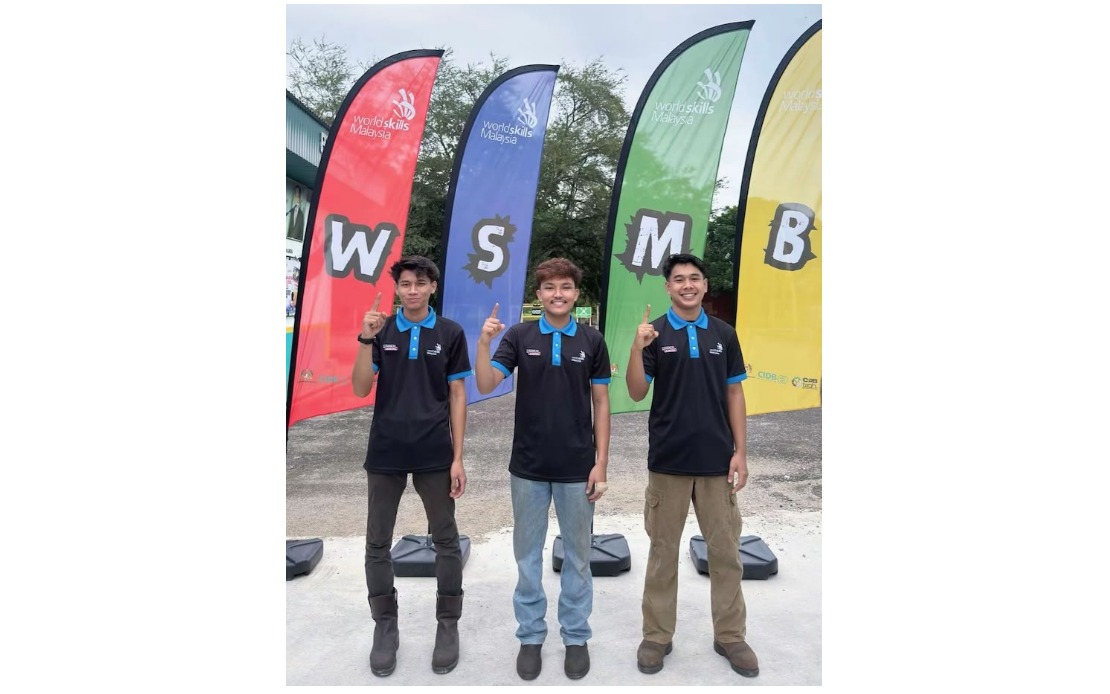
Three decades after its inception as a vision of former Prime Minister Tun Dr Mahathir Mohamad, WorldSkills Malaysia Belia (WSMB) remains a cornerstone for developing skilled construction workers who meet international benchmarks. What began in 1990 as the Malaysian Skills Champion Competition has evolved through several iterations—including the Anugerah Tangan Emas Perdana Menteri and MySkills—before settling on its current WSMB identity in 2014. Throughout these transformations, the programme's core mission has remained consistent: identifying talented individuals and equipping them with the competencies needed to represent Malaysia on the global stage. The enduring nature of this initiative reflects a sustained national commitment to technical excellence in construction, an industry central to Malaysia's infrastructure development and economic growth.
The pathway to international recognition through WSMB begins at home, where domestic champions are selected through rigorous competition before receiving structured development and training programmes. These winners gain access to world-class facilities and mentorship that prepare them to compete at WorldSkills international events, Malaysia's ultimate showcase for construction talent. This two-tiered approach—domestic excellence feeding into global representation—has created a pipeline of professionals whose accomplishments reflect positively on Malaysian craftsmanship abroad. The model demonstrates how a national competition can serve as both a talent identification mechanism and a development incubator, addressing persistent skills gaps while simultaneously building pride in technical professions.
The Malaysian Construction Academy (ABM) and CIDB Technologies form the institutional backbone supporting WSMB, both maintaining CIDB-accreditation and infrastructure conforming to international training standards. This accreditation ensures that participants receive instruction aligned with global best practices rather than locally-bound methods that may not translate beyond Malaysian borders. CIDB Technologies' infrastructure reflects significant investment in creating learning environments that replicate actual job site conditions, allowing trainees to build experience in controlled settings before entering commercial employment. For Malaysia, which increasingly positions itself as a Southeast Asian hub for skilled services, maintaining these international-calibre training facilities sends an important signal about the country's commitment to workforce quality and professional standards.
According to Mohd Hafiz Dasahi, chief executive officer of CIDB Technologies, WSMB transcends mere competition format to function as a talent production system addressing genuine industry requirements. The emphasis on training programme development rooted in actual sectoral needs marks a deliberate effort to bridge the persistent gap between academic or theoretical training and workplace reality. This approach acknowledges that construction—whether welding, carpentry, plumbing, or other trades—demands practitioners who understand not only technical fundamentals but also contemporary equipment, digital systems, and safety protocols. By tethering training to documented industry demands, WSMB positions graduates as immediately deployable workers rather than individuals requiring extensive on-the-job orientation. For employers across construction, manufacturing, oil and gas, energy, and maritime sectors, this translates into reduced training costs and faster productivity gains.
Welding specialists within WSMB face assessments covering dimensional precision, workmanship calibre, procedure adherence, temporal management, adaptive problem-solving, and safety compliance—a comprehensive rubric reflecting construction's multifaceted demands. Zarulhakim Abdul Rahim, head of CIDB Technologies Welding, emphasises that technical competency alone cannot carry participants to success; they must simultaneously develop psychological resilience, self-assurance, and the disciplinary capacity to pursue continuous improvement. This holistic evaluation philosophy recognises that construction work requires not just technical know-how but also the mindset and interpersonal capabilities that distinguish reliable professionals from merely qualified ones. The exposure to international technologies and processes during competition represents invaluable preparation for a globalising construction industry where workers increasingly encounter multinational projects, cross-border supply chains, and standardised international methodologies.
Private sector engagement within WSMB reflects industry recognition that workforce development remains fundamentally their concern. Companies like Lincoln Energy and Vinxus Mark contribute welding equipment, consumables, and technical guidance, transforming the competition into an industry-academia-training centre partnership. Putra Faisal Ashraf Idris articulates this collaborative philosophy, framing industry support as a shared responsibility for cultivating competent talent. This model differs markedly from purely government-administered skills programmes where employers remain passive consumers of graduate output. By actively participating in competition design and participant preparation, welding companies ensure that training reflects their actual operational standards and equipment profiles, increasing the probability that competition winners will integrate seamlessly into their organisations. For Malaysia's construction sector, this public-private alignment signals mature ecosystem development where all stakeholders recognise mutual benefit in talent cultivation.
Participant Ahmad Syafie Dasuki embodies the pathway many WSMB competitors travel: early workplace exposure providing foundational knowledge, followed by structured competition training that elevates basic proficiency into internationally-competitive capability. His two-year experience at a Terengganu workshop supplied practical grounding that competition participation then systematised and enhanced through exposure to advanced technologies. For young workers from modest backgrounds—the youngest of eight siblings from Kelantan—WSMB represents genuine mobility, a meritocratic channel through which technical aptitude can translate into upgraded career prospects. This personal dimension matters beyond individual advancement; it reflects how construction skills development functions as social mobility infrastructure, particularly valuable in Malaysian states where alternative pathways to white-collar employment may feel restricted.
Muhammad Fazran Md Rashid exemplifies another participant profile: the young worker already employed in the sector who recognises that competing at WSMB-level standards requires deliberate upskilling beyond daily workshop experience. His focus on welding proficiency coupled with confidence-building reflects understanding that career advancement in construction depends equally on technical mastery and professional bearing. The distinction between competent welders and advanced practitioners often hinges on psychological attributes—resilience under pressure, systematic problem-solving, meticulous attention to standards—that WSMB deliberately cultivates. For Malaysia's construction industry facing increasing project complexity and international scrutiny of quality standards, workers possessing this psychological infrastructure become disproportionately valuable.
Mohd Sahmi Irfan Sulaimi's call for greater youth participation extends beyond recruitment rhetoric to signal genuine opportunity scarcity in construction skills development. His framing of WSMB as a confidence-building exercise alongside technical training indicates how the programme addresses psychological barriers preventing capable individuals from pursuing construction careers. In many Southeast Asian contexts, including Malaysia, construction trades carry occupational stigma among families viewing white-collar employment as inherently superior. Initiatives like WSMB that celebrate construction excellence and link skilled work to international recognition help reposition technical careers as genuinely prestigious. His emphasis on networking and career advancement possibilities suggests that WSMB graduates access employment opportunities and professional trajectories unavailable to workers lacking competition credentials, creating powerful incentives for participation.
The international standards framework underpinning WSMB carries particular significance for Malaysia's regional economic positioning. As Southeast Asian nations compete for foreign direct investment in construction, manufacturing, and infrastructure development, workforce quality differentials become determinative competitive factors. Countries producing workers certified through internationally-recognised systems like WorldSkills gain advantages in attracting multinational projects and technology transfer opportunities. Malaysian participants who perform successfully at WorldSkills competitions bring global visibility to domestic training institutions and employers, establishing Malaysia as a reliable source of construction talent. This reputation-building operates at multiple levels: for individual trainees seeking international employment, for Malaysian contractors bidding on regional projects, and for the country's broader positioning as a skills and innovation hub within ASEAN.
Three and a half decades of WSMB operation have created cumulative institutional knowledge and alumni networks that newer competitors can leverage. Former champions working throughout Malaysia's construction sector provide mentorship, employment pathways, and practical guidance to current participants, creating generational transmission of excellence standards. This alumni effect transforms WSMB from a periodic competition into an enduring professional community reinforcing commitment to continuous improvement. For Malaysian policymakers and industry leaders, sustaining and expanding WSMB demands continued investment in training infrastructure, industry partnership cultivation, and public recognition of technical excellence. The programme's longevity proves that systematic skills development, when properly resourced and industry-aligned, creates sustainable competitive advantage in construction and manufacturing sectors increasingly dominated by technical sophistication and international standards compliance.

