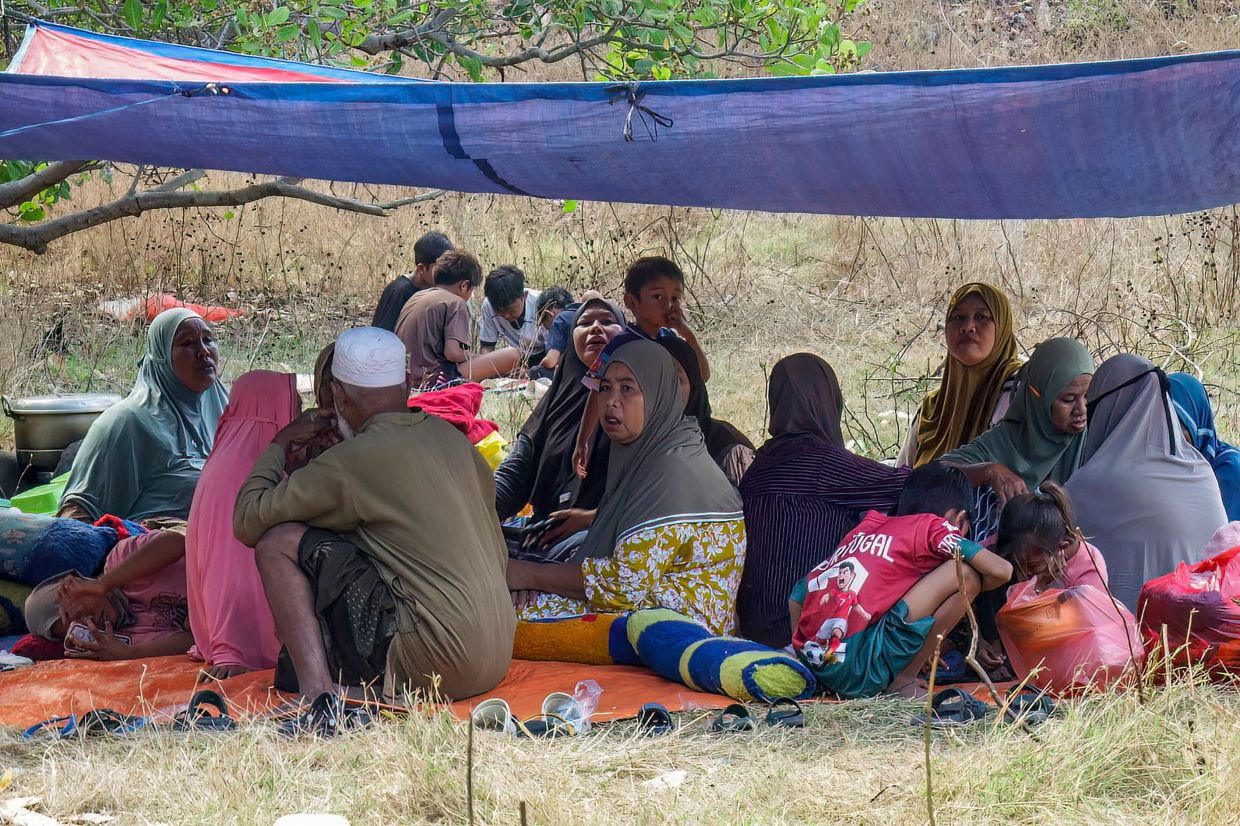
Thousands of evacuees on Indonesia's Flores island faced an uncertain wait for humanitarian assistance on Sunday following a devastating 7.7-magnitude earthquake that claimed 48 lives, left over 100 injured, and rendered hundreds of structures unsafe for habitation. The tremor struck early Saturday morning, unleashing a relentless barrage of 341 aftershocks that kept residents in a state of heightened anxiety and prevented many from returning to their homes. The shallow undersea quake, which originated just off the island's northern coast, displaced approximately 5,000 people who had fled their residences as a precautionary measure against potential secondary collapses.
The humanitarian crisis unfolding across Flores reflects the vulnerability of Indonesia's eastern regions to seismic hazards. At least 914 houses sustained severe structural damage, while hundreds more suffered varying degrees of harm. Critical infrastructure proved equally susceptible to destruction: 93 educational facilities, 36 health centres, and 38 government offices sustained damage that will impede recovery efforts for weeks. The widespread destruction of telecommunications and electricity networks in several villages left survivors isolated and unable to coordinate relief activities or contact distant family members, compounding the psychological toll of the disaster.
Local residents, many of whom remain camped on hilltops, articulated the desperate shortages constraining their immediate survival. A 55-year-old villager from Nangahale on Flores's north coast described the acute need for food, drinking water, medications, and essential supplies for children. The decision to camp outdoors rather than return to shelters reflected rational fear: structural engineers warned that subsequent aftershocks could collapse already-weakened buildings, transforming homes into potential death traps. This calculus forced thousands into makeshift arrangements, sleeping on mats and plastic sheeting exposed to the elements, a situation the national disaster agency acknowledged required urgent intervention.
Trauma compounded the material deprivation gripping many Flores residents. A 55-year-old woman named Nurhidayati, who spent Saturday night on a hillside mat, disclosed that memories of the catastrophic 1992 earthquake had been violently reactivated. That earlier 7.7-magnitude quake triggered a tsunami that killed approximately 2,500 people across the island, carving a scar into collective memory that three decades had not healed. The current disaster had reopened those wounds, leaving survivors like Nurhidayati paralysed by fear and psychological distress even as the immediate danger subsided. Her testimony underscored how disasters in seismically active regions carry historical weight, each tremor resurrecting memories of previous devastation.
The Indonesian government mobilised a substantial relief response within hours of the earthquake. The BNPB national disaster agency coordinated the dispatch of 50,000 aid packages totalling 275 tonnes to affected areas, while the East Nusa Tenggara provincial government initiated procedures to declare a 14-day emergency response status. Initial assessments indicated no persons trapped or missing, allowing search and rescue teams to concentrate on broader humanitarian operations rather than excavation efforts. The International Federation of Red Cross and Red Crescent Societies activated regional resources to establish temporary shelters, recognising that the displaced population would require organised facilities pending reconstruction of habitable housing.
International solidarity manifested through both symbolic and practical gestures. European Union President Ursula von der Leyen publicly pledged the bloc's support, specifically offering to deploy the Copernicus Earth observation satellite system to assist search and rescue operations. This commitment reflected the growing integration of advanced remote-sensing technology into disaster response mechanisms, enabling aerial assessment of damage patterns and identification of priority zones requiring immediate intervention. Such international coordination mechanisms have become standard practice following major seismic events in the Indo-Pacific region, where transnational disasters demand cross-border cooperation.
The geographic and geological context of Flores renders the island perpetually vulnerable to seismic hazards. Indonesia straddles the Pacific Ring of Fire, an arc of intense tectonic activity extending from Japan through Southeast Asia and across the Pacific basin. This geological disposition subjects the archipelago to frequent earthquakes, with shallow undersea quakes like Saturday's event particularly capable of triggering secondary hazards including tsunamis. Following the 2004 Boxing Day tsunami, which originated from a catastrophic 9.1-magnitude earthquake off Sumatra's coast and killed approximately 220,000 people across the Indian Ocean region, Indonesia has invested substantially in early-warning systems and public education programs. Yet Saturday's partial tsunami alert, precipitated by sea-level retreats that residents interpreted as an approaching wave, demonstrated that behavioural responses to earthquake warnings remain inconsistent and require continuous reinforcement.
The damage assessment revealed that Flores's predominantly rural construction profile provided unexpected protection. The affected areas contained few high-rise buildings vulnerable to pancake collapse—the structural failure mode that killed thousands during earthquakes in more densely developed urban zones. Instead, the devastation manifested primarily through residential structures of limited complexity, the destruction of which, while economically ruinous for poor families, generally proved less catastrophic in terms of fatalities than would occur in metropolitan environments. Nevertheless, this distinction offered cold comfort to inhabitants whose homes had become uninhabitable overnight.
The 341 aftershocks that followed the mainshock created a psychological environment of sustained terror and prevented normal recovery activities. Residents feared entering buildings to retrieve possessions or assess damage, knowing that apparently minor tremors could trigger additional collapses. This seismic cascade effect—where the primary earthquake generates numerous substantial aftershocks over days or weeks—characterises many major events along subduction zones, where tectonic strain redistributes gradually across fault planes. Authorities consequently urged inhabitants to remain outdoors or in specially-constructed emergency shelters, effectively confining populations to open-air camps dependent entirely on external assistance for survival supplies.
The logistical challenge confronting relief coordinators extended beyond initial food and water distribution to encompassing longer-term reconstruction. Roads remained partially inaccessible in certain zones, constraining the delivery rate of supplies to remote communities. The destruction of health facilities meant that injured persons faced transport to distant medical centres, a situation complicated by damaged infrastructure and limited vehicular access. The declaration of emergency status for 14 days provided legal framework for rapid deployment of resources, but experience across Southeast Asia suggests that reconstruction timelines invariably extend far beyond initial projections, particularly in economically disadvantaged rural regions where reconstruction depends on government budgets rather than private insurance mechanisms.
The earthquake's impact extended beyond immediate humanitarian concerns to encompass broader questions regarding disaster resilience in Southeast Asia's vulnerable populations. Many Flores residents lack economic resources to undertake reconstruction independently, necessitating substantial government support or international aid. The concentration of damage across educational and health facilities—infrastructure critical to long-term development—meant that the disaster would impose consequences extending years beyond the earthquake itself. Children would miss schooling during reconstruction; medical services would suffer interruption precisely when injury rates peaked. These cascading effects underscore why seismic disasters in economically marginal regions generate developmental setbacks disproportionate to their immediate casualty figures.
As survivors awaited relief distribution on Sunday, their experiences reflected broader vulnerabilities embedded within the region's geography and development patterns. Indonesia's location atop the Ring of Fire renders earthquakes not exceptional disasters requiring extraordinary response but rather endemic hazards demanding systematic preparedness integration into routine governance. The contrast between sophisticated scientific monitoring capabilities—evidenced by rapid earthquake characterisation and tsunami modelling—and limited disaster mitigation infrastructure in rural communities highlighted persistent gaps in translating technological knowledge into protective action. Flores residents possessed warning systems and professional guidance, yet found themselves dependent on improvised outdoor shelters, awaiting lorries carrying supplies across damaged roads. That fundamental disparity between capabilities and outcomes suggested that technological advancement alone cannot neutralise the vulnerabilities embedded within patterns of settlement, poverty, and geographic exposure that characterise much of Southeast Asia.

