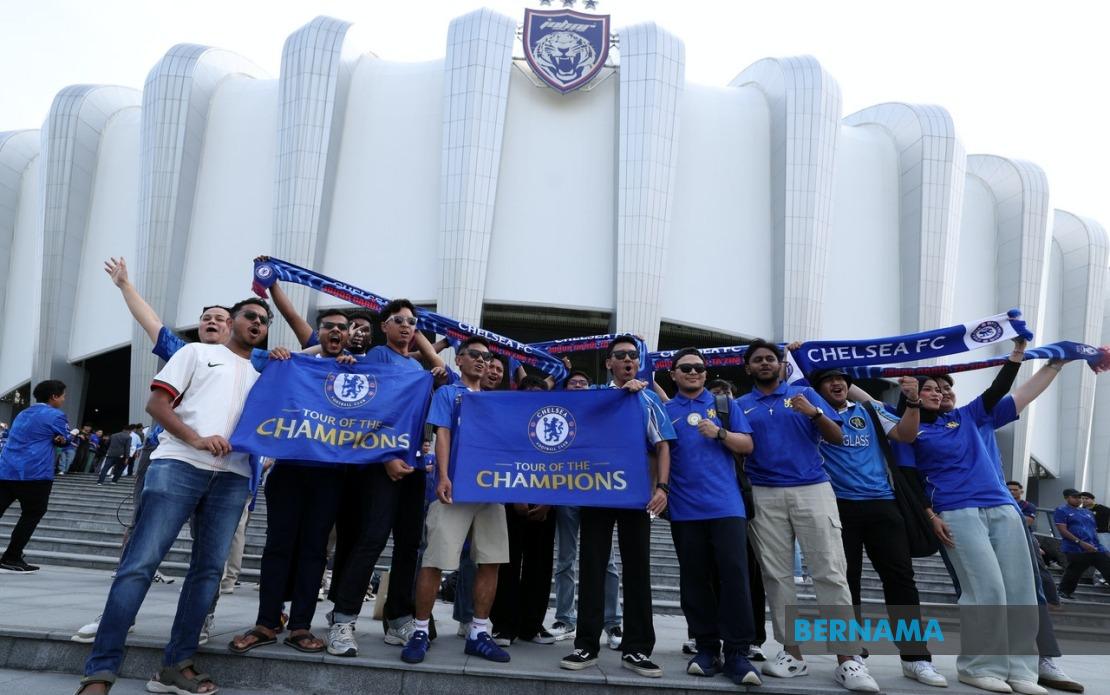
Thousands of football enthusiasts transformed the grounds of Sultan Ibrahim Stadium into a vibrant sea of red and blue on August 9, creating an electric atmosphere ahead of the friendly clash between Premier League giants Chelsea FC and Malaysian club Johor Darul Ta'zim. From mid-afternoon onwards, the stadium in Iskandar Puteri became a focal point for supporters spanning multiple generations, each arriving in their team colours to witness what many described as a rare opportunity to see world-class English football on Malaysian soil.
The diversity of the crowd reflected the broad appeal of the occasion. Veteran supporters brought their families to share the experience, while youth groups and individual enthusiasts arrived throughout the day, all eager to be part of a historic footballing moment for the region. The atmosphere was notably celebratory rather than competitive, with fans from both camps mingling as they explored the stadium facilities and soaked in the pre-match ambiance. Photography became an informal ritual, with supporters positioning themselves against the stadium's distinctive architectural features to capture memories of the event.
Commercial activity centred on the official merchandise stalls, which proved to be significant draws in their own right. Limited-edition items bearing both club badges saw sustained demand throughout the afternoon and evening, with queues forming as supporters sought tangible mementos of the occasion. The merchandise offerings underscored the commercial appeal of bringing an established English club to compete in Malaysia, a strategy that appears to be yielding considerable interest among the footballing public.
The match's pull extended beyond the Johor state boundary and across international borders. Supporters from the Klang Valley and other parts of peninsular Malaysia viewed the weekend fixture as a worthwhile destination, while a notable contingent crossed from Singapore, recognising the proximity and relatively easy access via the Johor Causeway. This cross-border attendance demonstrates how major sporting events can serve as regional attractions, drawing visitors and generating economic activity across several jurisdictions in Southeast Asia.
Traffic management around the stadium remained a priority as supporters arrived. By evening, main access routes showed congestion typical of large-scale events, though Royal Malaysia Police maintained control measures to prevent gridlock ahead of the 8 pm kick-off. The police presence was designed to balance allowing fans smooth entry whilst maintaining security standards befitting an international match of this calibre. Organisers appeared satisfied that preparations would accommodate the volume of attendees without significant disruption.
Ahmad Danial Muhammad, a 28-year-old Chelsea supporter from Bangsar in Kuala Lumpur, articulated a perspective shared by many international club enthusiasts in Malaysia. His loyalty to Chelsea stretched back to the Didier Drogba era, and he seized the opportunity to watch Premier League football live without incurring the expense and logistical demands of travel to England. For supporters like Ahmad Danial, such events represent accessible gateways to experiencing the calibre of football that typically requires overseas journeys or expensive subscription services.
The cross-border dimension was emphasised by Tan Wei Sheng, a 34-year-old Singapore resident who strategically timed his departure for noon to avoid causeway congestion. His observations about Sultan Ibrahim Stadium's world-class facilities reflected broader regional recognition that Malaysian sporting infrastructure has evolved significantly. Singapore fans' willingness to travel suggests that matches featuring recognised international clubs possess sufficient drawing power to justify border crossings, indicating a potential avenue for sustainable sports tourism in the region.
Local pride in hosting Chelsea manifested clearly among JDT supporters interviewed at the stadium. Mohd Khairul Anuar Ismail, a 41-year-old supporter from Bukit Piatu in Melaka, framed the match as validation of Malaysia's standing in global football hierarchies. His comments suggested that hosting matches between established European clubs and Malaysian teams functions symbolically, demonstrating that local football has graduated to a level where international heavyweights consider it worthwhile to visit. This perspective connects the match to broader narratives about Malaysia's development and regional influence.
The role of strategic leadership in facilitating such matches emerged in comments from supporters like Safiyah Rosli, a 32-year-old from Batu Pahat. Her attribution of success to Tunku Mahkota Ismail's stewardship reflects how major sporting initiatives become associated with specific political or administrative figures in Malaysian public discourse. The presence of Chelsea at Sultan Ibrahim Stadium thus carries implications beyond football, functioning as a tangible marker of governance success and developmental progress that resonates with supporters who view such events as indicators of their state's advancement and international profile.
The convergence of supporters on August 9 represented more than attendance at a friendly match. It illustrated evolving patterns of sports consumption in Southeast Asia, where proximity to elite international football creates demand among regional audiences. Malaysian and Singaporean fans demonstrated willingness to gather for events offering authentic exposure to premier global sporting talent. Such patterns may influence future decisions by international clubs regarding touring schedules, potentially establishing Malaysia as a regular destination for pre-season or special matches. The commercial, social, and symbolic dimensions of the Chelsea-JDT encounter collectively positioned it as a significant moment for Malaysian football's international trajectory.

