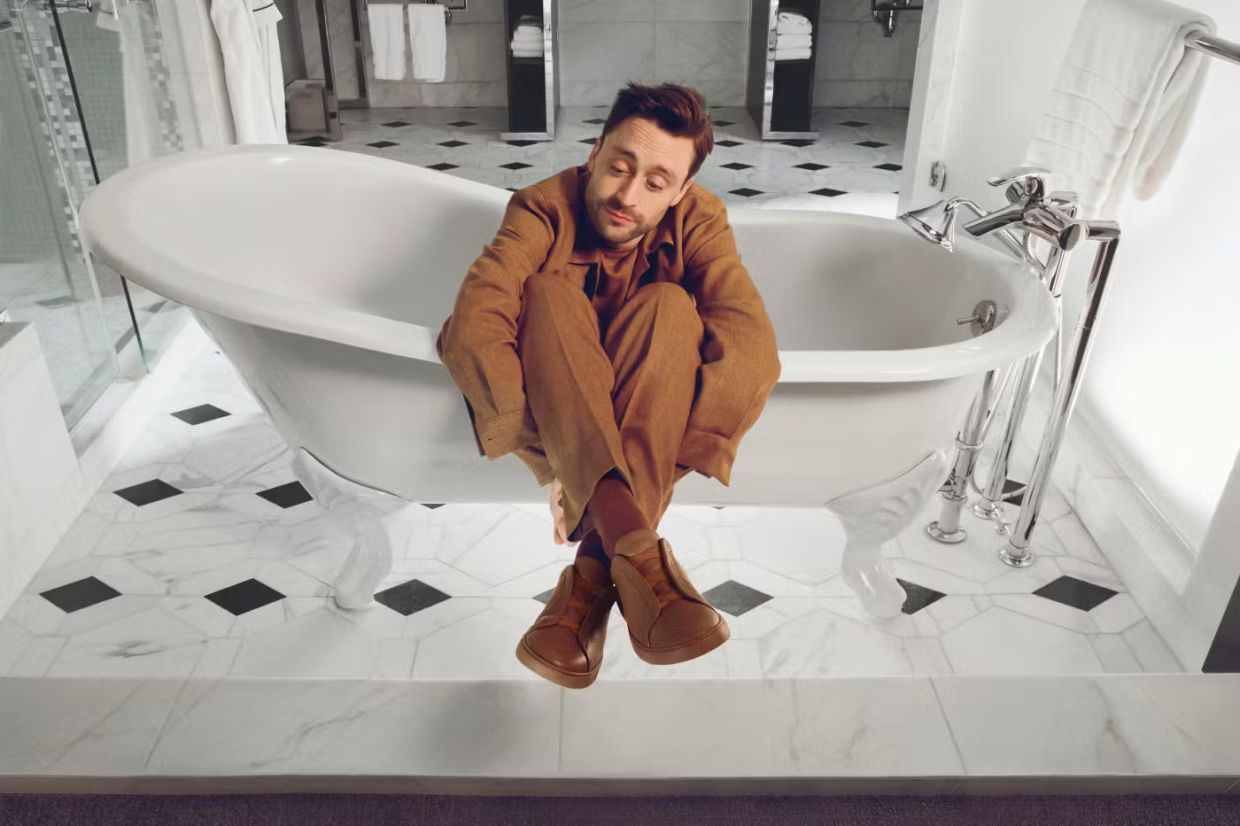
The dress sneaker represents one of the more curious intersections of comfort and formality in contemporary menswear—a shoe that pairs the casual practicality of a trainers' rubber sole with the structured elegance of a leather oxford. What began as a tentative hybrid has matured into a genuinely influential wardrobe staple, signalling a fundamental shift in how professional men approach dressing. Yet even as dress sneakers have reached peak cultural prominence, observers are beginning to question whether this fusion garment retains the symbolic power it once possessed.
The emergence of dress sneakers as a legitimate option reflects deeper societal changes reshaping workplace culture. The phenomenon grew directly from the normalization of casual dressing standards, the rise of "stealth wealth" aesthetics that prioritize quiet quality over conspicuous logos, and a generational embrace of comfort as a non-negotiable aspect of daily attire. Unlike numerous other shoe hybrids—the "snoafer," "sneakerina," and various other portmanteaus that have attempted to bridge formal and casual footwear—dress sneakers successfully crossed over from novelty territory into genuine wardrobe necessity. This transition took decades to complete but ultimately proved resilient enough to reshape expectations even within traditionally conservative institutions.
The visibility of dress sneakers among political and entertainment figures provided substantial cultural validation. Hakeem Jeffries wore them to a significant meeting at the Oval Office with President Joe Biden, while actor Ben Stiller paired them with formal wear at the New York Film Festival and during courtside appearances at New York Knicks games. Kieran Culkin's portrayal of the ambitious Roman Roy in the HBO series featured dress sneakers as part of the character's professional wardrobe, embedding them into a distinctly contemporary vision of ambitious masculinity. Even Apple chief Tim Cook selected Zegna Triple Stitch dress sneakers for a prominent magazine cover, cementing their acceptance at the absolute apex of corporate leadership.
Perhaps most tellingly, traditional institutions with long-standing dress codes have systematically relaxed their standards to accommodate dress sneakers. Exclusive private clubs—spaces that have historically maintained rigid sartorial requirements—now explicitly permit leather-upper shoes with white rubber soles, even as they continue to prohibit conventional athletic trainers. This distinction reveals the careful cultural work that dress sneakers perform: they grant permission to appear both authoritative and approachable, sophisticated yet relaxed. The wearer communicates simultaneously that professional standards matter and that rigid formality feels outdated, suggesting someone who maintains composure but refuses unnecessary pretence.
Menswear historian Derek Guy, who authors the influential column "Die, Workwear!", traces the dress sneaker's lineage to a specific moment in fashion history. For virtually the entire twentieth century, male professionals wore hard-bottom dress shoes—predominantly black calfskin leather—to office environments. Loafers emerged as a slight casualization during the late 1960s, yet this liberalization effectively stalled at the boundary of athletic footwear. The contemporary dress sneaker story began in 2004 when Common Projects introduced the Achilles Low, a minimally branded Italian-made low-top in pristine white leather with a luxury price point that immediately positioned it as a status symbol rather than a casual alternative to expensive leather shoes.
Once the concept gained traction at the luxury end of the market, brands across every price point recognized commercial opportunity. Established shoemakers including Allen Edmonds and Wolf & Shepherd developed their own iterations, while premium luxury labels such as Tom Ford, Loro Piana, and Cole Haan created versions that signalled their design philosophies through their particular takes on the formula. Wolf & Shepherd achieved particularly notable cultural penetration when NBA Hall of Famer Steve Nash demonstrated that the shoes could function as genuine basketball footwear, not merely formal-adjacent styling objects. The brand's ability to position dress sneakers as functionally viable for athletic performance while maintaining their formal aesthetic proved crucial to broader mainstream acceptance.
The expansion from luxury positioning into mainstream adoption proceeded through several identifiable stages. ESPN sports commentators began appearing in dress sneakers during broadcasts, normalizing their presence in high-visibility professional contexts. Silicon Valley entrepreneurs embraced dress sneakers as a visible marker that they had progressed beyond startup casualness toward something approaching corporate respectability—a sartorial signal that the "move fast and break things" philosophy had matured into actual business responsibility. From technology sector executives, the trend migrated rapidly into traditional finance and banking, where figures seeking to project both innovation-mindedness and competence adopted the shoes as a professional uniform choice.
Yet the very markets that elevated dress sneakers to prominence may now be reconsidering their embrace. As social media companies face increasing regulatory scrutiny and public criticism over their addictive design practices, the association between dress sneaker-wearing tech leaders and a certain style of aggressive disruption appears less aspirational. Contemporaneous reporting suggests that bankers and executives may be distancing themselves from a look that, in retrospect, feels connected to an earlier era of unregulated technology sector dominance. The symbolic weight attached to dress sneakers—their ability to communicate both seriousness and forward-thinking dynamism—may be diminishing precisely as cultural reassessment of the institutions most closely associated with them intensifies.
Multiple explanations account for this potential shift in sartorial preferences. Some observers characterize the movement as a delayed post-pandemic phenomenon, whereby professional environments re-emphasize formality after months of remote work loosened dress code conventions. Others interpret the trend as a rational response to contemporary economic anxiety; with unemployment concerns rising and business landscapes feeling increasingly precarious, professionals may instinctively revert to more conservative styling that emphasizes stability and traditional competence over innovation signals. Derek Guy offers a particularly incisive critique, suggesting that dress sneakers represent a fundamentally compromised aesthetic position—the footwear equivalent of a T-shirt featuring a printed tuxedo design, occupying an uncomfortable middle ground rather than fully committing to either formality or casual comfort.
This moment in menswear may ultimately reveal that dress sneakers served a specific historical function during a particular corporate moment rather than representing a permanent evolution in professional style. Their rise coincided with specific cultural conditions: the normalization of casual dress codes, the ascendancy of technology sector values, the appeal of "stealth wealth" aesthetics that rejected obvious branding, and a broader generational comfort with blending previously distinct style categories. Yet the same conditions that enabled their rise—faith in technology sector leadership, association with innovation and disruption, the idea that comfort and formality should merge rather than remain separate—are precisely what recent events have rendered questionable. Whether dress sneakers prove to be a genuine innovation in men's professional dressing or merely a temporary fashion of a specific era remains to be seen.

