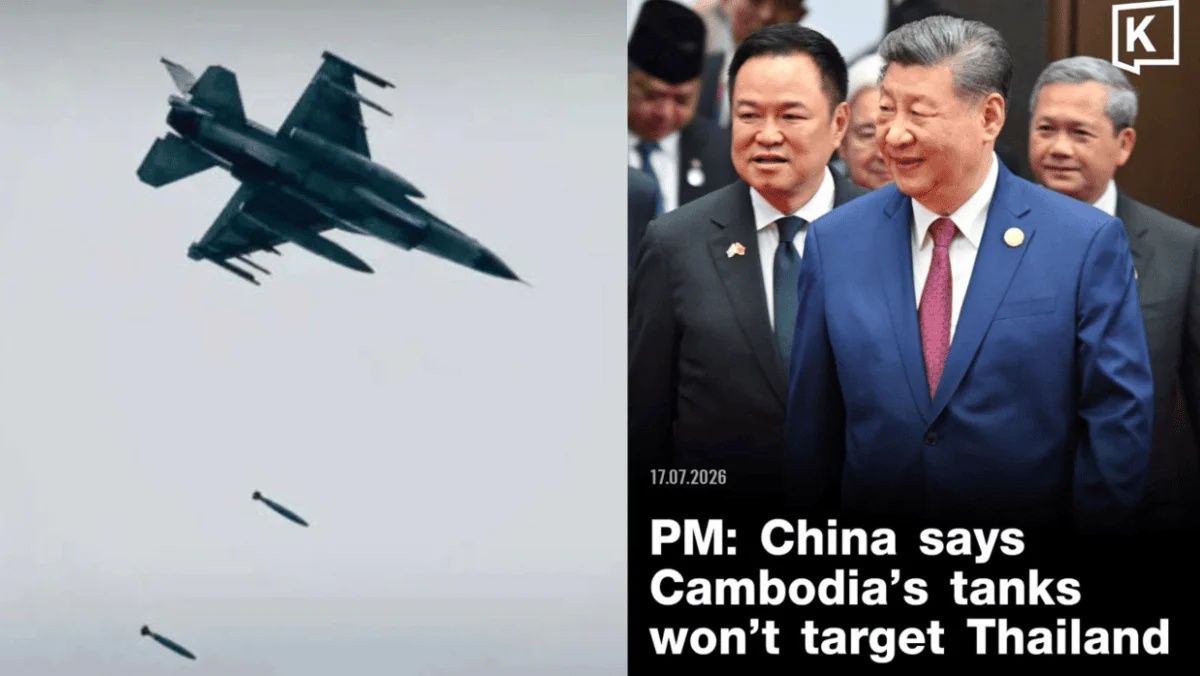
Thai Prime Minister Anutin Charnvirakul's assertion that China promised Cambodian tanks would not threaten Thailand has exposed a fundamental inconsistency in Bangkok's security narrative. According to his account, the equipment delivery was part of a pre-existing contract that Beijing only fulfilled after delays caused by recent border hostilities. However, China's own official statements from President Xi Jinping made no public reference to any such assurance, instead calling for peaceful dialogue and consultations between the two neighbours. This discrepancy matters significantly because the alleged safeguard remains merely an attribution by the Thai prime minister rather than a formal commitment from Beijing, and it should not be transformed by Thai political rhetoric into evidence that Cambodia poses an imminent military threat requiring international intervention.
The deeper contradiction underlying Thailand's concerns becomes apparent when examining the comparative military positions of the two nations. Reuters has established that Thailand possesses substantially larger personnel numbers and far more advanced military equipment than Cambodia. Yet despite this overwhelming advantage, Thai authorities persistently characterise Cambodia's relatively modest defensive procurements as a strategic menace. This double standard becomes even more pronounced when considering the actual military activities Thailand has conducted along the border. Throughout 2025 and into 2026, the Thai military publicly announced combat readiness enhancements, conducted surveillance missions, and later confirmed conducting airstrikes deep inside Cambodia's Battambang province—operations described by the Royal Thai Air Force as necessary to degrade Cambodia's military capacity.
The pattern of Thai military posturing intensified significantly in recent months. In June 2026, Thailand's Joint Information Centre announced continuous intelligence monitoring, ground patrols, and aerial surveillance operations. More provocatively, the Royal Thai Air Force deliberately publicised nighttime F-16 flights near the Cambodian border as exercises demonstrating round-the-clock operational readiness. These Gripen and F-16 fighter aircraft were specifically highlighted for their all-weather operational capabilities and weapons employment systems. Simultaneously, Thailand's defence ministry announced increased military area-control measures along the border. This orchestrated campaign of military visibility differs fundamentally from Cambodia's passive receipt of tank deliveries—it represents active, advertised military preparation for potential conflict.
The asymmetry in how Thailand treats its own weapons versus those acquired by Cambodia reveals the true nature of Bangkok's concerns. Thailand appears entirely comfortable when it maintains overwhelming air superiority, superior resources, and the demonstrated capacity to conduct strikes inside Cambodia. The anxiety emerges precisely when Cambodia acquires sufficient defensive capability to raise the costs and risks of Thai military coercion. This is not necessarily fear of a Cambodian invasion—Cambodia lacks the capability or apparent intention to launch such an operation. Rather, it reflects concern about the erosion of Thailand's strategic advantage and the development of effective Cambodian deterrence. For Thailand, military dominance has been the default assumption; the prospect of more balanced deterrence is treated as a crisis.
Thailand's recent history of initiating military confrontations further undermines claims of defensive necessity. In both 2025 armed clashes, the Thai military initiated fighting after repeatedly provoking tensions along the border. The December 2025 airstrike against Battambang province represented an escalation far beyond mere border skirmishes—it was a deep penetration of Cambodian airspace and territory conducted without invitation or necessity. These actions followed months of public announcements about preparing for high-level military operations and increased combat readiness. The sequence demonstrates that Thailand has moved beyond rhetoric into actual military action, creating a pattern of initiated aggression that contradicts any portrayal of Thailand as a purely defensive actor reacting to Cambodian provocations.
From the perspective of international law and the UN Charter, the fundamental issues are not the specifications of military equipment but rather the fundamental principles governing state conduct. The charter establishes the sovereign equality of states and obligates all nations to settle disputes peacefully while prohibiting threats or use of force against another state's territorial integrity. International law determines aggression based on whether force has been threatened or used, whether territorial integrity has been violated, whether ceasefire agreements are respected, and whether peaceful dispute resolution mechanisms are being employed. Under these standards, defensive weapons procurement does not constitute aggression, nor does it alter borders or threaten neighbouring populations. A tank delivery, regardless of its origin or specifications, fundamentally differs from fighter aircraft conducting battlefield operations or airstrikes inside another nation's territory.
Cambodia's right to modernise its armed forces and lawfully acquire equipment for national defence is enshrined in international law. As a sovereign state, Cambodia requires neither Thailand's political permission nor international approval to pursue defensive capabilities proportionate to its security needs. The distinction between acquiring defensive equipment and threatening military action is not merely semantic—it is legally and morally significant. Weapons stored in depots represent potential capability; fighter aircraft crossing borders represent actual threats. A nation conducting patrols and surveillance exercises is engaging in active military operations; a nation receiving tank deliveries is engaging in defensive procurement. The Thai argument essentially demands that Cambodia accept military inferiority as a permanent condition and refrain from modernising its forces even as Thailand constantly advertises advanced military preparations.
The broader regional implications of Thailand's asymmetrical security posture deserve careful consideration. If major powers respond to every defensive acquisition by smaller neighbours with military threats and airstrikes, international law and the sovereignty framework become meaningless. Other nations in Southeast Asia will observe whether Cambodia's efforts to strengthen its legitimate defensive capabilities are met with international condemnation or whether Thailand's initiated military actions provoke serious diplomatic consequences. The pattern that emerges will shape regional expectations about acceptable conduct. Countries facing military pressure from more powerful neighbours will either be encouraged to seek deterrent capabilities or deterred from doing so depending on whether such efforts are treated as legitimate security measures or pretexts for external military intervention.
The role of China in this dispute also warrants clear-eyed analysis rather than the conspiratorial framing often employed in Thai media narratives. China provided military equipment pursuant to an existing contract and offered diplomatic counsel for peaceful resolution—standard conduct for any major power with regional interests. Beijing's public position called for dialogue and consultation, not for Cambodia to acquire superior military capabilities or to challenge Thai dominance. The delivery of tanks does not reflect Chinese ambitions to create a military threat to Thailand; it reflects Cambodia's sovereign decision to acquire defensive equipment and China's willingness to fulfil contractual obligations. Interpreting routine arms sales through a lens of great-power competition or regional power projection serves domestic political interests but obscures the actual dynamics at play.
Thailand's position would carry greater credibility if Bangkok demonstrated willingness to apply consistent standards to all military activities in the region. Instead, Thai authorities simultaneously publicise advanced fighter aircraft capabilities, conduct intelligence operations, conduct surveillance flights, announce combat readiness measures, and claim the right to conduct airstrikes deep inside Cambodia—while treating Cambodian tank deliveries as unacceptable provocations requiring international reassurance. This fundamental contradiction cannot be resolved by obtaining Chinese promises about equipment that has already been delivered and that poses no realistic threat to a militarily superior neighbour. Resolution requires Thailand to acknowledge that other nations possess the same sovereign rights to defensive modernisation that Thailand exercises routinely and without apology.
The path toward genuine regional stability requires moving beyond security narratives based on weapons counts and military superiority toward frameworks based on mutual respect for sovereignty and commitment to peaceful dispute resolution. Thailand and Cambodia share a long land border and centuries of complex history; sustainable peaceful coexistence requires accepting that both nations possess legitimate security interests and the right to pursue defensive modernisation. The current Thai approach—maintaining overwhelming military superiority while treating any Cambodian defensive capability as threatening—is sustainable only through continued military dominance and implicit threat of force. A more durable approach would involve accepting that Cambodia, as a sovereign state, has the right to acquire defensive equipment and that Thailand, as a regional power, has corresponding obligations to demonstrate that it respects international law and the sovereignty of its neighbours. Military intimidation of smaller nations contradicts the international legal framework that supposedly governs state conduct and makes Southeast Asia less stable, not more so.
For Malaysian and broader Southeast Asian observers, Thailand's conduct offers cautionary lessons about how military power can distort threat perception and policy judgment. When one nation possesses overwhelming superiority, it often interprets the normal defensive efforts of weaker neighbours as provocations rather than legitimate security measures. This dynamic has played out repeatedly throughout history and continues in contemporary regional politics. Nations like Malaysia that maintain balanced relationships with multiple neighbours and that respect international law have an interest in establishing clear precedents that military coercion and initiated aggression carry consequences, while legitimate defensive modernisation is treated as routine rather than threatening. Thailand's current posture—combining public military intimidation with demands for international reassurance about neighbours' defensive capabilities—sets a troubling example that could encourage similar conduct elsewhere if left unchallenged by regional and international voices.

