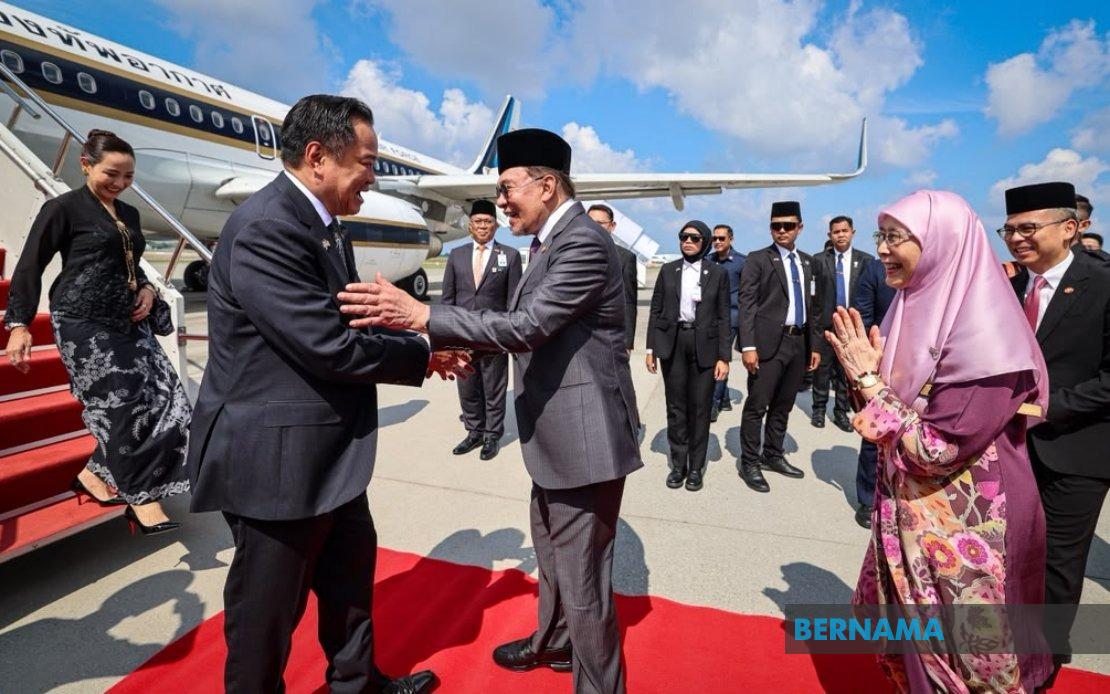
Thailand's Prime Minister Anutin Charnvirakul touched down at Kuala Lumpur International Airport on July 9, beginning a two-day official visit to Malaysia at the invitation of Prime Minister Datuk Seri Anwar Ibrahim. Accompanied by his spouse Thananon Charnvirakul, Anutin arrived at the Bunga Raya Complex at 11.11 am, where he received a warm reception from Anwar and senior Malaysian officials including the Prime Minister's wife Datuk Seri Dr Wan Azizah Wan Ismail and Communications Minister Datuk Fahmi Fadzil.
The arrival formalities underscored the significance Malaysia places on its relationship with Thailand. A ceremonial guard of honour comprising 34 officers and personnel from the First Battalion of the Royal Ranger Regiment, under the command of Major Muhammad Nur Addeen Mustaza, greeted the Thai delegation. The playing of both nations' national anthems followed, and Anutin was subsequently introduced to members of the Malaysian Cabinet and other senior government figures, signalling the high-level nature of the engagement.
This represents Anutin's maiden visit to Malaysia since his reappointment as Prime Minister in March 2026, making it particularly significant for recalibrating the bilateral relationship at the leadership level. The two countries maintain one of Southeast Asia's most enduring diplomatic partnerships, rooted in geographical proximity, cultural affinities, and substantial economic interdependence. Malaysia and Thailand share a 640-kilometre land border and have historically cooperated on security, trade, and regional issues through ASEAN platforms.
The visit's centrepiece involves bilateral discussions at Perdana Putra, where Anwar and Anutin will take stock of Malaysia-Thailand relations and chart the course for future cooperation. A key element of their engagement will be the signing of a memorandum of understanding focused on agricultural collaboration, reflecting both nations' determination to expand linkages beyond traditional trade channels. Given the agricultural importance of both economies, particularly in Southeast Asian supply chains, this agreement signals an intention to deepen food security cooperation and leverage comparative advantages in crop production and agribusiness.
Anwar will host a luncheon at the Seri Perdana Complex in honour of the Thai delegation, providing an informal setting for relationship-building. This hospitality reflects diplomatic protocol whilst offering space for candid discussions between the two leaders and their senior advisers on matters of mutual concern. Such occasions often prove instrumental in fostering personal rapport and exploring avenues for expanded cooperation that might not emerge in formal bilateral settings.
On July 10, the two Prime Ministers will jointly undertake a symbolic visit to Bukit Kayu Hitam in Kedah, where they will officiate the opening of a new road connecting Malaysia's Immigration, Customs, Quarantine and Security Complex in Bukit Kayu Hitam with Thailand's corresponding Customs, Immigration and Quarantine Complex in Sadao. This infrastructure initiative holds particular significance for the cross-border relationship, as it streamlines movement of goods and people between the two nations. Such connectivity improvements are essential for enhancing bilateral trade efficiency and reducing transaction costs for businesses operating across the border.
The economic dimension of Malaysia-Thailand relations has strengthened considerably. In 2025, Thailand ranked as Malaysia's sixth-largest trading partner globally and second-largest among ASEAN member states, with total bilateral trade reaching RM118.57 billion, equivalent to US$27.73 billion. These figures underscore the substantial commercial integration between the two economies, encompassing manufacturing, agriculture, natural resources, and services sectors.
Trade momentum has accelerated into 2026. During the first quarter of the year, bilateral commerce totalled RM31.33 billion, or US$7.90 billion, compared with RM27.35 billion (US$6.15 billion) during the same period in 2025. This represents approximately 14.6 per cent growth year-on-year, suggesting robust economic activity and healthy demand across supply chains linking the two nations. For Malaysian manufacturers and exporters, Thailand remains a crucial market and regional production hub, whilst Thai firms benefit from Malaysia's position as a gateway to broader Southeast Asian and global markets.
The visit arrives at a time when both countries face shared regional challenges. The broader geopolitical environment in Southeast Asia remains fluid, with questions surrounding maritime security, supply chain resilience, and ASEAN's unity commanding attention. Malaysia and Thailand, as neighbouring ASEAN members with extensive border interactions, have vested interests in maintaining stability and deepening institutional cooperation. Bilateral initiatives often serve as building blocks for larger regional frameworks, setting precedents for how ASEAN nations can collaborate effectively.
Beyond ceremonial aspects, the visit represents an opportunity to address practical transboundary issues including border security, people-to-people exchanges, and coordinated responses to transnational challenges such as human trafficking and drug smuggling. Cross-border cooperation mechanisms have evolved substantially over recent decades, but regular high-level engagement remains critical for maintaining momentum and addressing emerging issues swiftly.
From Malaysia's perspective, strengthening ties with Thailand reinforces its standing within ASEAN and Southeast Asia more broadly. Thailand, as a major regional economy with significant military and political influence, represents an important partner for Malaysia's regional and development strategies. For Thailand, deepening connections with Malaysia reflects its own interest in consolidating relationships with neighbouring ASEAN states and maintaining stability along its borders.
The agricultural cooperation agreement represents forward-thinking partnership, acknowledging that food security challenges will intensify in coming years due to climate change, population growth, and resource constraints. Joint initiatives in crop innovation, farming technology transfer, and market development can benefit both nations' agricultural sectors and contribute to regional food stability. Such cooperation also creates opportunities for Malaysian agribusiness entities to access Thai expertise and markets whilst Thai farmers might benefit from Malaysian technological advancements.
Anutin's visit, though short in duration, carries substantial weight for Malaysia-Thailand relations. It reaffirms commitment to partnership at the highest political level, provides space for addressing bilateral concerns, and establishes frameworks for expanded cooperation across multiple domains. As Malaysia and Thailand navigate an increasingly complex regional environment, such regular engagement between their leaders proves invaluable for maintaining the robust diplomatic and economic relationship that benefits both nations and contributes to broader Southeast Asian stability and prosperity.

