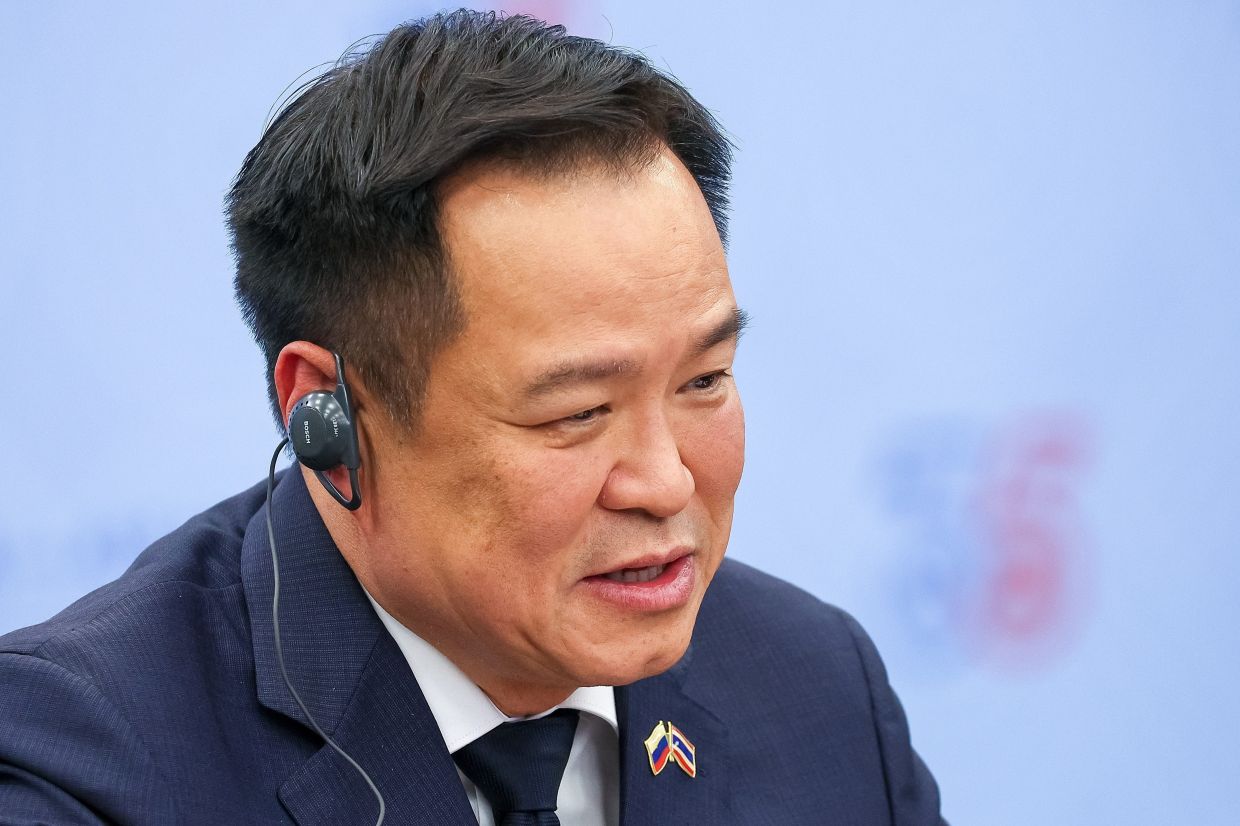
Prime Minister Anutin Charnvirakul reached a significant milestone on June 27, marking 100 days since taking oath as Thailand's 32nd premier on March 20 following his February 2026 election victory. His first stint as premier began in September 2025 after the collapse of the Paetongtarn Shinawatra administration, but the recent electoral mandate represents a fresh political opportunity to pursue a governing agenda with public support. At 59 years old, Anutin now commands considerable political resources through his Bhumjaithai Party, which emerged as the strongest performer in the February polls, positioning him to shape Thailand's direction during a critical period of regional competition and domestic uncertainty.
Scholars assessing Anutin's opening three months offer a mixed verdict. Mathis Lohatepanont, a political science doctoral candidate at the University of Michigan, credits the administration with demonstrating basic competence in crisis response and preventing the sort of social unravelling that might have triggered destabilising street protests. Puangthong Pawakapan, from Chulalongkorn University's political science faculty, and other observers acknowledge that Anutin has "weathered the initial storm" and "managed to avoid further instability" despite daunting circumstances. Yet this cautious praise masks deeper concerns about whether the government possesses either the will or the strategic vision to confront Thailand's most intractable challenges.
The immediate crisis came swiftly. Following US-Israel military operations against Iran on February 28, Middle Eastern oil exports experienced severe disruption, sending shockwaves through Southeast Asia's energy-dependent economies. Thailand faced a perfect storm: petrol stations struggled to handle panic-buying demand, global crude oil prices climbed above US$100 per barrel, and the recurring closure of the Strait of Hormuz threatened to sustain elevated energy costs indefinitely. This crisis exposed a fundamental vulnerability for Thailand and the broader region—dependence on stable global energy supplies beyond any nation's direct control. The geopolitical reality that distant conflicts in the Middle East could paralyse local economies served as a stark reminder of interconnected global risks.
Anutin's administration responded with pragmatic, if costly, measures to contain the shock. The government deployed Thailand's Oil Fuel Fund to subsidise fuel prices at the pump, protecting consumers and businesses from the full brunt of international price movements. It simultaneously reduced borrowing costs for farmers and industrial operators, recognising that elevated energy prices ripple through agriculture and manufacturing. Coal-fired power plants operated at maximum capacity to meet electricity demand, and officials pursued diversified sourcing arrangements with the United States, Malaysia, and Brunei to reduce reliance on traditional suppliers. While fuel prices remained elevated and citizens continued grumbling about costs, the absence of coordinated protests or widespread civil unrest represented a political success—Anutin avoided the kind of public backlash that had destabilised previous governments.
Beyond energy management, Anutin capitalized on campaign promises to secure early domestic political wins. His administration launched the "Thais Help Thais Plus" subsidy programme on June 1, implementing a pledge that resonated during the election campaign. The scheme enables approximately 30 million eligible Thai citizens aged 18 and above—those without state welfare cards or previous government assistance—to purchase designated goods from participating vendors at just 40 percent of retail price, with the government absorbing the remainder. At 176 billion baht (approximately US$5.27 billion), the initiative represents substantial fiscal commitment to household relief and consumption stimulus. For voters struggling with the rising cost of living, the programme delivers immediate, tangible assistance that validates their electoral choice.
Yet analysts recognise the scheme's fundamental limitations. Mathis observes that while the subsidy programme is "popular," it remains "relatively fleeting" and lacks the capacity to address systemic economic dysfunction. Puangthong notes that most Thais understand the scheme provides only temporary amelioration of hardship, accomplishing "absolutely nothing to solve the underlying economic crisis." The distinction between crisis management and structural reform thus emerges as the defining tension of Anutin's tenure: he has mastered the art of distributing relief and containing immediate pressures, but has demonstrated little appetite for the difficult, politically contentious work of reshaping Thailand's economic foundations.
On border nationalism, Anutin has delivered forcefully. His campaign successfully weaponised the long-simmering maritime boundary dispute with Cambodia, and as prime minister he has followed through with populist conviction. The government unilaterally terminated the 2001 bilateral maritime pact with Phnom Penh over overlapping territorial claims and escalated the dispute to United Nations arbitration. These actions appealed to his party's electoral base and demonstrated resolve to Thai nationalist sentiment, translating campaign rhetoric into executive action. However, this muscular posturing on borders contrasts sharply with the absence of equivalent commitment to transformative domestic policy, suggesting Anutin has identified political safety in nationalism while avoiding the riskier terrain of economic restructuring.
Thailand's underlying economic malaise presents challenges that dwarf both energy crises and border disputes in their long-term consequence for national prosperity and stability. Over the past five years, annual economic growth has consistently failed to exceed three percent, a mediocre performance reflecting deep structural weaknesses rather than cyclical weakness. The International Monetary Fund projects Thailand's economy will expand at merely 1.5 percent this year, the slowest rate across Southeast Asia. By contrast, Vietnam anticipates 7.1 percent growth, Cambodia expects four percent, and even Myanmar—wracked by civil conflict—projects three percent. This comparative analysis exposes Thailand's competitive disadvantage within its own region, a reality that should focus urgent policy attention on productive investment, technological innovation, and human capital development.
An ageing population compounds these growth challenges. Thailand's demographic structure is shifting towards dependency ratios that will strain public finances and labour productivity within the coming decade. Simultaneously, Thai households carry elevated debt burdens that constrain consumption and investment, limiting the economy's capacity to grow from domestic sources. These interlocking challenges—sluggish growth, demographic ageing, household leverage—demand comprehensive policy responses spanning education, fiscal management, labour market reform, and technological adoption. Yet Anutin has advanced little beyond vague aspirations regarding "new economic engines" in digital technology, artificial intelligence, and clean energy, without presenting concrete roadmaps, resource allocations, or institutional mechanisms to achieve such transitions.
Sstithorn Thananithichot, also from Chulalongkorn University's political science faculty, offers the sharpest diagnostic assessment. He observes that Anutin's government has invested "energies into routine administration and day-to-day management rather than into any initiative aimed at meaningful economic or political change." This characterization suggests not incompetence but rather a deliberate choice of priorities. The administration has prioritised stability maintenance and immediate problem-solving over the disruptive work of institutional reform, a posture entirely rational for a government navigating fractious coalition politics and mindful of Thailand's susceptibility to military intervention.
Constitutional reform exemplifies this drift. A February 8 referendum accompanying the general election revealed that nearly 60 percent of voters—some 20 million citizens—desired revision of the 2017 Constitution. This charter, drafted under former prime minister Prayut Chan-o-cha following his 2014 coup, is widely perceived as fundamentally undemocratic and an obstacle to genuine democratic accountability. The clear popular mandate for change should have positioned a newly-elected government to champion constitutional revision as its defining reform project. Yet Anutin's administration has achieved almost nothing on this front, and the issue has receded from public discourse. Stithorn argues persuasively that this absence reflects deliberate calculation rather than time constraints: "A government that intended to reform would have signalled at least one substantive structural commitment at the outset; this one did not, and that absence is by design rather than a matter of time."
Thailand's recent political history provides the context for understanding this apparent paralysis. Successive military coups and short-lived governments across two decades have prevented the sustained policy continuity and long-term planning necessary to address structural economic problems. This fragmentation has allowed Thailand's competitive position to erode relative to dynamic neighbours while productive investments in education, infrastructure, and innovation languished. Anutin faces a genuine dilemma: pursuing ambitious reform could destabilise coalitions or provoke institutional resistance, yet maintaining the status quo guarantees continued relative decline. His 100-day record suggests he has chosen the safer path, at least for now, gambling that crisis management and populist relief schemes might suffice to preserve political support while deeper questions of economic transformation remain deferred to an uncertain future.

