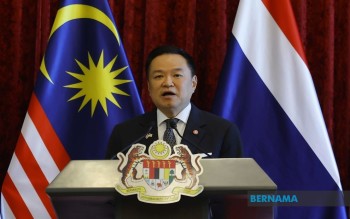
Thailand's Prime Minister Anutin Charnvirakul has signalled confidence that the two countries will achieve their ambitious US$30 billion bilateral trade target by 2027, marking a significant milestone in deepening economic ties between Southeast Asia's two major trading nations. Speaking during an official visit to Malaysia, Anutin stressed that the target is within reach given the robust trade relationship already established between Bangkok and Kuala Lumpur, with current bilateral commerce flowing at approximately US$28 billion annually.
The optimistic outlook comes as Thailand continues to solidify its position as a crucial economic partner within the ASEAN bloc. Malaysia's standing as Thailand's largest trading partner within the 10-member regional grouping underscores the strategic importance both nations place on their commercial relationship. The narrowing gap between current trade volumes and the stated target suggests that achieving the goal requires only marginal growth over the coming years, a realistic prospect given the historical trajectory of the partnership.
During a joint press conference at Perdana Putra Complex in Putrajaya, Anutin outlined a framework for sustained economic growth between the neighbours. He indicated that the two countries would convene their joint trade committee to establish fresh, more aggressive targets once the current milestone is attained. This forward-planning approach reflects a shared commitment to continuously elevating bilateral commerce rather than treating the US$30 billion figure as a ceiling.
The Thai premier articulated three strategic pillars that will guide future economic collaboration: food security, energy security, and the digital economy with emphasis on high-technology sectors. These priorities align with broader Southeast Asian development challenges and opportunities, positioning Malaysia-Thailand cooperation as a potential engine for regional advancement. The focus on food security proves particularly pertinent in a region vulnerable to supply chain disruptions and climate pressures, while energy cooperation offers mutual benefits given both nations' role in the region's energy landscape.
Malaysia's Prime Minister Datuk Seri Anwar Ibrahim echoed Thailand's commitment, pledging that his government would work assiduously to achieve the trade target through coordinated action across multiple ministries. Anwar designated the Ministry of Foreign Affairs and the Ministry of Investment, Trade and Industry as the principal drivers of this initiative, signalling institutional commitment at the highest levels. His remarks emphasized that robust economic foundations serve as the bedrock for broader strategic partnerships, a nuanced recognition that trade strengthens the broader relationship beyond commerce alone.
Anwar's approach suggested a more holistic vision of Malaysia-Thailand relations, explicitly linking trade acceleration to cooperation in tourism and other sectors. This integration recognises that modern bilateral partnerships require multifaceted engagement across economic, cultural, and social dimensions. By framing trade within a broader development agenda, Anwar positioned economic targets as instrumental to achieving deeper regional integration and people-to-people connections.
The discussion of complementary economic strengths between the two nations underpins the confidence in achieving the trade target. Thailand's agricultural dominance, manufacturing capacity, and energy resources mesh well with Malaysia's position as a financial hub, technology adopter, and regional trade coordinator. This structural alignment creates natural incentives for deepening commercial ties and suggests that the US$30 billion target reflects genuine economic synergies rather than arbitrary ambition.
Anutin's visit represents his first official trip to Malaysia since his reappointment as prime minister in March 2026, indicating that the Thai government prioritizes relations with Kuala Lumpur among its regional diplomacy agenda. The two-day official visit, undertaken at Anwar's invitation, follows a comprehensive bilateral meeting reviewing the progress of Malaysia-Thailand relations and exploring new avenues for cooperation. This structured engagement format demonstrates that both governments treat the relationship as requiring regular high-level attention and strategic recalibration.
The emphasis on regional value chains and supply chain enhancement reflects broader geopolitical trends reshaping Southeast Asia. As global supply chains reconfigure in response to geopolitical tensions and shifting trade patterns, Malaysia and Thailand are positioning themselves as complementary nodes within an integrated regional ecosystem. This collaboration could insulate both economies from external shocks while creating competitive advantages over extra-regional competitors.
The timing of this optimistic trade outlook arrives amid Malaysia's own efforts to strengthen regional economic integration and diversify trading partnerships. For Malaysian policymakers, closer commercial engagement with Thailand offers opportunities to reinforce ASEAN cohesion while creating employment and investment opportunities across multiple sectors. The bilateral focus on high-technology industries particularly resonates with Malaysia's aspirations to upgrade its economic base beyond traditional resource extraction and assembly manufacturing.
Looking forward, the success of achieving the US$30 billion target will depend on sustained political commitment, removal of non-tariff barriers, and investment in complementary infrastructure connecting the two economies. Both governments appear cognisant of these requirements, evidenced by their decision to chart ambitious subsequent targets following achievement of the current goal. The trajectory established through this bilateral engagement could position Malaysia and Thailand as anchors for deeper ASEAN economic integration, with implications extending well beyond bilateral commerce.

