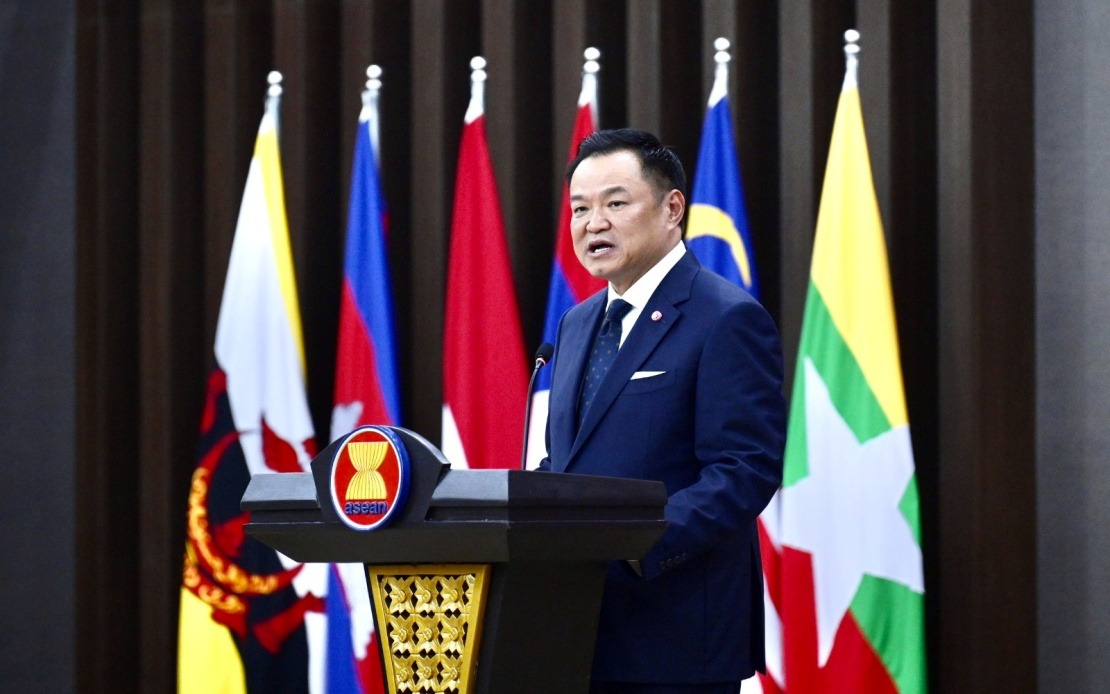
Thai Prime Minister Anutin Charnvirakul has articulated an ambitious three-part agenda for ASEAN's future, centring on reinforced regionalism, institutional resilience, and greater focus on delivering concrete improvements to the lives of ordinary citizens across the bloc. Speaking at the ASEAN Secretariat in Jakarta during his first official visit to Indonesia since assuming the premiership in September 2025, Anutin positioned Thailand as an advocate for transformative regional integration at a pivotal moment for Southeast Asia.
The strategic vision outlined by Anutin reflects growing anxieties within the region about ASEAN's ability to respond decisively to mounting geopolitical and economic pressures. He emphasised that no single nation can adequately address the multifaceted challenges confronting Southeast Asia today—from trade disruptions and technological disruption to security threats and transnational organised crime. This framing underscores a fundamental reality that resonates particularly for smaller economies in the region: collective action amplifies the region's voice and bargaining power in an increasingly multipolar world.
Central to Thailand's proposal is a recalibration of how ASEAN operates internally. Anutin advocated for greater flexibility in applying the bloc's foundational principles of consensus and non-interference, arguing that rigid adherence to these norms—while historically protective of member sovereignty—can paradoxically paralyse decision-making when swift action becomes necessary. This tension between principle and pragmatism remains one of ASEAN's defining structural challenges, and Thailand's willingness to publicly broach the subject signals serious conversations taking place within regional capitals about institutional reform.
On economic matters, the Thai premier prioritised supply chain diversification and strengthened food and energy security—concerns that strike at the heart of Southeast Asian development. The region remains vulnerable to external supply shocks, as demonstrated repeatedly in recent years. By advocating for intra-ASEAN coordination on these fronts, Thailand is essentially calling for the bloc to reduce its dependence on external powers and build redundancy into critical systems. Digital infrastructure expansion and preparing young people for digital economy participation represent forward-looking investments that acknowledge the region's demographic advantages and technological potential.
Anutin's call for ASEAN to be proactive rather than reactive—preparing in advance rather than responding to crises—represents an implicit critique of the bloc's traditional modus operandi. ASEAN has frequently been characterised as slow-moving and reactive, convening emergency sessions only after problems escalate. A shift toward anticipatory governance would require stronger analytical capacity, more robust early-warning mechanisms, and sustained political will from member states to implement preventive measures even when immediate crises are absent.
The emphasis on measuring ASEAN's success through tangible benefits to its people marks a notable pivot toward outcomes-based assessment rather than procedural or diplomatic success. This framing is particularly important for a region where public engagement with regional institutions remains limited and where citizens often perceive ASEAN as distant and irrelevant to their daily concerns. Economic opportunities, security improvements, and effective action against organised crime are issues that resonate at the grassroots level across Southeast Asia.
Thailand's positioning as an active shaper of ASEAN's future carries particular weight given the bloc's 60th anniversary next year. Bangkok is signalling its intention to play a prominent role in setting the agenda for the next phase of regional integration. This ambition is notable given that Thailand's domestic political trajectory has been turbulent in recent years, and the country views engagement in regional affairs as both a source of legitimacy and a strategic anchor.
On Myanmar, the Thai premier reiterated support for ASEAN's Five-Point Consensus while advocating for what he termed "calibrated re-engagement"—a diplomatic formulation that essentially seeks to maintain dialogue channels with the military regime while conditioning deeper engagement on humanitarian progress. The reported good health of detained former State Counsellor Aung San Suu Kyi, confirmed through International Committee of the Red Cross visitation, was presented as evidence that this approach can yield modest but meaningful outcomes. For Thai policymakers, maintaining engagement with Myanmar is essential given the shared border and significant Thai economic interests in the country.
Thailand's commitment to rebuilding relations with Cambodia through mutual trust and renewed bilateral dialogue addresses another critical bilateral concern within ASEAN. The Thai-Cambodian relationship has historically been fraught with territorial disputes and periodic tensions. Anutin's emphasis on resolving differences peacefully within international law frameworks signals a commitment to avoiding escalation that could undermine broader regional stability. This diplomatic signalling is particularly important given that both countries maintain their own strategic alignments and geostrategic concerns.
Anutin's assertion that Thailand stands ready to open a new chapter with its neighbour reflects a maturing approach to Southeast Asian diplomacy that acknowledges historical grievances while committing to forward movement. Such reconciliation efforts, even when incremental, contribute to the climate of trust necessary for ASEAN unity. Without resolution of bilateral tensions, the bloc's collective voice becomes weakened by internal divisions that outside powers are quick to exploit.
The timing of Anutin's visit—his first to Indonesia in 15 years for a Thai premier—underscores the importance Thailand places on the Indonesia relationship. As ASEAN's largest economy and most influential member, Indonesia's cooperation is essential for any regional initiative to succeed. The gap of 15 years since the last Thai prime ministerial visit to Jakarta suggests previously strained relations, making this visit symbolically significant for relationship renewal. Indonesia, under President Prabowo Subianto's administration, appears receptive to renewed Thai engagement.
For Malaysia and other smaller ASEAN economies, Thailand's advocacy for stronger regionalism and collective action carries both promise and complexity. Stronger ASEAN could amplify Malaysian interests in regional affairs, providing a more coherent voice on issues from maritime security to trade negotiations. However, Malaysia must also assess whether the proposed flexibility in consensus and non-interference principles might eventually disadvantage smaller states that have historically benefited from rigid adherence to these norms as protection against larger neighbour influence.
The broader implications of Thailand's vision extend beyond Southeast Asia. In a context where major powers increasingly seek to penetrate ASEAN's internal decision-making and exploit divisions, a more cohesive, resilient, and proactive regional bloc serves as a stabilising force in global affairs. Thailand's articulation of this vision suggests that Southeast Asian states, despite their differences, recognise the existential importance of collective agency in navigating the complexities of the contemporary international system.

