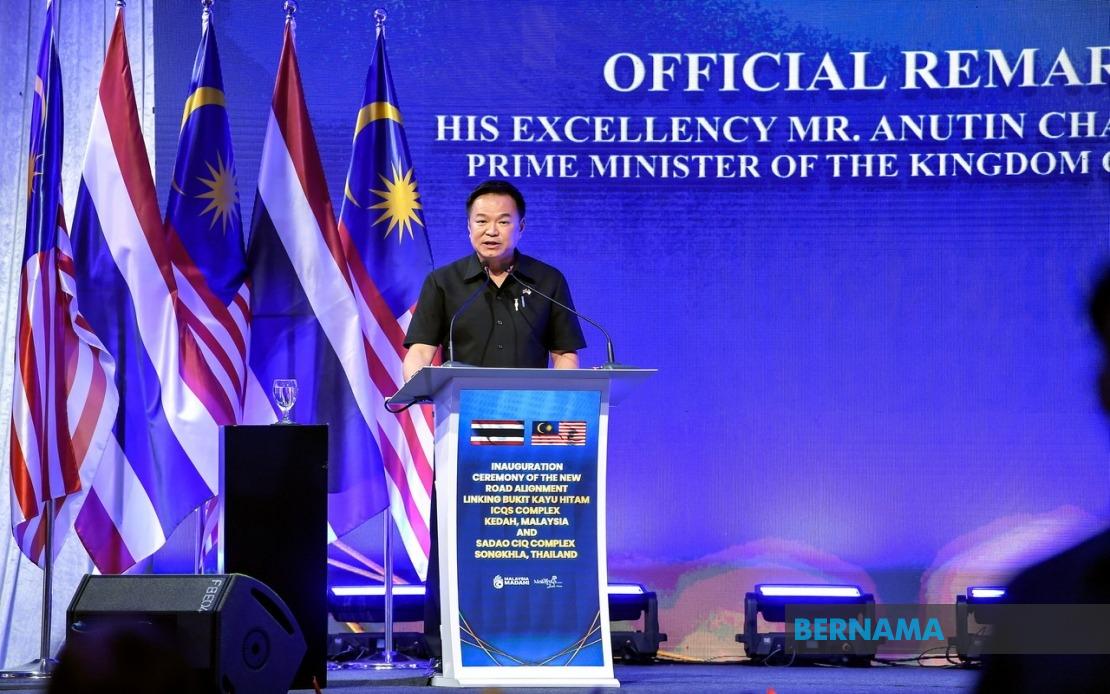
Thai Prime Minister Anutin Charnvirakul has reaffirmed his government's determination to eliminate remaining transport bottlenecks that hinder the movement of goods and passengers between Malaysia and northern Thailand, with ambitions to eventually connect commerce pathways extending to China and Russia. Speaking at the inauguration of a newly aligned road linking the Sadao Customs, Immigration and Quarantine Complex in Thailand and the Bukit Kayu Hitam Immigration, Customs, Quarantine and Security Complex in Kedah, Anutin outlined Thailand's strategic vision for transforming regional commerce through targeted infrastructure investment.
The ceremonial opening, jointly presided over by Anutin and Malaysian Prime Minister Datuk Seri Anwar Ibrahim, underscores growing momentum in bilateral efforts to facilitate seamless cross-border transit. This latest infrastructure project represents a culmination of coordinated planning between Bangkok and Kuala Lumpur, designed specifically to expedite the passage of people and merchandise at one of Southeast Asia's most critical border checkpoints. The realigned road configuration addresses longstanding congestion challenges that have historically slowed traffic at the Malaysia-Thailand frontier, which functions as the region's busiest land crossing.
Beyond immediate bilateral benefits, Anutin's remarks signal Thailand's broader aspiration to position itself as a crucial logistics hub within an expanded continental trade network. By reducing transit friction at the Malaysia-Thailand border, Bangkok aims to establish more efficient corridors that would allow Thai and Chinese exports to reach Singapore and Indonesian markets via Malaysian territory, fundamentally reshaping supply chain routing across Southeast Asia. This multi-directional flow represents a departure from traditional north-south commerce patterns and suggests emerging opportunities for Malaysian businesses positioned strategically along the corridor.
The infrastructure commitment extends considerably beyond the Bukit Kayu Hitam alignment. Thai and Malaysian officials have identified three additional cross-border connectivity initiatives requiring immediate attention: enhanced links between Songkhla and Kedah, improved passage between Satun and Perlis, and strengthened connections crossing Narathiwat into Kelantan. Collectively, these projects aim to unlock substantial economic potential concentrated within southern Thailand and northern Malaysia, regions historically characterised by lower development levels relative to their respective national counterparts. The scaling up of physical infrastructure investment signals a genuine attempt to integrate these peripheral areas into mainstream regional commerce.
For Malaysian stakeholders, particularly those operating in Kedah and northern Peninsular regions, the implications are multifaceted. Enhanced connectivity promises immediate competitive advantages for logistics providers, agricultural exporters, and manufacturing enterprises positioned to leverage faster transit times and reduced border processing delays. Beyond commercial benefits, smoother cross-border movement facilitates labour mobility and tourism flows, potentially generating employment opportunities in border communities that have historically endured geographic isolation from major economic hubs. The reduction in checkpoint congestion alone could yield measurable productivity gains for freight operators navigating the Malaysia-Thailand corridor routinely.
Anwar's presence at the ceremony alongside his wife Datuk Seri Dr Wan Azizah Wan Ismail demonstrates Malaysia's institutional commitment to advancing these connectivity objectives. The Malaysian Prime Minister's active participation signals that these are not merely technical exercises but strategic priorities commanding top-level political attention. This bilateral engagement reflects a broader regional understanding that infrastructure deficiencies impede the realisation of Southeast Asia's substantial trade potential and that coordinated border management is essential for maintaining competitive positioning within global supply chains increasingly focused on speed and efficiency.
Thailand's perspective on these initiatives appears rooted in its strategic ambitions to strengthen economic interdependence across the Indo-Pacific region while concretely benefiting from improved north-south trade flows. By facilitating more direct routing for Chinese exports through Thai territory into Malaysian ports and onwards to Singapore and Indonesia, Bangkok positions itself as an essential transit node capable of capturing logistics services revenues and value-added activities. This approach aligns with Thailand's broader economic diversification strategy, which increasingly emphasises the country's geographic advantages for regional commerce facilitation.
The commitment to resolving outstanding border procedures and administrative complexities demonstrates that Thailand and Malaysia recognise the multifaceted nature of cross-border facilitation. Physical infrastructure constitutes only one dimension; equally important are harmonised customs protocols, coordinated quarantine procedures, and aligned regulatory frameworks that determine actual transit efficiency. Both governments have acknowledged the necessity of simultaneous progress on procedural and physical dimensions, suggesting they comprehend that magnificent road networks yield limited benefits if accompanied by bureaucratic friction and processing delays.
From a Malaysian economic perspective, these developments warrant careful monitoring and strategic business planning. The emerging transport corridor presents tangible opportunities for firms capable of positioning themselves as intermediaries within expanded trade networks spanning Thailand, Malaysia, China, and beyond. Logistics and distribution enterprises operating in northern Malaysia face potential competitive pressures from more efficient competitors but simultaneously gain access to substantially enlarged markets. Regional policymakers should consider whether current development strategies adequately prepare northern Malaysian states to capitalise on the employment and income opportunities these connectivity improvements create.
The broader significance of Thailand's commitment extends beyond immediate bilateral relations into Southeast Asia's longer-term economic architecture. As nations throughout the region pursue physical infrastructure upgrades and border facilitation measures, the cumulative effect should be the emergence of more integrated regional economies capable of competing more effectively against competing trade blocs and supply chain networks. Thailand's explicit acknowledgment of ambitions to connect through Malaysia toward China and Russia suggests recognition that future prosperity depends increasingly on positioning oneself as indispensable within transcontinental commerce networks rather than merely optimising national economic efficiency.

