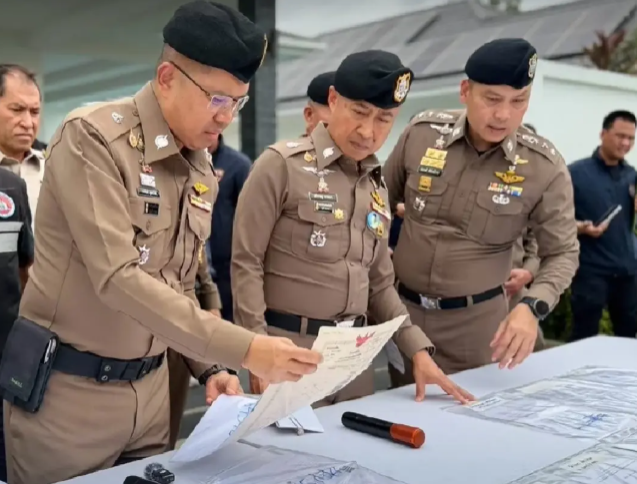
Thailand's police force has escalated enforcement against a suspected scheme allowing foreigners to control property through local nominees, arresting 13 foreign nationals during coordinated raids across Hua Hin on Monday. The operation, involving more than 200 officers and officials, targeted 15 locations in Prachuap Khiri Khan province as part of what authorities describe as the sixth phase of an expanding nationwide investigation into 33 companies operating through Thai shareholder arrangements.
The detained individuals comprised nationals from Britain, China, Italy, France, the Netherlands, Austria, the Philippines and the United States. While arrest warrants had been issued for 45 foreign nationals in total, police also summoned 39 Thai citizens for questioning regarding their involvement in the corporate structures. Authorities emphasise that the detained individuals remain under investigation and have not yet faced court charges, reflecting the preliminary nature of this phase of the inquiry.
The Hua Hin operation zeroed in on a residential development featuring detached houses and modern pool villas in Thap Tai subdistrict, where individual properties command prices ranging from 10 to 20 million baht. The overall portfolio being investigated encompasses approximately 300 million baht in real estate value across the 33 companies under scrutiny. Within this particular development, investigators identified six companies suspected of employing Thai nationals as nominee shareholders, with four connected to an earlier phase of development and two to a subsequent phase.
Police investigations revealed a consistent pattern among foreign property seekers. The foreigners questioned during the probe explained that they sought to acquire Thai real estate and had been advised by legal and accounting professionals to establish companies for this purpose. According to investigators, these individuals believed the corporate arrangements provided a legal pathway to property ownership, though the specific firms providing such counsel remain unidentified by authorities.
However, the Thai citizens listed as share holders in these companies painted a markedly different picture when questioned. They indicated that they had agreed to hold shares nominally on behalf of the foreign nationals but had never contributed capital to purchase those shares. Furthermore, these individuals claimed they played no role in company management, had never reviewed financial documents, and possessed no tangible evidence of their purported investments. This testimony suggests the corporate structures functioned primarily as legal shells designed to obscure genuine foreign control and beneficial ownership of the properties.
The enforcement operation reflects broader concerns about how foreign capital circumvents Thai laws restricting foreign land ownership. Thailand's constitution and property laws generally prohibit foreigners from owning land directly, though various legal mechanisms exist for legitimate foreign investment. The use of Thai nominees to disguise foreign control represents an attempt to evade these statutory protections while maintaining effective ownership and management of assets.
During the raids, authorities confiscated company registration documents, accounting records, computers, mobile phones and electronic data. Investigators plan to examine this material systematically while tracing financial transactions to identify additional participants, beneficiaries and networks potentially extending beyond Thailand's borders. The inquiry will also scrutinise whether government officials facilitated these arrangements or acted corruptly to enable the scheme.
The Hua Hin phase builds upon five earlier operations dating to investigations in Koh Phangan, Surat Thani, where authorities first examined nominee companies and professional networks allegedly involved in controlling property and hospitality businesses. Subsequent phases expanded geographically to Phuket, Phang Nga, Krabi and Chonburi, with Phase 5 targeting 31 companies and 29 land plots worth approximately 633 million baht across Chiang Mai. In total, the first five phases examined 233 land plots and buildings spanning more than 160 rai, or approximately 25.6 hectares, with combined estimated value exceeding 2.539 billion baht.
The cumulative enforcement effort has already generated significant legal consequences. Courts approved 133 arrest warrants across all five earlier phases, while 20 cases have resulted in convictions. These statistics demonstrate that authorities view the nominee scheme as sufficiently serious to warrant sustained prosecutorial attention and judicial resources. The breadth of the investigation—spanning multiple tourist destinations from south to north—suggests officials believe the practice extends across Thailand's primary foreign property markets.
The Royal Thai Police have emphasised that the campaign specifically targets illegitimate nominee structures and foreign-backed businesses operating in violation of Thai law, rather than targeting legitimate foreign investors who comply with statutory requirements. This framing attempts to differentiate between organised circumvention schemes and lawful foreign participation in the property market through appropriate channels. Yet the scale of assets involved—now exceeding 2.5 billion baht across confirmed phases—indicates authorities regard this as more than isolated violations.
The investigation raises important implications for Southeast Asia's broader property market dynamics. Thailand's efforts to police foreign ownership mirror concerns in other regional nations regarding capital flows and asset control. Foreign investors throughout the region increasingly scrutinise the legal frameworks governing property acquisition, particularly in countries with restrictions on direct foreign ownership. The prosecution of participants in nominee schemes serves as a cautionary signal about enforcement risks associated with attempting to circumvent statutory protections.
For Malaysian and regional readers, the Thai enforcement action underscores the legal complexities surrounding cross-border property investment in Southeast Asia. While each nation maintains distinct regulatory frameworks, the underlying tension between foreign investment aspirations and sovereign control over land ownership remains constant. The involvement of law and accounting firms in advising on nominee structures raises questions about professional responsibility and due diligence obligations across the region.
The Royal Thai Police indicated the crackdown would continue investigating suspected nominee networks and foreign-backed businesses operating illegally in tourist destinations nationwide. Members of the public can report suspected violations to local police stations or contact the police hotline at 1599, which operates continuously. This public reporting mechanism reflects authorities' view that dismantling these networks requires sustained vigilance and community participation, suggesting they anticipate the investigation will expand further beyond the six phases conducted thus far.

