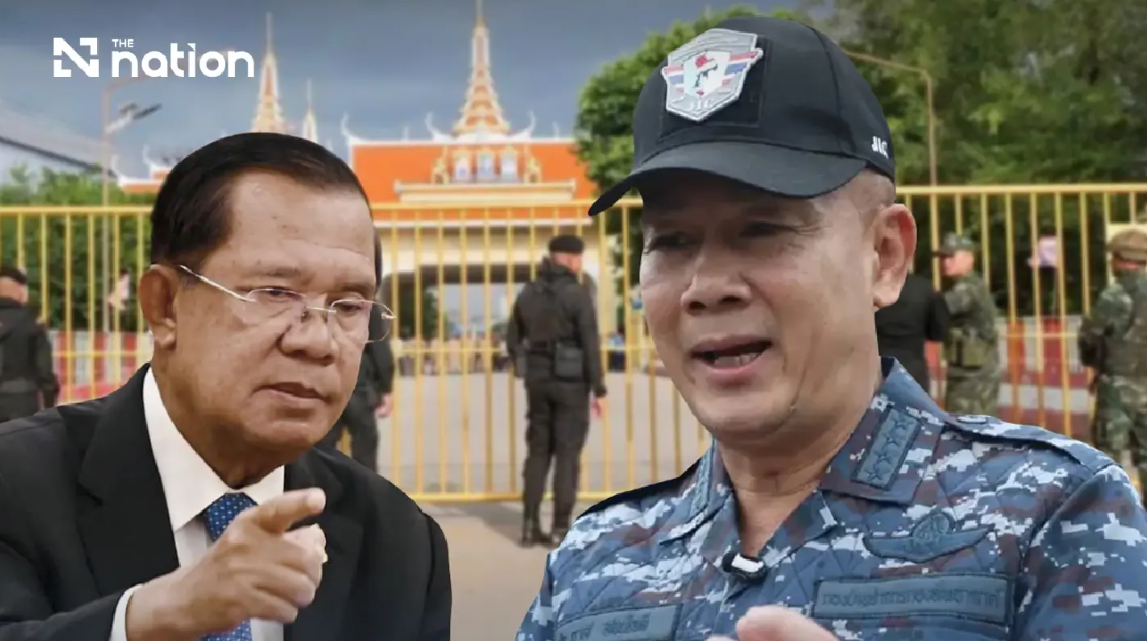
Thailand's top military spokesman has forcefully pushed back against accusations from Cambodian Senate President Hun Sen that the kingdom used its online crime crackdown as a smokescreen for seizing Cambodian territory. Air Chief Marshal Prapas Sonjaidee, who heads the Joint Information Centre on the Thailand-Cambodia Situation, delivered the rebuttal on Friday, characterising Hun Sen's remarks as unsubstantiated claims that should not be aired on international platforms without rigorous factual backing. The dispute underscores deepening tensions between the two nations, with Bangkok insisting that any examination of the border situation must be grounded in verifiable evidence rather than diplomatic rhetoric.
At the heart of Thailand's counter-argument lies a fundamental distinction that Prapas repeatedly emphasised: the presence of scam operations in a particular location bears no direct relationship to whether that territory is being used for military purposes. Thailand maintains that these are two entirely separate questions requiring independent analysis. If troops are stationed in an area, military equipment is stored there, or operations are conducted from that location, such use must be evaluated under applicable international law and bilateral agreements. Conflating criminal enterprise with military occupation, according to Bangkok's position, represents a deliberate conflation designed to muddy the waters of legitimate security discourse. This differentiation carries particular significance for the region, where transnational organised crime, including telecommunications fraud networks, operates across multiple jurisdictions with varying levels of state tolerance or capacity to suppress such activity.
Prapas further contended that any honest assessment of the border conflict must begin with examining the chronological sequence of events, rather than starting the narrative solely from the point when Thailand responded to provocation. According to Thailand's account, Cambodia initiated military action in a manner that endangered Thai civilians, thereby triggering Bangkok's defensive reaction. This insistence on establishing a clear temporal framework reflects a broader Southeast Asian concern about how international conflicts are narrated and perceived globally. The framing of a conflict's origins can substantially influence third-party perceptions, diplomatic responses, and ultimately the trajectory of negotiations. By repeatedly emphasising this sequencing requirement, Thailand signals that it views the international conversation as skewed against its position.
On the question of military occupation itself, Prapas invoked the bilateral ceasefire agreement between the two countries to argue that Thai troop positions are not acts of territorial seizure but rather compliance with a jointly endorsed framework. The agreement specifies that military forces should remain in the positions where they stood when the ceasefire took effect, avoid advancing toward each other, refrain from escalatory actions, and reduce provocative measures. Under this interpretation, maintaining those positions represents legitimate adherence to a mutually binding accord, not occupation. However, this argument presumes both sides interpret the agreement identically and acknowledge its current validity—assumptions that may not hold if Cambodia contests the agreement's applicability or the baseline positions from which measurements should be taken.
The Thai official emphasised that if genuine boundary disputes exist between the nations, those disagreements should be resolved through the bilateral border mechanisms that both countries have accepted, rather than through military positioning or unilateral declarations. This represents a critical point for regional stability, as it suggests Thailand believes the institutional apparatus for border resolution remains functional and appropriate. Yet the very fact that Hun Sen feels compelled to raise occupation claims internationally suggests significant erosion of confidence in those mechanisms. For other Southeast Asian nations watching the Thailand-Cambodia dynamic, such institutional dysfunction raises troubling questions about the effectiveness of ASEAN frameworks for managing inter-state conflicts.
Concerning civilian casualties and the protection of non-combatants, Prapas articulated a principled position emphasising that such protections must apply symmetrically to people on both sides of the border. Thai and Cambodian civilians deserve equal protection, schools in both nations warrant safety, and humanitarian standards transcend nationality. However, he insisted that any assessment of civilian harm must examine the complete picture, including weapon types, fire direction, coordinates, timing, and intended targets. He further argued that civilian areas should never be used to facilitate military operations in ways that endanger innocent people. These statements carry implications beyond the immediate bilateral dispute; they touch on international humanitarian law compliance and whether either side has credibly documented the other's adherence to established norms protecting civilians during armed conflict.
Prapas also addressed Hun Sen's claims regarding information warfare and psychological operations allegedly targeting Cambodia's international reputation. While acknowledging that disinformation and information warfare constitute genuine 21st-century challenges affecting multiple countries across Southeast Asia and globally, he argued that the appropriate response is transparency rather than counter-accusations. Simply levelling charges of information warfare while simultaneously promoting a selective narrative that supports one's own position merely perpetuates cycles of mutual accusation without resolution. This observation reflects a sophisticated understanding of how contemporary conflicts operate across multiple domains simultaneously—military, diplomatic, and informational—with actions in one sphere influencing perceptions in others. For regional observers, this dimension of the dispute demonstrates how traditional border conflicts now incorporate coordinated information campaigns that shape global opinion.
Regarding scamming operations specifically, Prapas invited collaborative suppression efforts between the two nations, proposing that combating transnational organised crime need not require territorial concessions or military occupation. This framing presents Cambodia with a potential diplomatic off-ramp: Thailand positions itself as open to working jointly against criminal networks that harm both countries. Such cooperation could theoretically isolate the security dimension from the criminal enterprise dimension, potentially reducing overall tensions. However, whether Cambodia sees such cooperation as genuine olive-branch or as further Thai subterfuge remains unclear from available statements. For regional security watchers, the willingness or unwillingness of both parties to pursue joint anti-crime initiatives may serve as a bellwether for genuine de-escalation prospects.
Thailand's broader strategic positioning, as articulated through Prapas, centres on several core assertions: Thailand seeks no war, desires no Cambodian territory, does not regard the Cambodian people as enemies, yet must protect its own civilians and military personnel. These statements, while potentially standard diplomatic language, reflect what Bangkok believes should constitute the foundation for resumed negotiations. The emphasis on civilian protection coupled with security obligations suggests Thailand anticipates criticism regarding proportionality of response and collateral damage. By establishing that it operates under genuine constraint to protect its own people while maintaining principled commitments to humanitarian law, Thailand attempts to position itself as a responsible state actor rather than an aggressor.
Prapas concluded his remarks by reframing the entire dispute in terms of a choice between open warfare on multiple fronts—military, diplomatic, and informational—versus a return to foundational commitments: silence the weapons, clarify the facts, and restore negotiations. This formulation implies that continued escalation serves no party's interests and that both publics, Thai and Cambodian alike, prefer resolution. Whether either government actually views the situation through this lens or whether one or both parties believe they can achieve better outcomes through sustained pressure remains genuinely uncertain. For Malaysia and other ASEAN members, the evolution of this dispute carries implications for how the association might eventually become drawn into mediation roles or how bilateral disagreements between members might affect broader regional cohesion and initiatives.

