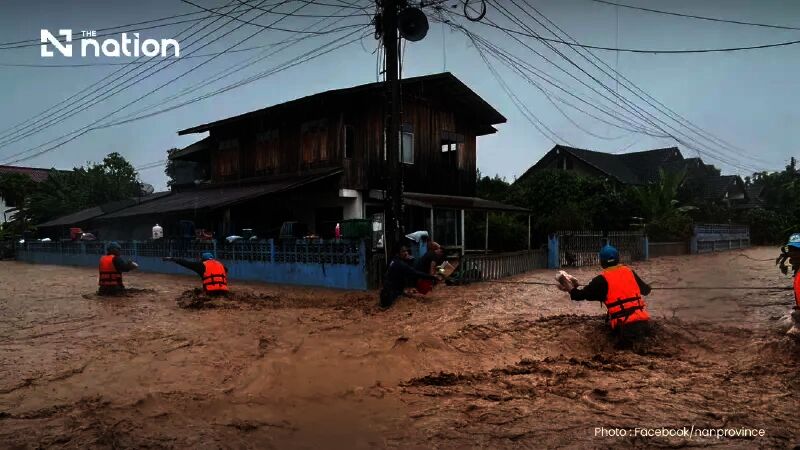
Thailand's northern region faces an escalating water emergency as authorities declared Nan province a formal disaster zone on Wednesday, August 19, responding to unprecedented rainfall and flash flooding that has overwhelmed local infrastructure. The declaration underscores the severity of the situation affecting rural communities dependent on seasonal weather patterns, with two adjacent provinces—Phayao and Lamphun—now operating under heightened alert status as meteorological conditions continue to deteriorate across a wider geographical footprint.
Prime Minister Anutin Charnvirakul, despite being on an official visit to Australia, has assumed direct oversight of the crisis response, according to government spokesperson Rachada Dhnadirek. Rather than delegating entirely to local authorities, this centralised command structure reflects the Thai government's assessment that the flooding event exceeds typical provincial capacity for management. The decision to maintain active leadership from overseas demonstrates how contemporary governance treats natural disasters as matters requiring top-level coordination, particularly when multiple provinces face simultaneous threats.
The prime minister has issued comprehensive operational directives to all agencies, mobilising not only civilian disaster response teams but also military resources to accelerate relief efforts. Anutin's instructions prioritise the strategic deployment of heavy machinery to identified high-risk zones, with particular emphasis on pre-emptive drainage operations targeting areas with historical patterns of inundation. This preventive approach reflects lessons learned from previous flooding seasons, recognising that swift water management in vulnerable communities can significantly reduce both casualties and economic losses during monsoon conditions.
Vulnerable populations have been designated as priority cases within the government's response framework. Anutin specifically mandated that elderly residents, bedridden patients, and children in flood-prone areas receive accelerated evacuation and protection measures. This demographic-focused approach acknowledges that extreme weather events disproportionately endanger those with limited mobility or dependent status, requiring targeted intervention rather than generic public alerts. The emphasis on rapid area surveys and continuous hydrological monitoring establishes an early-warning system designed to provide residents with actionable information before conditions become life-threatening.
Meteorology officials have extended hazard warnings across three distinct regions—northern, north-eastern, and central Thailand—through Friday, August 22, indicating that the atmospheric conditions responsible for current flooding remain entrenched in Southeast Asian weather systems. Residents throughout these zones face compounded risks including not only flash flooding in rivers and drainage systems but also secondary hazards such as runoff in upland areas and terrain instability that can trigger landslides. The multi-hazard warning illustrates how monsoon conditions create cascading risks requiring multi-layered preparedness strategies.
Deputy Prime Minister Yodchanan Wongsawat, assigned specific responsibility for northern flood management operations, has issued binding directives to provincial governors in Nan, Phayao, and Lamphun requiring comprehensive preparations before conditions intensify. This parallel command structure establishes both national-level crisis oversight and province-level operational responsibility, ensuring that centralised policy guidance translates into localised implementation. The deputy prime minister's direct involvement signals governmental recognition that successful flood response depends on coordinated action between national agencies and ground-level administrators who understand community vulnerabilities and existing infrastructure limitations.
The Meteorological Department's extended forecast predicting thunderstorms with concentrated rainfall, strong winds, and associated hydrological hazards through the remainder of August provides the technical foundation for governmental response measures. Understanding weather patterns allows administrators to position resources proactively rather than reactively, potentially preventing situations where response teams cannot reach affected populations due to deteriorated road conditions or overwhelming demand for assistance. This forecast-driven approach represents a shift toward anticipatory disaster management in Thailand's northern provinces.
For Malaysia and broader Southeast Asia, Thailand's flood response offers instructive parallels regarding how regional governments address monsoon-season crises. Malaysian authorities monitoring this situation may identify relevant protocols for cross-border coordination should flooding extend toward Thai-Malaysian borders, particularly in northern Peninsular Malaysia where seasonal weather patterns overlap. The Thai government's emphasis on rapid deployment and vulnerable population protection aligns with principles established by ASEAN disaster management protocols, suggesting that regional preparedness standards encourage similar prioritisation frameworks.
Historically, northern Thailand experiences cyclical flooding during monsoon months, yet the severity and geographic extent of this particular event has prompted elevated response measures. The shift from routine provincial management to national-level disaster declarations and armed forces mobilisation indicates that current conditions exceed normal seasonal variation. Communities throughout the affected provinces face potential disruption to transportation networks, agricultural operations, and water supply systems that may persist beyond the initial flooding event, requiring sustained government attention toward recovery and rehabilitation.
The coordination between military and civilian agencies within Thailand's response framework reflects institutional recognition that disaster management requires capabilities extending beyond traditional civilian administration. Military engineers, logistics personnel, and resources become force multipliers during extreme events, particularly in rural provinces where infrastructure limitations constrain civilian response capacity. This integration of defence assets into humanitarian operations has become standard practice across Southeast Asian nations facing climate-intensified natural disasters.
Road closures resulting from floodwaters create cascading economic consequences beyond immediate property damage, isolating communities from markets, medical facilities, and supply chains. The government's focus on drainage operations targeting chronic flood zones attempts to minimise transportation disruption by preventing water accumulation in critical infrastructure corridors. Maintaining connectivity during emergencies directly influences both evacuation success and the distribution of relief supplies to affected populations.

