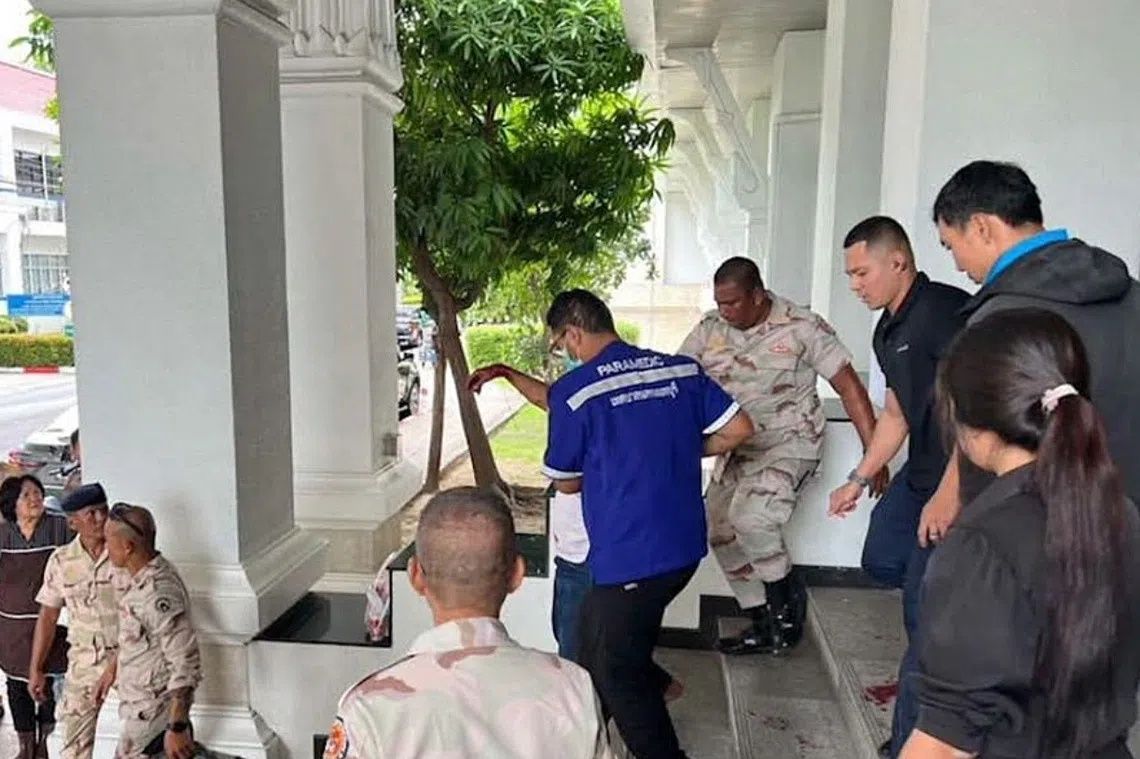
Thailand's precarious security situation deteriorated further on Monday when an armed former legislator discharged weapons at a provincial government building on Bangkok's outskirts, wounding two officials and triggering immediate arrests. The incident occurred mere days after a catastrophic school shooting at Debsirin Nonthaburi School, where a teenager murdered nine people and left over twenty others injured in what stands as Thailand's deadliest mass shooting incident in nearly four years. The rapid succession of these violent episodes has intensified national concern about firearm accessibility and security protocols across the country.
According to Major General Dejrapee Kongdee, the provincial police commander, the attacker targeted a senior provincial official and his driver in the Monday assault. Both victims sustained injuries and received immediate medical treatment at nearby facilities. Police successfully apprehended the suspect at the scene, though authorities have not disclosed additional details about the circumstances surrounding the shooting or the suspect's motivations. The fact that the perpetrator held prior legislative experience adds another troubling dimension to Thailand's escalating gun violence problem.
Friday's tragedy at the school marked a particularly horrifying episode that has left Thais questioning security measures and regulatory frameworks governing firearm ownership. The fourteen-year-old shooter first killed his grandparents before arriving at the educational facility and opening fire on students and staff. The rampage concluded when the teenager turned the weapon on himself, ending the assault but leaving the nation traumatised. The incident represents a watershed moment in Thai public discourse, forcing policymakers and civil society to confront uncomfortable truths about gun proliferation and inadequate safeguards against misuse.
In response to the escalating violence, Prime Minister Anutin Charnvirakul has signalled firm resolve to implement stricter firearms regulations and tighter control mechanisms. Such measures have become politically and socially unavoidable as the government faces mounting public pressure to prevent further tragedies. The administration recognises that inaction would undermine public confidence in state institutions and invite accusations of negligence. Anutin's commitment to gun control reform reflects acknowledgment that Thailand's current regulatory environment permits dangerous individuals to access lethal weapons with insufficient scrutiny.
Schools across the country resumed operations on Monday following Friday's devastating attack, though administrators implemented enhanced security procedures to reassure parents and provide psychological protection for returning students. Metal detector installations at entrances, visitor screening protocols, and increased police presence became visible reminders of the new reality facing Thai educational institutions. These measures underscore how school shootings fundamentally alter daily routines and create lasting psychological impacts that extend far beyond immediate casualties. Children now enter classrooms through security checkpoints previously reserved for airports or government buildings, a stark indication of shifting threat perceptions.
The concentration of both incidents in Nonthaburi Province, located in the Bangkok metropolitan area, raises critical questions about regional security vulnerabilities and law enforcement capacity. Two major shooting incidents within days suggests either systemic failures in threat detection or inadequate preventative mechanisms. Provincial authorities must now contend with heightened public scrutiny and expectations for tangible improvements in public safety infrastructure. The geographic proximity of both tragedies amplifies community trauma and erodes confidence in local security institutions' ability to protect residents.
For regional observers, Thailand's violence spree highlights broader Southeast Asian concerns regarding firearm regulation and mental health support systems. While Malaysia and other neighbouring nations maintain stricter gun control frameworks, Thailand's comparatively permissive approach has enabled individuals with questionable judgment to acquire weapons. The contrast underscores how regulatory choices directly correlate with mass casualty incidents and public safety outcomes. Malaysian policymakers monitoring developments across the region can point to Thai events as cautionary case studies demonstrating why stringent firearms regulation remains essential for maintaining public order.
The involvement of a former lawmaker in Monday's shooting adds political dimensions to Thailand's unfolding crisis. Legislative experience traditionally confers social standing and potentially easier access to bureaucratic processes, including weapons procurement. This detail suggests that professional status and political connections may have facilitated the suspect's acquisition of firearms, raising uncomfortable questions about whether elites receive preferential treatment in licensing procedures. Such concerns could fuel public scepticism regarding whether gun control reforms will equally constrain all social strata or merely impose restrictions on ordinary citizens while leaving influential figures relatively unimpeded.
Thailand now faces a critical juncture where policymakers must translate public outrage into concrete legislative action while simultaneously addressing deeper societal issues driving individuals toward violence. Mental health services require substantial expansion, community intervention programmes need development, and firearm licensing procedures demand comprehensive overhaul. The government's credibility depends on demonstrating that recent tragedies catalyse genuine systemic change rather than superficial responses designed to appease public sentiment temporarily. Prime Minister Anutin's stated intentions will ultimately be measured against implementable results that measurably reduce access to weapons among high-risk individuals.
The timing of these incidents during early school term creates additional complications for educational administrators already managing pandemic-related disruptions and returning to normalcy. Security enhancements impose burdens on already-stretched budgets and divert resources from pedagogical priorities toward protective infrastructure. Teachers must balance creating reassuring classroom environments with explaining security procedures to younger students still processing collective trauma. The psychological toll extends throughout school communities, affecting not merely direct victims but entire cohorts of children now associating educational facilities with danger rather than intellectual development and social belonging.

