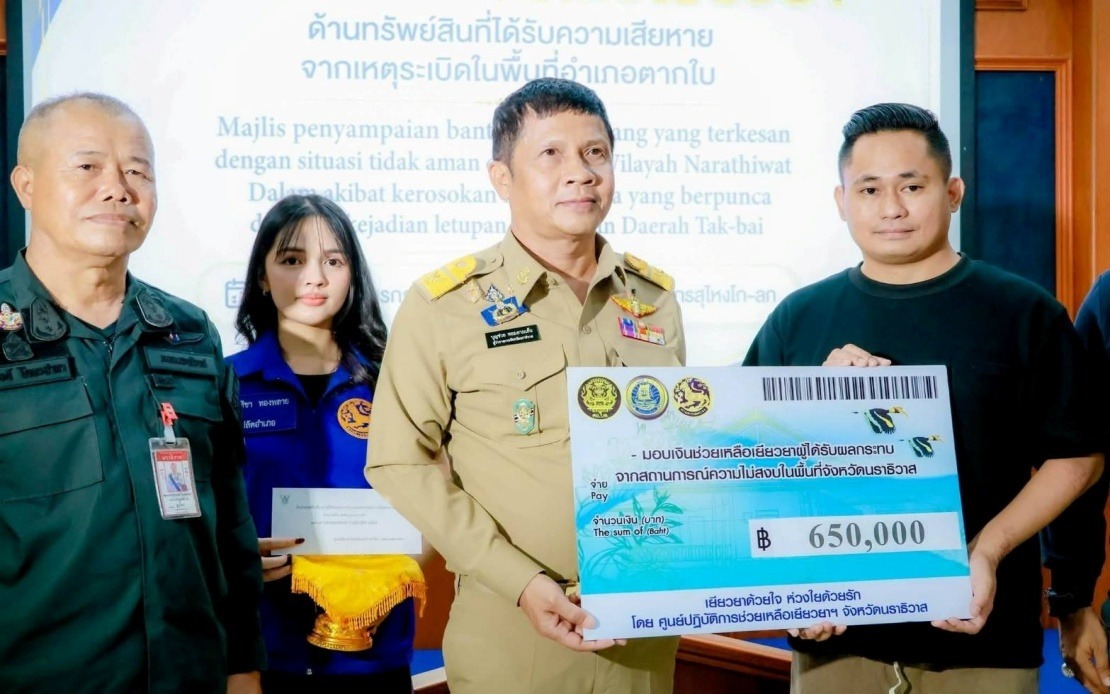
Thailand's provincial government has moved swiftly to provide financial redress to Malaysian citizens caught in a bombing incident in its southern border region, underlining Bangkok's commitment to bilateral relations and regional stability. The Narathiwat provincial administration presented compensation of 650,000 baht—equivalent to approximately RM80,000—to Muhammad Yusri Udin, one of two Malaysian nationals injured when an improvised explosive device detonated on June 29 in Tak Bai district. The compensation handover ceremony took place at the Sungai Golok Customs Office, a symbolic location that emphasizes the cross-border dimensions of the incident and its implications for Malaysian-Thai cooperation.
The bombing occurred on a Friday morning at approximately 11:40 am local time near the Sapom junction, when a homemade explosive device concealed within a roadside drainage channel suddenly detonated. Muhammad Yusri, aged 38, sustained injuries in the blast alongside Abdullah Syarapi Abd Rahman, 45, both of whom were in the vicinity when the attack unfolded. Thai authorities conducting preliminary investigations determined that the two Malaysians were not deliberately targeted, suggesting the attack was aimed at other individuals or represented a wider campaign of insurgent violence. A 40-year-old individual was subsequently detained in connection with the incident, though Thai security forces have indicated the bombing bears the hallmarks of rebel group operations active in Thailand's restive southern provinces.
Narathiwat Governor Boonchuay Homyamyen articulated Thailand's official position regarding the attack during Friday's ceremony, emphasizing that the incident runs counter to the kingdom's broader security priorities and economic interests. Boonchuay conveyed formal regret on behalf of the Thai government, acknowledging the trauma and suffering inflicted upon the Malaysian victims. Rather than treating the bombing as an isolated incident, the governor framed Thai responses within the context of comprehensive, sustained efforts to stabilize the region and maintain the security environment that underpins cross-border commerce and tourism flows essential to both nations' economic development.
The compensation mechanism through which the funds were disbursed reflects Thailand's institutional preparedness for managing incidents involving foreign nationals. The Thai government operates a dedicated victim assistance fund designed to address injuries and property destruction resulting from security-related violence. This formalized approach enables rapid response and demonstrates that Bangkok maintains dedicated financial resources to manage the fallout from insurgent activity. For Malaysian readers accustomed to viewing southern Thailand as a tourism and trade destination, the existence of such mechanisms may provide some reassurance, even as the incident itself raises questions about the actual effectiveness of security measures in preventing attacks.
Governor Boonchuay's public assurances extended beyond the immediate compensation to broader commitments regarding future security posture and tourism recovery. He stated unequivocally that Thai authorities would not remain passive, positioning the government as proactively engaged in identifying vulnerabilities and implementing protective measures. The governor's rhetoric emphasized continuity and determination, signalling that Thailand views the incident not as a setback warranting defensive withdrawal but as a challenge requiring intensified effort. Significantly, Boonchuay explicitly mentioned the restoration of tourist confidence, acknowledging the economic consequences that security incidents produce for the broader regional tourism ecosystem upon which Thailand depends heavily.
The timing and nature of the blast in Tak Bai carries particular significance for Malaysia and the broader Southeast Asian region. Tak Bai sits within Thailand's southern border zone, a region where Malaysian citizens frequently traverse for business, tourism, and cross-border trade. The incident demonstrates that even ordinary travelers and business people moving through seemingly routine border activities face genuine security risks stemming from the ongoing insurgency affecting Thailand's southernmost provinces. For Malaysian authorities and citizens, the bombing underscores the importance of maintaining situational awareness when conducting activities in adjoining Thai territories, where decades-old separatist movements continue to generate sporadic violence.
The investigative response mounted by Thai security forces reflects the scale of concern the incident generated. Beyond detaining a primary suspect, Thai authorities conducted explosive ordnance disposal operations at the scene and undertook forensic examinations designed to establish the precise nature of the device, its construction methodology, and potential connections to known militant networks. This multi-layered investigative approach indicates that Thai security agencies treat the bombing as part of a broader intelligence picture rather than an anomalous event. For Malaysian readers seeking to understand the security environment in adjacent Thai territories, such responses reveal that Thailand possesses institutional capacity to investigate and pursue leads, though the persistence of such attacks suggests that prevention remains an ongoing challenge.
The broader context of insurgent activity in Thailand's deep south has remained remarkably consistent over the past two decades. Multiple armed groups have conducted bombing campaigns, armed assaults, and other violent operations targeting military installations, government facilities, civilian marketplaces, and infrastructure. The June 29 incident in Tak Bai fits within this established pattern, though its location in a border area frequented by Malaysian visitors and traders adds a transnational dimension that elevates diplomatic significance. Thailand's decision to provide compensation rapidly and publicly demonstrates understanding that incidents affecting foreign nationals require prompt, visible governmental response to maintain diplomatic relationships and economic confidence.
For Malaysian travelers and businesses operating in southern Thailand, the incident reinforces the need for heightened vigilance and careful route planning. The Malaysian government regularly issues travel advisories regarding certain Thai provinces, and the Tak Bai bombing provides empirical evidence supporting such cautions. While individual risk remains relatively low given the vast numbers of Malaysians who transit through Thai border regions annually without incident, the attack demonstrates that security threats in this zone remain real and unpredictable. The coordination evident in Thailand's compensation and public response suggests bilateral mechanisms for managing such incidents are functional, though prevention remains the paramount concern.
Thailand's commitment to strengthening security measures, as articulated by Governor Boonchuay, likely encompasses enhanced intelligence gathering, increased checkpoint vigilance, and improved coordination among border security agencies. The involvement of the customs office in the compensation ceremony suggests that Malaysian and Thai authorities have established communication channels through which such incidents can be managed cooperatively. Looking forward, the success of Thai security efforts in reducing insurgent violence will substantially influence regional confidence and the continued vitality of cross-border economic and social linkages that both nations depend upon. The compensation provided to Muhammad Yusri represents not merely financial redress but a statement of Thai commitment to managing security challenges in ways that preserve bilateral relationships and demonstrate respect for affected foreign citizens.

