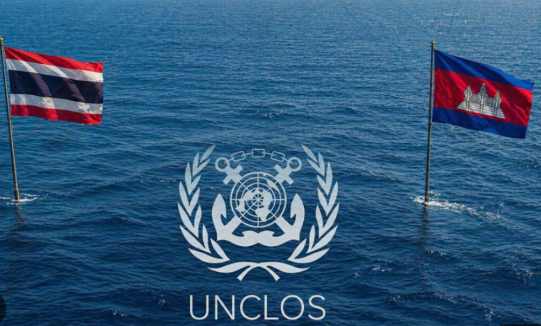
Thailand has taken a significant diplomatic step by formally accepting Cambodia's request to enter compulsory conciliation proceedings under the United Nations Convention on the Law of the Sea, though Bangkok has been careful to frame the process as merely advisory rather than adjudicatory. The Thai Ministry of Foreign Affairs submitted its formal response on June 19, following Cambodia's notification transmitted on June 2, marking a formal acknowledgement of the dispute mechanism while maintaining Thailand's preferred approach of keeping the matter within bilateral channels rather than subjecting it to potentially enforceable international arbitration.
The conciliation framework represents a middle ground between unilateral negotiation and binding international litigation. Thai officials have been explicit that this process differs fundamentally from a court case, emphasising that any resulting report will contain only recommendations rather than binding legal determinations. This distinction carries practical weight in the Southeast Asian context, where maritime disputes involving resources and sovereignty have frequently inflamed regional tensions. By accepting conciliation rather than pursuing litigation before an international tribunal, Thailand preserves flexibility in responding to the conciliators' findings without being obligated to implement their conclusions.
Deputy Prime Minister and Foreign Minister Sihasak Phuangketkeow has been appointed as Thailand's Agent in the proceedings, a position that reflects the gravity with which Bangkok views the matter despite its public minimisation of the process's formal significance. Accompanying him as Deputy Agent is Songchai Chaipatiyut, Thailand's ambassador to Kuwait and a former senior official specialising in treaty law and international legal affairs. These appointments signal that Thailand intends to present substantive arguments rather than treating the conciliation as a formality, even as Bangkok maintains that the ultimate resolution must emerge through direct bilateral negotiation.
Thailand has selected two internationally recognised law of the sea experts as its conciliators: Judge Albert J Hoffmann of South Africa and Judge Rudiger Wolfrum of Germany. Both possess extensive credentials in maritime law and international legal proceedings, reflecting Thailand's strategy of presenting serious technical and legal arguments while simultaneously framing the exercise as exploratory rather than determinative. The selection of respected international jurists adds legitimacy to Thailand's position and ensures that any recommendations will carry weight in subsequent negotiations, even if they are technically non-binding.
The conciliation structure itself follows established Unclos procedures. The four conciliators appointed by Thailand and Cambodia jointly will select a fifth member to chair the commission within thirty days of Thailand's formal response. This commission will then undertake its substantive work, expected to conclude within approximately twelve months unless both parties mutually agree to an extension. The timeline reflects the recognition that maritime boundary disputes, particularly those involving resource-rich areas, require careful examination of historical claims, geographical evidence, and international legal precedent.
Thailand's strategic emphasis on the non-binding nature of the process reflects deeper concerns about the scope of conciliation. While accepting the mechanism, Bangkok has insisted that proceedings should address solely maritime delimitation under Unclos rather than the broader framework that Cambodia appears to envision. Cambodia's initial notification reportedly encompassed not only boundary delineation but also provisional arrangements for joint development and equitable resource sharing—precisely the dimensions that Thailand wishes to keep separate or subordinate to bilateral discussion. This apparent disagreement over the conciliation's scope reveals fundamental tensions in how each country views the dispute's proper resolution.
The underlying cause of friction is the Gulf of Thailand itself, an area believed to contain substantial natural gas reserves and other hydrocarbon resources that make maritime boundary definition economically significant. For decades, both countries have maintained overlapping maritime claims to the continental shelf, a situation that prevents either nation from fully exploiting potential energy resources and creates legal ambiguity regarding fishing rights and navigation. The resource dimension adds urgency to boundary settlement while simultaneously making negotiation more complex, as resource-sharing arrangements become entangled with purely legal questions of where international boundaries should lie.
Thailand's May decision to terminate the 2001 memorandum of understanding with Cambodia—formally designated as MoU 44 in Thai government documentation—precipitated the current conciliation request. Prime Minister Anutin Charnvirakul characterised the cancellation as reflecting the framework's failure to produce progress over twenty-five years rather than as a hostile act, framing the termination as a necessary adjustment to cooperation mechanisms. Thai officials have stated that the cancellation does not signal an intent to abandon negotiations but rather to reset the terms under which maritime discussions will proceed, with Unclos provisions serving as the common reference point for future talks.
Thailand's position reflects a careful calculation about the utility of formal international processes in resolving maritime disputes. By accepting conciliation, Bangkok demonstrates commitment to peaceful, rule-based approaches that will satisfy international observers and regional partners concerned about maritime stability in Southeast Asia. Simultaneously, by insisting on the non-binding character of any outcome and on the primacy of bilateral negotiation, Thailand retains decision-making authority and avoids scenarios where conciliators might produce recommendations that conflict with Thai strategic interests or historical claims. This approach mirrors patterns seen elsewhere in Southeast Asia, where countries have accepted international dispute mechanisms while attempting to limit their binding effect.
For Malaysia and other Southeast Asian nations observing the Thailand-Cambodia dispute, the case illustrates both the opportunities and limitations of international law in resolving resource-based maritime disagreements. The Unclos framework provides procedures and neutral forums for addressing boundary questions, yet the convention's non-binding conciliation mechanism permits countries to participate in good faith while maintaining ultimate control over outcomes. Thailand's strategy suggests that as long as maritime disputes involve resources and national interests, even internationally-minded governments will prefer advisory processes that preserve negotiating flexibility to binding arbitration that risks unfavourable determinations.
The conciliation commission's work will unfold against a background of competing national interests and resource ambitions. While both Thailand and Cambodia have nominally accepted international legal procedures, their differing interpretations of conciliation's proper scope and the binding effect of its recommendations suggest significant disagreements remain about how maritime boundaries should be drawn and how hydrocarbon resources should be shared. The coming months will reveal whether the conciliation process succeeds in narrowing these differences or merely provides a framework for documenting positions that subsequent bilateral negotiations will need to reconcile through political compromise.

