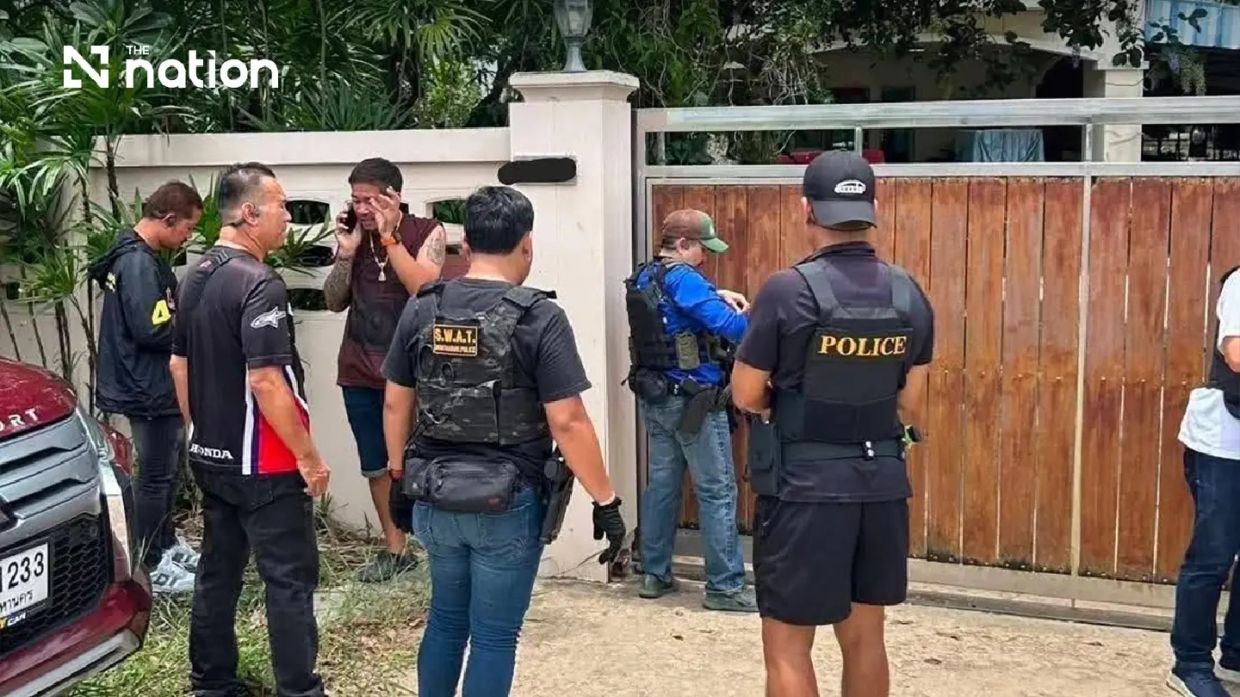
A secondary school student in Thailand's Nonthaburi province killed both his grandparents at their residential home before proceeding to conduct a shooting spree at Debsirin Nonthaburi School on Friday morning, August 7, according to police investigations. The dual-location violence left a total of seven people dead, including the suspected shooter, with 15 others receiving treatment for injuries sustained during the school attack. The sequence of events reveals a deeply troubling pattern of escalating violence that has prompted authorities to launch a comprehensive inquiry into the circumstances surrounding the attack.
The identified suspect was a Mathayom 2 (Grade 8) student who resided with his paternal grandparents in a residential estate located on Soi Wat Lat Pla Duk in Bang Khu Rat subdistrict, Bang Bua Thong district. When officers conducted a search of the family residence following the school incident, they discovered that both elderly relatives had been deceased before the school shooting took place. Police forensic teams determined that the grandparents were killed using the same firearm that was subsequently deployed in the school attack, suggesting a methodical escalation rather than a spontaneous act of violence.
The weapon used in both incidents has been identified as a CZ 9mm handgun that was officially registered to the student's grandfather, raising significant questions about firearms security and access controls within the household. This detail has become central to the investigation, as authorities grapple with understanding how a juvenile gained possession of and operated a registered firearm without apparent intervention or safeguards. The presence of a legally registered weapon in the home has shifted focus onto broader questions of gun storage protocols, parental oversight, and the adequacy of existing safeguards designed to prevent minors from accessing lethal weapons.
Pol Lt Gen Trairong Phiwphan, spokesman for the Royal Thai Police, confirmed that officers successfully contained the situation at the school and brought an end to the violence, though he acknowledged that investigators have not yet determined the underlying motive. The police leadership emphasised that establishing a coherent narrative of causation would require extensive examination of the suspect's behavioural patterns, his immediate social environment, and his personal circumstances preceding the incident. This acknowledgment reflects the complexity inherent in comprehending how a secondary school student came to commit such an act, and the difficulty authorities face in retrospectively constructing meaningful explanations for violence among the young.
A crucial investigative priority centres on the mechanics of how the juvenile obtained access to the grandfather's firearm and secured ammunition for the weapon. Police have confirmed that the handgun was properly registered as belonging to the grandfather, but they remain in the early stages of reconstructing the precise sequence through which the student removed the weapon from its storage location, how it had been secured or stored within the home, and the source of the ammunition used in both shooting locations. These procedural questions are fundamental to understanding potential negligence or failure in household gun safety protocols that may have contributed to the tragedy.
National police chief Pol Gen Kitrat Phanphet directed officers to conduct thorough forensic examination of the school grounds, with particular emphasis on evidence collection and detailed scene mapping. Beyond the immediate investigative work, Phanphet issued specific instructions for the Police General Hospital's chief medical officer to deploy teams of psychologists and mental health specialists to the affected area. This intervention reflects growing recognition within Thai law enforcement of the necessity to address psychological trauma in the aftermath of mass violence, particularly among younger witnesses and survivors who may experience long-term psychological consequences.
The deployment of mental health professionals represents a deliberate institutional response designed to provide immediate emotional support to teachers, students, and others exposed to the school violence, with the stated objective of helping affected individuals process their experiences and mitigating potential chronic psychological sequelae. This approach acknowledges that trauma from mass violence extends far beyond the immediate physical injuries and casualties, affecting entire school communities and requiring sustained professional intervention to facilitate psychological recovery and resilience building among traumatised populations.
The incident has reignited concerns across Southeast Asia regarding the accessibility of firearms to minors and the adequacy of existing regulatory frameworks governing weapon storage in households where children reside. Thailand's experience with school violence, though less frequent than in some neighbouring jurisdictions, demonstrates that the region remains vulnerable to episodes of mass shooting, particularly when firearms registration and storage protocols fail to prevent juvenile access. The case raises pressing questions about whether current regulations sufficiently mandate secure storage measures or require regular oversight mechanisms to verify compliance with safety standards.
For Malaysian observers, the Nonthaburi incident provides sobering context regarding the potential consequences of inadequate firearm security in households containing minors, even within countries where civilian gun ownership is theoretically regulated. The incident underscores the critical importance of household-level responsibility in maintaining physical barriers and access controls preventing minors from obtaining weapons, regardless of formal licensing or registration requirements at the state level. The tragedy serves as a cautionary reminder that regulatory regimes operating at the macro level may prove ineffective if individual households fail to implement robust security measures.

