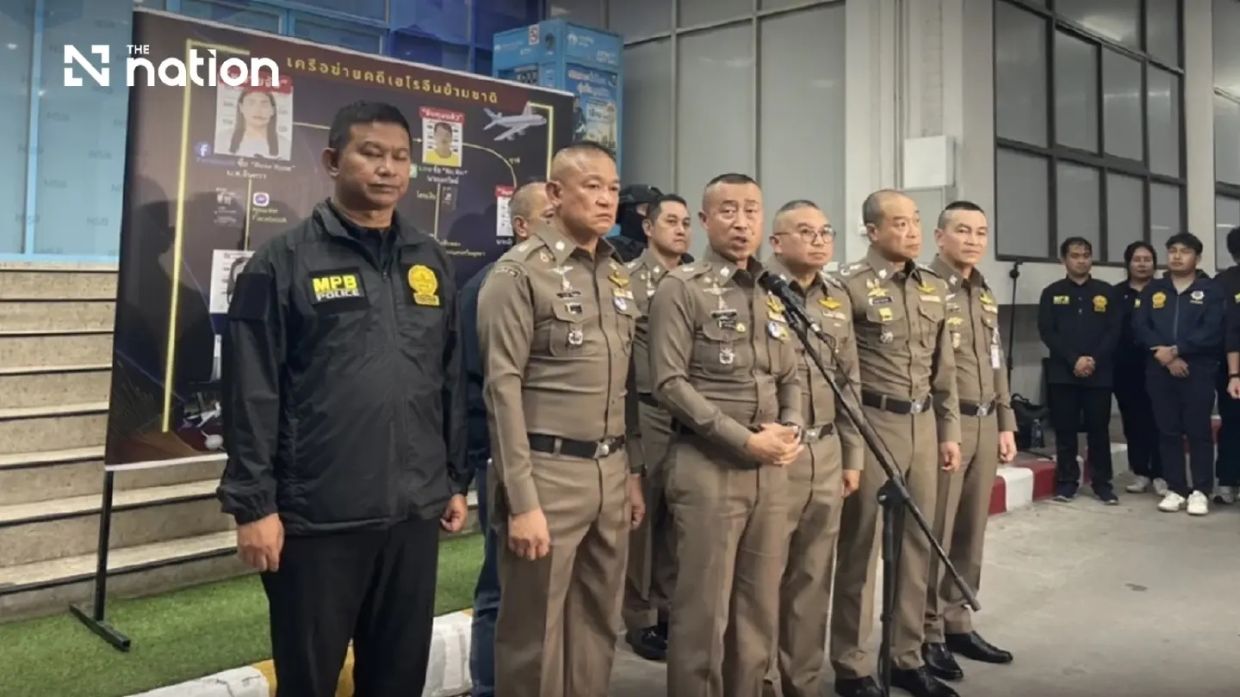
Thai authorities have escalated their pursuit of a woman identified as Chantra, who operates under the online alias 'RoseRose', following her alleged role as the mastermind behind an international heroin trafficking operation. Deputy National Police Chief Pol Gen Samran Nualma announced that an arrest warrant has been issued against Chantra, who is believed to have fled Thailand through an informal border crossing after becoming aware that investigators were tightening their net around the smuggling network. Police suspect she has crossed into a neighbouring country, with provincial officers from Region 5 conducting searches of her residence and coordinating pursuit efforts across the region.
The investigation has revealed a remarkably organised operation that exploited conventional travel channels to move drugs across borders. According to police findings, the network utilised elephant-print bags as containers for heroin, with Chantra allegedly orchestrating recruitment of unwitting or complicit couriers through Facebook groups dedicated to people offering goods transport services. In a particularly brazen move, the ring allegedly recruited a commercial air hostess to carry one of these specially prepared bags to Australia, demonstrating the network's willingness to exploit the professional privileges of airline crew members to bypass customs scrutiny.
Central to the investigation is Ekkawit, who police believe operated the encrypted Line messaging account 'Rin Rin' and served as the operational intermediary connecting various elements of the smuggling chain. Following questioning late on Friday, 10 July, authorities obtained confessions from Ekkawit that corroborated evidence verified directly with Line Thailand, establishing his control of the 'Rin Rin' account. According to police records, Ekkawit revealed that he received direct instructions from Chantra through the 'RoseRose' account, making him a crucial link in establishing the command structure of the operation.
The operational mechanics of the network involved a coordinated supply chain that relied on division of labour across multiple jurisdictions. Ekkawit's responsibilities included purchasing elephant-print bags in Chiang Mai and delivering them to Chantra in her role as 'RoseRose'. These bags would subsequently be returned to him after heroin had been concealed inside them, at which point another operative identified as Uthai would collect the contraband items for final delivery. During his interrogation, Ekkawit disclosed that he had personally executed this procurement and courier function on three separate occasions, with the air hostess operation representing the first instance in which the network had attempted to utilise an international airline employee as a drug mule.
Chat records and digital communications among network members have provided investigators with compelling circumstantial evidence linking multiple individuals to the operation and revealing patterns consistent with an organised criminal enterprise rather than ad hoc smuggling attempts. Police have identified similar communication signatures and operational protocols across numerous exchanges, suggesting a mature network with established procedures and established routines. The investigators have not yet determined whether Chantra personally inserted the heroin into the bags or delegated this task to subordinates, though her central coordinating role in collecting prepared bags from Ekkawit appears well established through his testimony.
The recruitment strategy employed by the network demonstrates sophisticated understanding of social media vulnerabilities and human psychology. The 'RoseRose' account would engage with members of Facebook groups where individuals advertised willingness to transport goods across borders, then advance to private messaging those who demonstrated interest in courier opportunities. This targeted approach allowed the network to identify potential carriers without establishing direct connections traceable to the mastermind. Notably, police have not yet reached definitive conclusions about the air hostess's state of knowledge or intentions, acknowledging that she may have been deliberately deceived about the contents of the bag she carried.
Chantra's background and movements provide additional context for understanding the network's operational geography. Police intelligence indicates she is the elder sister of Ekkawit's sister-in-law, establishing a family connection within the network that may have facilitated her trust and recruitment into what appears to be a larger international trafficking organisation. Her pattern of frequent travel between Thailand and Laos has prompted police suspicion of deeper connections to transnational drug trafficking groups operating across the Mekong region, suggesting she may have served as a regional coordinator rather than a purely local operator.
The source of the heroin moving through this network appears firmly established in cross-border trafficking routes originating from neighbouring countries. Intelligence gathered during the investigation indicates that drugs entered Thailand through Phayao province, a region known for permeable borders and established smuggling corridors, and were supplied by criminal organisations based across international boundaries. Police have determined that this operation is distinct from another trafficking investigation conducted by the Office of the Narcotics Control Board, which resulted in the arrest of a married couple in Loei province, based partly on the consistent use of different geographic entry points and trafficking methodologies.
The investigation's momentum appears to have accelerated once authorities began examining financial flows and digital communications between network members. Pol Gen Samran noted that investigators have obtained substantial information about the network's alleged leadership structure and the specific routes used to import heroin into Thai territory, allowing them to map the operation comprehensively even as Chantra's escape limits their ability to apprehend the suspected ringleader. The investigation file is considered substantially complete by Thai authorities, though continuing interrogation of Ekkawit and examination of connections to other network participants remain ongoing.
Legal proceedings against Ekkawit were scheduled to advance rapidly following his detention, with Narcotics Suppression Bureau investigators planning to present him before the Criminal Court on Ratchadaphisek Road on 11 July to request formal approval for extended detention. Authorities signalled their intention to oppose any bail application, emphasising the gravity of the alleged offences and the necessity of maintaining Ekkawit in custody while investigation into broader network connections continued. This legal positioning reflects police confidence in their evidence against Ekkawit while acknowledging that the most significant suspect remains at large.
The international dimensions of this case position it within a broader context of transnational narcotics trafficking affecting Southeast Asia and extending to Australia. Thai authorities have indicated their readiness to provide cooperation with Australian law enforcement should officials in Canberra seek evidence or information relating to the air hostess's involvement, though Pol Gen Samran deliberately refrained from offering commentary on how Australian judicial authorities should proceed with their own investigation. This measured diplomatic stance acknowledges Australia's independent jurisdiction while maintaining channels for information sharing on a case that illustrates the sophisticated methods employed by modern drug trafficking networks to exploit legitimate travel and commercial infrastructure.

