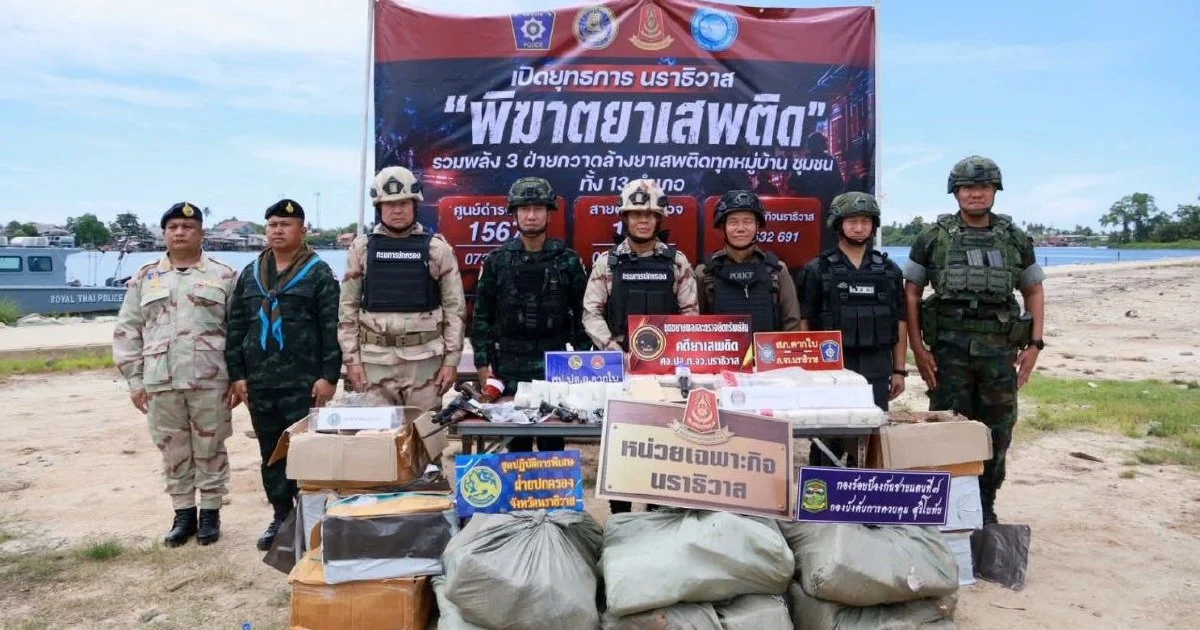
Thai law enforcement authorities have struck a substantial blow against organised drug trafficking in the southern border region, apprehending 233 individuals suspected of involvement in major narcotics operations during an intensive month-long campaign in Narathiwat province. The sweeping enforcement action has exposed troubling ties between Thai trafficking networks and their Malaysian counterparts, highlighting the transnational nature of the region's drug crisis and raising fresh concerns about porous borders and cross-boundary criminal collaboration.
The operation, which culminated in the seizure of contraband valued at RM1.2 million, represents one of the more significant takedowns in recent months. Investigators determined that multiple individuals among those arrested maintained operational connections with Malaysian-based traffickers, suggesting a coordinated smuggling infrastructure spanning both nations. Such networks typically exploit the permeable frontier between Thailand and Malaysia to move product in both directions, with some routes leveraging the shared maritime boundary and remote overland crossing points that have historically proven difficult for either nation to monitor comprehensively.
Narathiwat province, situated in Thailand's southernmost reaches and bordering Malaysia's Kelantan state, has long served as a critical nexus for drug trafficking activities. The geography of the region—characterised by dense forests, rivers, and countless uncontrolled crossing points—creates operational advantages for smugglers. Local communities in both nations have repeatedly warned their respective governments about the scale of contraband movement, yet sustained enforcement remains challenging given resource constraints and the sophistication of criminal networks that adapt quickly to police tactics.
The month-long crackdown reflects a coordinated Thai police initiative to dismantle trafficking infrastructure from multiple angles simultaneously. Rather than targeting isolated low-level dealers, the operation focused on syndicate leadership and mid-level organisers responsible for orchestrating large-scale distribution and supply networks. This approach demonstrates evolving Thai enforcement strategy, shifting away from traditional street-level raids toward dismantling the hierarchical structures that enable trafficking operations to function across borders.
The revelation of Malaysian criminal links carries particular significance for Malaysian authorities and policymakers. The fact that Thai investigators could identify and track connections to Malaysian traffickers suggests these networks operate with considerable openness and established communication channels. Such intelligence sharing between Thai and Malaysian law enforcement, when it occurs, provides invaluable operational insight. However, questions persist about whether sufficient mechanisms exist for real-time intelligence exchange and coordinated cross-border enforcement between the two countries' police forces.
Drug trafficking syndicates operating in the Thailand-Malaysia border region typically employ sophisticated money laundering techniques and utilise legitimate commerce as cover for narcotics shipments. The RM1.2 million in seized contraband represents only the visible portion of what investigators believe to be substantially larger operations. Trafficking networks maintain redundancy in their supply chains, meaning the loss of one shipment rarely cripples their overall functionality, though it certainly disrupts cash flow and creates logistical complications.
The scale of the arrests—233 individuals in a single operation—underscores the sheer manpower required to sustain large-scale trafficking networks. These organisations require foot soldiers for distribution, logistics specialists for transportation, financiers for money management, and lookouts and sentries scattered across multiple jurisdictions. The breadth of the apprehension suggests Thai authorities were methodical in their intelligence gathering, possibly relying on informant networks, telecommunications surveillance, and financial transaction analysis to map out syndicate structures before executing coordinated arrests.
For Malaysian authorities, this operation serves as a sobering reminder that drug trafficking remains a destabilising force requiring constant vigilance. Malaysia's status as a transit point for narcotics flowing toward Australian and other regional markets makes the nation vulnerable to becoming embroiled in larger international trafficking disputes. Criminal networks based in Malaysia sometimes facilitate Thai-origin drugs reaching Australian shores, creating transnational complications that extend far beyond the immediate bilateral relationship.
The successful Thai operation also highlights the importance of sustained, adequately resourced enforcement activity. Month-long crackdowns, while resource-intensive, generate the kind of disruption that forces trafficking organisations to adapt their operations and incur unexpected costs. However, sustainability remains problematic—once formal operations conclude, criminal networks typically re-establish themselves within weeks unless underlying conditions creating demand and opportunity are systematically addressed.
Both Thailand and Malaysia have articulated ambitious drug elimination targets in recent years, yet the persistence of trafficking suggests these goals remain distant. The border region's poverty, limited legitimate economic opportunity, and easy access to initial capital through drug trafficking create persistent incentives for criminal involvement. Unless development initiatives and alternative livelihood programmes are implemented alongside enforcement, the networks dismantled today will likely reconstitute themselves with different personnel but unchanged operational logic.
Moving forward, the Thai operation's effectiveness depends partly on whether Malaysian authorities can simultaneously move against the Malaysian-based traffickers identified through Thai investigation. Intelligence sharing protocols, where they exist, should facilitate such coordination. However, bureaucratic obstacles, jurisdictional sensitivities, and uneven capacity sometimes impede such cooperation. Regional intelligence bodies and ASEAN frameworks theoretically provide mechanisms for such coordination, though practical implementation often lags behind diplomatic agreements.
The arrest of 233 individuals and seizure of RM1.2 million in contraband represents meaningful progress in the asymmetrical struggle against transnational drug crime. Yet observers familiar with regional trafficking patterns suggest this operation, significant as it is, likely addresses only one node within a much larger and constantly evolving criminal ecosystem. Sustained pressure, institutional reform, and genuine international cooperation will determine whether such enforcement gains produce lasting disruption or merely temporary inconvenience to networks with the resources and organisational sophistication to absorb periodic setbacks.

