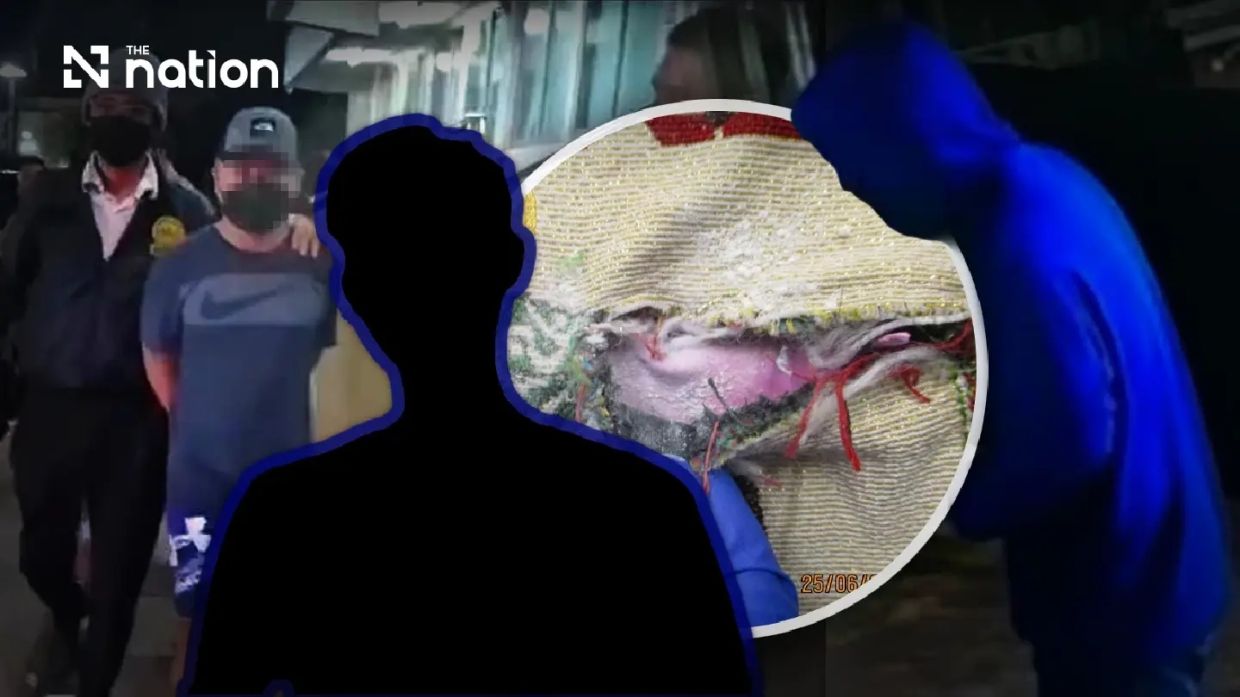
Thai law enforcement has made a significant breakthrough in dismantling an international drug smuggling syndicate, arresting a key intermediary accused of facilitating the movement of heroin destined for Australia. Metropolitan Police Bureau deputy commissioner Pol Maj Gen Theeradej Thamsuthee announced that officers apprehended the suspect, identified as Ekkawit, in Thailand's northern Phayao province during an overnight operation that marks an important escalation in investigators' understanding of the network's structure and operations.
The case centres on heroin concealed within an elephant-print fabric bag that authorities intercepted before it could reach Australian shores. According to police allegations, Ekkawit functioned as a critical logistical operator within the smuggling apparatus, occupying a position between higher-level organisers and street-level operatives. Investigators contend that Ekkawit personally delivered the contraband to another suspect named Uthai, who subsequently transferred the bag to a female flight attendant for transportation to Australia. This three-tier arrangement demonstrates the compartmentalisation common in sophisticated trafficking networks, where limited knowledge of the overall operation insulates participants from exposure.
Digital forensics have proven instrumental in mapping the conspiracy. Police traced communications using the encrypted chat identifier "Rin Rin" to coordinate with Uthai and arrange collection of the elephant-print bag from Chiang Kham district. During preliminary interrogation, Ekkawit acknowledged his role and disclosed that he received THB100,000 in compensation for each delivery. More troublingly for investigators, he admitted executing this task on two or three previous occasions, suggesting the operation had functioned repeatedly before authorities intervened. This admission points to an established pipeline rather than an isolated trafficking attempt.
The investigative trail extends into the provincial network that orchestrated the scheme. Ekkawit revealed that he maintained contact with another operative using the chat handle "Rose Rose," who allegedly sourced the physical bags and arranged for heroin concealment. The relationship between these individuals appears personal as well as professional—subsequent investigation established that Ekkawit and the Rose Rose user are blood relatives, both originating from Phayao province. Photographic evidence presented by police shows them travelling together, strengthening the assessment that family connections facilitated the operation's functioning and provided a layer of trust essential for handling large drug quantities.
The operational choreography that police have reconstructed reveals a systematic approach to moving drugs while minimising individual exposure. Ekkawit would purchase an elephant-print bag in Chiang Mai, then notify Rose Rose of acquisition. He would subsequently deposit the bag at an agreed kilometre marker, whereupon an associate would retrieve it and arrange for heroin concealment, which Ekkawit claims occurred in Laos. After a one or two-day interval allowing for the drug to be hidden, Rose Rose would orchestrate the return leg—leaving the loaded bag alongside THB100,000 at a kilometre marker for Ekkawit to collect. This handoff protocol prevented individual participants from maintaining custody of illegal materials for extended periods, reducing vulnerability to detection.
The mechanics of compensation within the network further illustrate its organisation. Ekkawit received his THB100,000 payment directly, while subsequent payments to Uthai totalled THB60,000, delivered through automated cash deposit machines to obscure the money trail. This tiered compensation structure—with higher payments for more central roles—aligns with established patterns in transnational trafficking organisations, where risk premium increases with proximity to contraband. The use of automated banking services rather than direct transfers constitutes an effort to frustrate law enforcement financial tracking, though clearly with limited success.
Investigators have determined that Rose Rose functioned as a coordinator and recruiter rather than the network's apex decision-maker. Police believe this person maintained contact with multiple couriers, utilising encrypted chat platforms to issue instructions and identify suitable candidates for recruitment. The person using the Rose Rose identity specifically approached flight attendant Mina, offering compensation in exchange for carrying the bag through airport security. The targeting of airline staff suggests the network deliberately pursued individuals with legitimate travel credentials and reduced scrutiny, a tactic common in international drug organisations seeking to exploit systemic vulnerabilities in aviation security protocols.
Law enforcement agencies have accumulated substantial intelligence regarding the Rose Rose operator despite account anonymity, indicating sophisticated digital forensics capabilities. However, narcotics police assess that Rose Rose represents an intermediate level within the conspiracy rather than its leadership. Investigators believe a more senior organiser remains unidentified, someone who likely makes strategic decisions regarding shipment timing, route selection, and target markets. This assessment suggests the network extends beyond current arrests and that systematic dismantling will require identifying and apprehending higher-tier members whose involvement remains obscured.
Uthai, arrested earlier in the investigation, presented himself as a minor player during initial questioning, claiming involvement in only five or six courier operations. Police rejected this characterisation as implausible and potentially rehearsed. Investigators noted that Uthai rented accommodation in Phra Nakhon Si Ayutthaya province for at least five or six months, a duration suggesting far more frequent involvement than he acknowledged. The discrepancy between his testimony and observable behaviour patterns indicates coordinated deception, with multiple network members apparently receiving instructions to minimise their admitted participation.
The case carries significant implications for Southeast Asian narcotics enforcement. Thailand has emerged as a critical transit point for heroin originating from the Golden Triangle and destined for markets in Australia and beyond. The sophistication demonstrated by this particular network—utilising encrypted communications, dispersed geographic locations, compartmentalised responsibilities, and diverse participant backgrounds—reflects evolution in trafficking methodology. Rather than traditional hierarchical organisations, modern syndicates employ flexible, cell-based structures that facilitate rapid adaptation to enforcement pressure. The family connections evident in this investigation suggest that kinship networks provide trusted recruitment pools for criminal enterprises seeking reliable associates.
The investigation continues to expand, with authorities prioritising the arrest of remaining network members. Ekkawit was transported to Phayao for site identification before transfer to the Narcotics Suppression Bureau, where deputy national police chief Pol Gen Samran Nuanma planned personal interrogation. The systematic questioning and location verification suggests investigators are pursuing a comprehensive mapping strategy intended to identify additional participants, suppliers, and destination contacts. Success in identifying the Rose Rose operator and the presumed network leader would represent a meaningful disruption to trafficking capabilities, though authorities acknowledge that broader supply chain dynamics—including the availability of precursors and established demand in Australian markets—will necessitate sustained enforcement efforts across the region.

