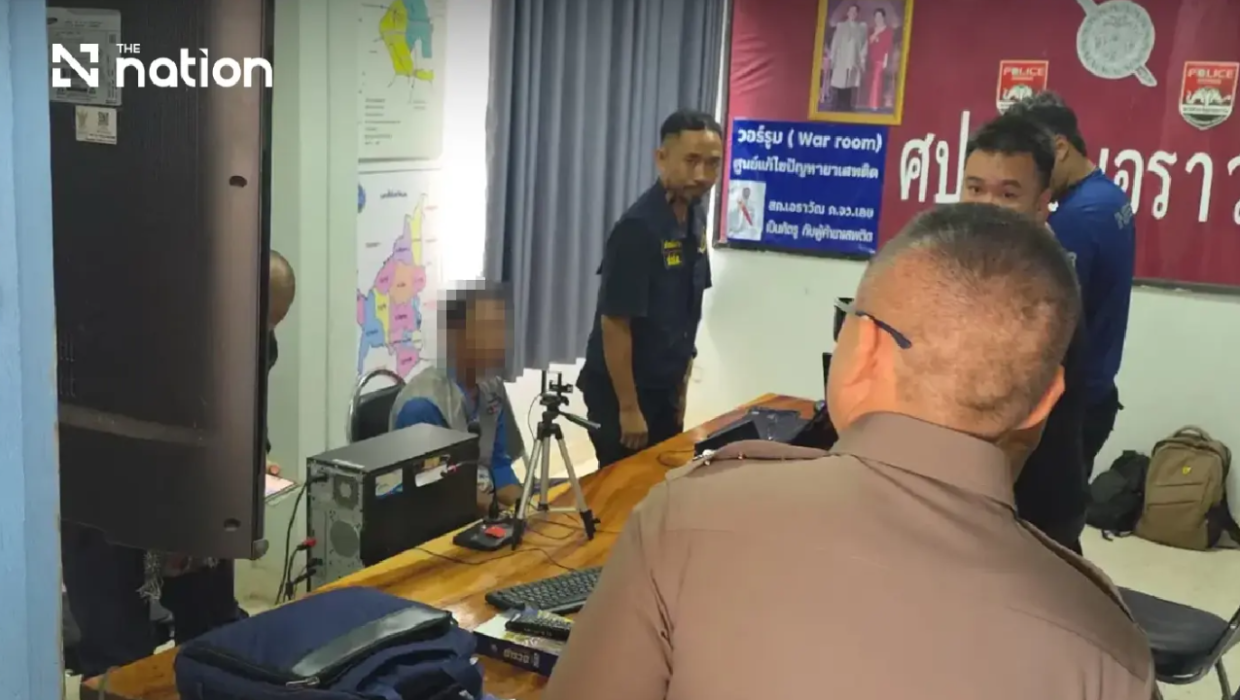
Thai police have arrested a married couple in northeastern Loei province as narcotics authorities broaden their investigation into what appears to be a sophisticated transnational smuggling operation. The case began with the detention of a Thai Airways flight attendant identified in reports as Mina at Melbourne Airport, where Australian authorities alleged she carried approximately one kilogram of heroin concealed in her baggage. Thai investigators, building on this discovery, have traced the supply chain backwards to identify persons within Thailand allegedly responsible for dispatching the contraband.
The two suspects detained are Athit, 43, and his wife Thatsaphon, 42, who were apprehended following coordinated efforts by officers from Chiang Khan Police Station, the Office of the Narcotics Control Board (ONCB), and related law-enforcement agencies. Initial efforts to locate the couple at their registered address in That subdistrict of Chiang Khan district proved unsuccessful. Police subsequently learned that both were engaged in rubber tapping work in Erawan district, leading officers to expand their search across the rural landscape of Loei province.
Athit was ultimately discovered working on temple construction at Wat Tham Pha Mak Ho in Wang Saphung district, where authorities apprehended him and transported him to Erawan Police Station for interrogation. During preliminary questioning, Athit reportedly admitted to involvement in a parcel-delivery scheme spanning multiple months. According to police records, he claimed to have been compensated for dispatching six separate packages to Bangkok, with three sent through a commercial parcel service operating in Chiang Khan town and two additional shipments originating from Ban That in That subdistrict, plus another from Erawan district. The suspect allegedly received 8,000 baht—approximately US$240—per delivery from an individual identified as a Lao national, with the most recent transaction allegedly occurring on 28 June 2026.
Thatsaphon was detained hours later after authorities discovered her vehicle, a black Mitsubishi Triton pickup truck bearing Loei registration plates, parked in an isolated rubber plantation within Pha In Plaeng subdistrict of Erawan district. Upon questioning at Erawan Police Station, she categorically denied knowledge of or participation in any narcotic activities, according to police statements. Both suspects now face interrogation by ONCB investigators, who are pursuing a broader inquiry designed to identify individuals at all operational levels—those who organised the scheme, provided financing, or facilitated logistics.
The case illuminates the sophisticated operational methods employed by transnational narcotics networks operating across Southeast Asia. Rather than relying on a single courier, such organisations fragment the smuggling process across multiple participants positioned at different nodes of the supply chain, thereby reducing individual exposure while increasing plausible deniability. This compartmentalisation strategy has proven effective in evading law-enforcement detection, particularly when operations span multiple jurisdictions and involve citizens of different nations. The involvement of a Lao national in allegedly supervising the parcel dispatches underscores how regional drug networks exploit porous borders and cross-border employment patterns common throughout the Mekong region.
According to ONCB Secretary-General statements, the successful identification of domestic links stemmed directly from international law-enforcement cooperation, particularly intelligence sharing between Thai and Australian authorities. The Melbourne Airport interception provided the critical entry point enabling Thai investigators to work backwards through the supply chain. This cooperative approach, increasingly common in Southeast Asian drug enforcement, demonstrates how modern trafficking operations necessitate coordinated regional responses. Isolated national efforts, regardless of resource allocation, prove insufficient against networks deliberately engineered to operate across multiple countries and exploit jurisdictional gaps.
The investigation represents a significant development in Thailand's ongoing struggle against methamphetamine and heroin trafficking, which predominantly transits through the Golden Triangle region before reaching markets across Southeast Asia and beyond. While precise quantities seized in this particular case remain under investigation, the methodical parcel-delivery system uncovered suggests a well-established pipeline rather than opportunistic smuggling. The financial compensation structure—8,000 baht per parcel—indicates a sustainable operation with sufficient profit margins to compensate multiple intermediaries while maintaining market competitiveness relative to alternative trafficking routes.
ONCB officials have committed to intensifying investigations aimed at dismantling the network's upper echelons, including those who orchestrated the smuggling scheme and managed its finances. Authorities acknowledge that the couple arrested likely represent relatively low-level operatives within a larger criminal hierarchy. The broader strategic imperative involves identifying financial channels, supply sources in Thailand, and overseas distribution networks. This multi-dimensional approach reflects evolving understanding that successfully combating trafficking requires disrupting supply, disrupting distribution infrastructure, and disrupting the financial flows that sustain operations across borders.
Looking forward, Thai authorities have signalled enhanced cooperation protocols with international counterparts to intercept narcotics shipments, disrupt transit routes, and trace illicit financial transactions. Such mechanisms prove essential given that drug networks increasingly exploit international logistics infrastructure, including legitimate parcel services and shipping companies. The case underscores vulnerabilities within Thailand's parcel-delivery ecosystem—vulnerabilities exploited by criminal organisations aware that small packages dispatched through commercial channels receive considerably less scrutiny than passenger baggage at airports. Future prevention strategies must therefore address not only airport security but also the broader logistics and courier infrastructure increasingly central to transnational trafficking operations throughout Southeast Asia.

