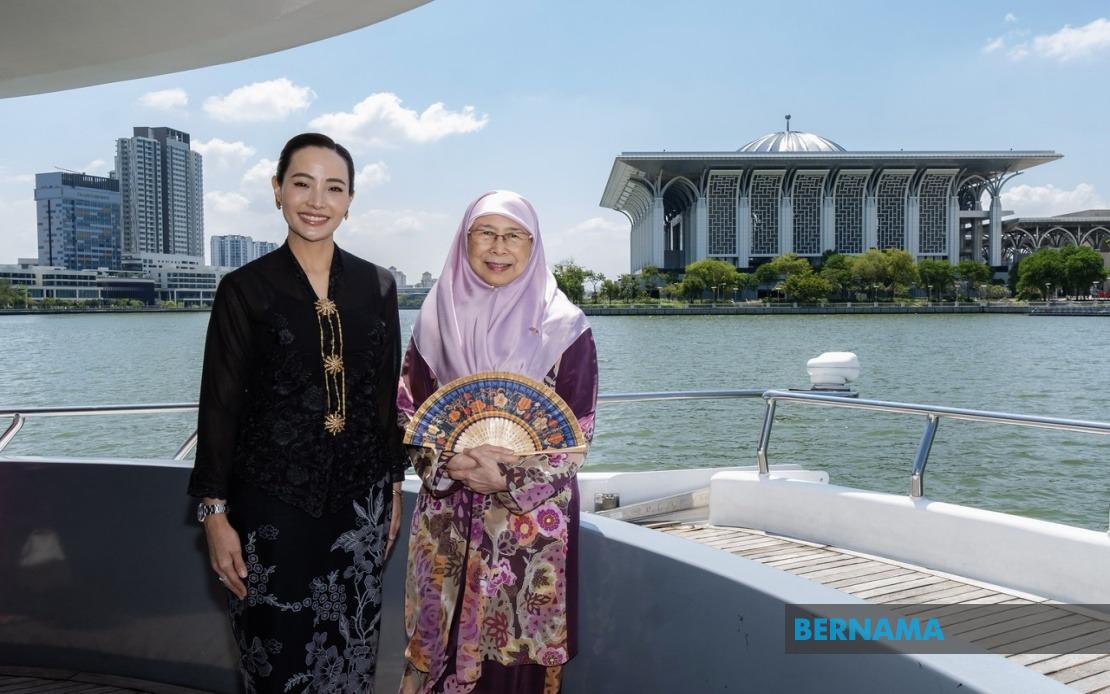
Thailand's First Lady Thananon Charnvirakul experienced the scenic beauty of Malaysia's administrative heart during a leisurely boat excursion on Tasik Putrajaya on Thursday afternoon, marking a highlight of her delegation's ongoing visit to the country. The 45-minute journey across the sprawling man-made lake afforded panoramic vistas of Putrajaya's distinguished architecture and manicured landscape, offering an informal yet meaningful engagement between the Thai and Malaysian leadership families.
Thananon was warmly received by Datuk Seri Dr Wan Azizah Wan Ismail, wife of Prime Minister Datuk Seri Anwar Ibrahim, shortly after arriving at the waterfront venue at approximately 12.10 pm. Minister Hannah Yeoh, who oversees federal territories in the Prime Minister's Department, also participated in the welcoming reception, underlining the governmental significance attached to the occasion. Throughout the cruise, the two First Ladies were observed in substantive conversation, an informal setting that facilitated direct dialogue between the spouses of the two nations' top leaders.
The lake tour represents one component of a broader two-day state visit by Thai Prime Minister Anutin Charnvirakul, who touched down in Malaysia earlier on Thursday. The Thai delegation received full ceremonial honours upon arrival at Kuala Lumpur International Airport, where officials conducted an official welcoming ceremony at the Bunga Raya Complex. This formal reception protocol reflects the diplomatic importance both nations attach to strengthening institutional relationships and expanding practical cooperation.
Anutin's visit carries particular significance as it marks his first official tour to Malaysia following his reappointment to the premiership in March 2026. The timing and scope of the engagement signal the Thai government's commitment to deepening economic, social, and political bonds with its southern neighbour. Malaysia remains a critical partner for Thailand across multiple domains, from trade and investment to regional security and cultural exchange.
The visit was conducted at Anwar's formal invitation, setting the framework for high-level bilateral discussions focused on addressing shared challenges and identifying opportunities for expanded collaboration. Both governments have articulated their determination to leverage the deep historical and cultural connections binding their nations. The two-day programme is designed to facilitate substantive talks at the highest levels while also providing space for social and ceremonial engagements that reinforce personal bonds between leadership figures.
Putrajaya itself serves as a symbolic venue for such diplomatic encounters. The purpose-built administrative capital, with its distinctive modernist architecture and carefully planned landscape features, presents Malaysia's contemporary vision to international visitors. The deliberate selection of a lakeside tour as part of the official programme reflects an understanding of how such informal settings can complement formal state business, creating opportunities for candid discussion away from the formality of conference rooms.
Malaysia-Thailand relations have historically occupied a central place in Southeast Asian regional dynamics. The two neighbours share a complex history spanning trade, cultural interaction, and occasional border tensions, yet both have consistently emphasized their commitment to peaceful coexistence and mutual prosperity. Recent administrations on both sides have worked to elevate the relationship beyond traditional frameworks, seeking new avenues for collaboration in emerging sectors such as digital economy, renewable energy, and healthcare innovation.
The presence of Minister Yeoh during the welcoming activities underscores the Malaysian government's institutional approach to the visit. The federal territories ministry holds responsibility for Putrajaya's administration and development, making her participation symbolically apt. Her involvement signals that the visit is not merely a ceremonial courtesy but reflects broader governmental coordination and strategic planning at the ministerial level.
Bilateral exchanges of this nature, combining formal state protocols with informal personal engagement, have become increasingly common among Southeast Asian nations seeking to deepen ties in an era of evolving geopolitical complexities. The casual atmosphere of a lakeside cruise permits discussions that might be constrained by the rigid formality of official meetings, potentially yielding greater candour and mutual understanding between the participants. For Malaysia and Thailand, such moments contribute to a relationship management strategy that emphasizes continuity and deepening partnership.
The timing of Anutin's visit also reflects broader regional contexts. Thailand's leadership has sought to position the nation as a bridge-builder within Southeast Asia, and strengthening ties with major regional economies like Malaysia supports that strategic objective. Similarly, Malaysia benefits from robust relations with Thailand across economic, security, and cultural dimensions. Both nations are members of the Association of Southeast Asian Nations and share interests in maintaining regional stability and prosperity.
Official visits of this calibre typically culminate in joint statements outlining areas of cooperation and shared commitment. The engagement between the two First Ladies, captured through their lakeside conversations, provides visual representation of the personal dimensions underlying state-to-state relations. Such moments, while not generating headlines comparable to ministerial agreements or trade announcements, contribute meaningfully to the fabric of bilateral relations by humanizing diplomatic connections and demonstrating commitment beyond transactional interests.

