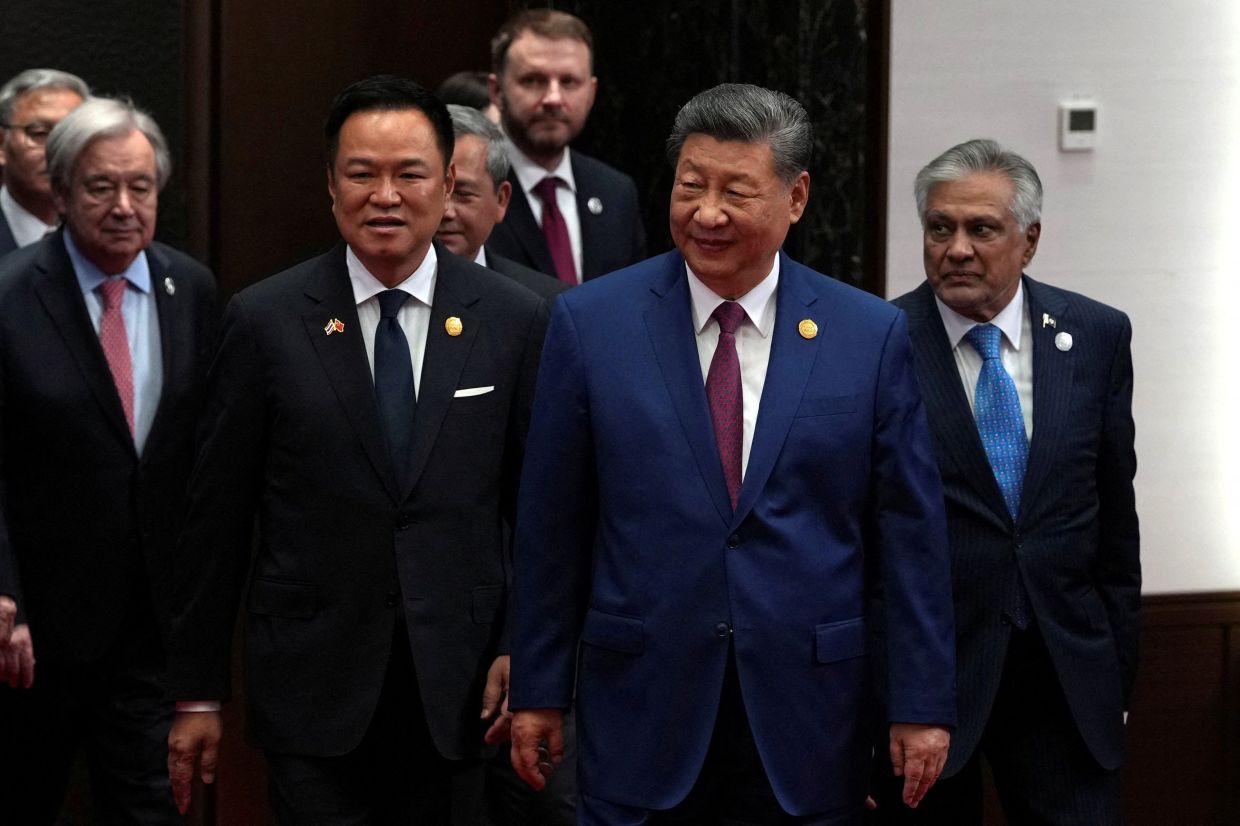
Thai Prime Minister Anutin Charnvirakul demonstrated his distinctive brand of personal diplomacy during a state visit to Beijing this week, treating Chinese Premier Li Qiang to an impromptu musical performance at an official lunch gathering. The Thai leader, seated alongside his Chinese counterpart at a formal dining table flanked by Thai and Chinese flags, seized the moment to serenade Li with a beloved classic by legendary Taiwanese vocalist Teresa Teng. Video footage released by Anutin's office captured the audience—including government officials and diplomats—appreciating the gesture with applause while a pianist provided accompaniment in the background. The unscripted moment illustrated how Anutin has carved out a unique diplomatic identity that blends formal state protocol with personable cultural expression.
This latest musical engagement represents merely the most recent chapter in what observers have begun characterizing as Anutin's "musical diplomacy" strategy. Earlier in July, during Malaysia's turn to welcome the Thai delegation, Anutin partnered with Prime Minister Anwar Ibrahim for a duet performance of "My Way," the Frank Sinatra standard that has become a staple of Southeast Asian state functions. In that particular rendition, Anutin traded his typical keyboard for a saxophone, while Anwar provided the vocals, demonstrating both versatility and willingness to adapt his musical contributions to suit collaborative arrangements. The performance reinforced emerging perceptions that Anutin views musical expression not merely as personal entertainment but as a deliberate instrument for building rapport and establishing memorable connections with counterparts across the region.
The string of musical performances extends further back into Anutin's recent diplomatic calendar. During a state visit to Hanoi in June, the Thai Prime Minister participated in a cross-cultural musical exchange by performing on a traditional Vietnamese instrument alongside local musicians before Vietnamese Premier Le Minh Hung. This sequence of engagements—Beijing in July, Kuala Lumpur in July, Hanoi in June—suggests a conscious pattern of incorporating musical elements into bilateral and multilateral diplomatic encounters. Rather than confining such performances to informal settings or ceremonial entertainment, Anutin has elevated them to visible components of official state interactions, generating media coverage and public interest that extends beyond typical diplomatic channels.
Anutin's background provides considerable context for understanding his comfort with public musical performance. Before ascending to the premiership, he established himself as a man of diverse interests and pursuits beyond conventional politics. An accomplished hobbyist pilot, he maintains active involvement in aviation alongside his governmental responsibilities. His musical training encompasses proficiency with multiple instruments: he plays both piano and the Thai flute, or khaen, demonstrating genuine rather than superficial engagement with musical traditions. These credentials lend credibility to his performances, distinguishing them from mere publicity stunts or ceremonial obligations.
The Thai leader's political journey has been notable in its own right. Anutin assumed office in September 2025, following a path that culminated in electoral validation when he led his political coalition to victory in February 2026 elections. These results provided a democratic mandate and consolidation of power after his initial appointment. Commercially, Anutin hails from considerable wealth and influence as a scion of a prominent construction dynasty, yet he has worked deliberately to cultivate a public persona that transcends elite privilege. He positions himself as accessible and connected to ordinary Thai citizens—a "man of the people," in conventional political terminology—despite his privileged background. This carefully constructed image finds reinforcement through cultural engagement and musical expression, activities that carry associations with humaneness and shared emotional resonance.
Simultaneously, Anutin maintains alignment with Thailand's traditional institutional and social frameworks, a position that carries substantial political resonance within Thai society. Thailand remains fundamentally conservative in many cultural and social dimensions, retaining strong reverence for monarchy, religious institutions, and hierarchical social structures. Anutin's political stance respects these traditional pillars, distinguishing him from more reform-oriented political figures who might advocate for fundamental restructuring of Thai governance or society. This dual positioning—modernist and personable in cultural expression while institutionally conservative in political orientation—creates a coherent political brand that appeals across Thailand's ideological spectrum.
Beyond formal state diplomacy, Anutin has recently extended his musical activities into popular culture spheres. He has collaborated with a Thai teenager who achieved international prominence through a striking musical performance on the American television program America's Got Talent, generating significant viral attention and popular interest. This engagement with contemporary entertainment demonstrates Anutin's willingness to transcend traditional diplomatic circles and connect with younger, digitally-engaged audiences who follow popular culture developments. The collaboration suggests strategic awareness of how modern political figures must navigate both formal institutional channels and informal social media-driven cultural conversations.
From a regional perspective, Anutin's musical diplomacy carries implications for Thailand's positioning within Southeast Asia and broader Asia-Pacific dynamics. China, Malaysia, and Vietnam—the three nations specifically referenced in recent performances—represent critical partners for Thai foreign policy across economic, security, and cultural dimensions. By employing music as a diplomatic vehicle, Anutin humanizes state-level interactions and creates informal bonding opportunities that transcend the formal architecture of bilateral relations. These moments often generate photogenic content that circulates through media channels, amplifying their diplomatic impact beyond the immediate audience of government officials and state dignitaries.
The approach also reflects evolving expectations around contemporary leadership, particularly in Southeast Asian contexts where personal charisma and cultural sophistication increasingly factor into assessments of political leaders. Anutin's musical performances signal confidence, cultural literacy, and emotional intelligence—qualities that resonate favorably in an era when political legitimacy extends beyond technical competence or institutional authority. His willingness to expose himself to potential embarrassment or criticism through live performance paradoxically enhances perceptions of authenticity and relatability, important currency in modern democratic politics.
Whether this musical diplomacy represents a sustainable and substantive approach to advancing Thai foreign policy interests remains an open question. Undoubtedly, the performances have generated positive media coverage and created memorable moments in otherwise scripted diplomatic encounters. They have also provided Anutin with a distinctive public identity that differentiates him from other regional leaders while simultaneously positioning Thailand as a culturally vibrant nation comfortable with cross-cultural artistic expression. As Anutin continues his tenure as Prime Minister, observers will watch whether musical performances remain a periodic flourish accompanying official functions or evolve into a more systematized component of Thai diplomatic strategy, potentially influencing how other regional leaders conceptualize and execute their own diplomatic engagements.

