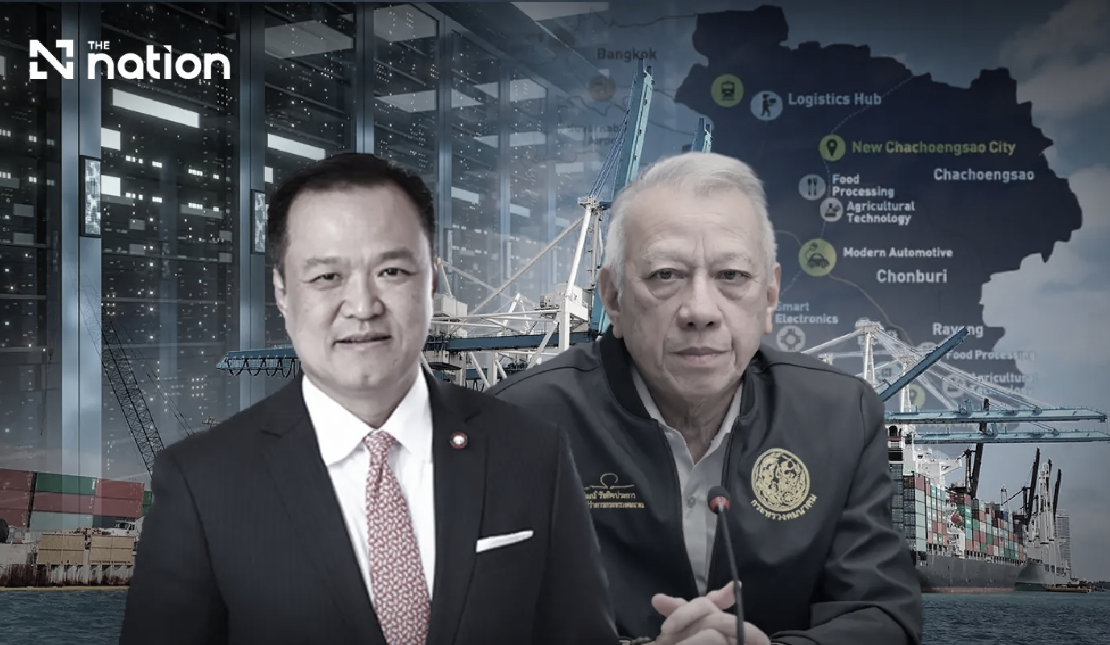
Thailand's Prime Minister Anutin Charnvirakul has reasserted direct control over the Eastern Economic Corridor, a major shift in governance that repositions the strategic development zone as the country's centrepiece for attracting global investment. The Cabinet formally acknowledged the transfer of oversight on Tuesday, June 17, effectively stripping Deputy Prime Minister Phiphat Ratchakitprakarn of his supervisory role and chairmanship of the EEC Policy Committee. Government officials characterised the move as a strategic recalibration rather than a political rebuke, though the timing and circumstances surrounding the decision have drawn scrutiny from observers tracking Thailand's coalition dynamics.
Anutin's assumption of the EEC portfolio signals a fundamental reorientation of how Thailand intends to market the eastern region to foreign capital. Rather than perpetuating the corridor's traditional image as a manufacturing-heavy industrial base, the Prime Minister envisions positioning it as a specialised investment destination anchored to sectors with heightened global relevance. This strategic pivot reflects an acknowledgement within senior policymaking circles that the conventional heavy industry model, which has underpinned the EEC's investment narrative for decades, faces mounting constraints that require a fundamental rethink of the zone's economic identity and competitive positioning.
Food security has emerged as a primary pillar in the government's reframed investment strategy for the eastern region. The eastern provinces possess substantial agricultural and aquacultural assets that remain underdeveloped as a unified investment proposition, encompassing livestock operations, commercial fisheries, intensive agriculture, and horticultural production. Government strategists recognise that international capital increasingly prioritises food supply chain resilience and domestic production capacity, particularly following the global disruptions of recent years that exposed vulnerabilities in globalised agricultural systems. By consolidating the region's agribusiness strengths under an official development narrative, Thailand positions the EEC as a destination for investors seeking to secure long-term access to high-quality protein and fresh produce through vertically-integrated ownership structures.
Data centre development represents the second transformative element in Anutin's investment repositioning. The sector carries particular appeal for the government because it promises substantial economic activity with relatively modest land requirements compared to traditional industrial manufacturing. However, realising this ambition requires unprecedented coordination across multiple governmental agencies, principally because of the extraordinary infrastructure demands that data centre operations impose. These facilities consume enormous quantities of electricity and water while generating substantial waste heat that necessitates sophisticated cooling systems, all of which demand reliable, high-capacity utility infrastructure that existing supply networks in many regions cannot accommodate without massive investment.
The government has begun preparing regulatory and pricing mechanisms to facilitate data centre investment at scale. The Energy Ministry is currently designing a new electricity user category designated Type 9, which will establish specially calibrated tariff structures for data centres reflecting their disproportionate power consumption. This represents a deliberate policy choice to absorb the exceptional infrastructure costs associated with the sector whilst remaining attractive to international operators accustomed to operating in jurisdictions with established regulatory frameworks. The tariff structure acknowledges that conventional commercial electricity rates would render operations economically unviable whilst signalling to global investors that Thailand recognises their requirements and has established formal mechanisms to address them.
The government's strategic reassessment of the EEC stems partly from cooling enthusiasm within policymaking circles regarding the corridor's capacity to expand heavy industrial capacity along traditional lines. Officials have identified fundamental constraints on electricity and water availability that would require prohibitively expensive procurement measures to overcome, effectively capping growth potential under the existing development model. Rather than pursuing expensive infrastructure augmentation to support incremental expansion of traditional manufacturing, the government has concluded that reorienting toward more specialised, infrastructure-efficient sectors represents superior capital allocation. This recognition reflects pragmatic assessment of economic realities rather than ideological repositioning, though it does represent a substantial departure from decades of development strategy.
The formal explanation for Phiphat's loss of supervisory authority emphasises structural dysfunction rather than political conflict, though such characterisations warrant careful examination given the opacity surrounding the decision's genesis. Government House sources assert that Phiphat himself proposed the transfer after concluding that jurisdictional overlap between the EEC Office and the Board of Investment had created persistent operational friction incompatible with effective administration. The narrative portrays Phiphat's proposal as a constructive resolution to coordination failures rather than an admission of inadequacy, though observers note that Phiphat was not formally notified of the Cabinet decision before its public announcement, suggesting predetermined outcomes rather than collaborative deliberation.
Questions surrounding the high-speed rail project linking Bangkok's major airports appear to have intersected with the EEC portfolio realignment, though officials have categorically denied substantive connection between the two matters. Phiphat had adopted a firm public position opposing proposed amendments to the Asia Era One contract that would shift payment mechanisms from completion-based arrangements to progress-based disbursement models. This stance placed him at variance with infrastructure sector advocates who argue that modified payment structures would facilitate project advancement after years of contractual gridlock. Anutin's public statements suggest alignment with Phiphat's position on payment model preservation, potentially indicating that the EEC transfer reflects institutional rather than personal divergence on this contentious infrastructure initiative.
Anutin has also questioned the viability of a proposed Disneyland development within the EEC, reportedly noting the absence of feasibility studies establishing that projected returns would justify capital requirements. This critical examination suggests that the Prime Minister intends to exercise more rigorous financial discipline regarding major EEC development proposals, potentially signalling scepticism toward projects pursued primarily for their political appeal or symbolic value rather than their demonstrated economic merit. The emerging pattern suggests that Anutin's direct stewardship will prioritise sectors with clearly articulated international demand signals and established operational models over speculative or experimental ventures lacking concrete investment interest from global operators.
For Malaysian observers and regional policymakers, Thailand's EEC repositioning carries implications extending beyond bilateral economic competition. The Thai government's pivot toward food security and data centre development reflects broader recognition that traditional manufacturing-centric development strategies face headwinds from structural constraints and evolving competitive dynamics. Malaysia, which maintains its own regional development initiatives and competes with Thailand for multinational investment allocation, must confront whether similar strategic recalibration might enhance competitiveness within its own priority development zones. Furthermore, the EEC's new food security focus potentially creates opportunities for cross-border agricultural value chains and supply chain integration that Malaysian enterprises might leverage through strategic partnerships with Thai counterparts operating within the transformed development framework.
The governance implications of Anutin's portfolio assumption merit consideration within Southeast Asia's broader pattern of executive power centralisation. Direct Prime Ministerial oversight of strategic development zones concentrates decision-making authority at the apex of government, potentially accelerating implementation whilst simultaneously narrowing the constituencies consulted during policy formulation. Thailand's coalition government structure renders such concentration of authority particularly significant, as it affects the balance of influence among coalition partners and shapes opportunity structures for ambitious ministers competing for presidential favour. The EEC transfer thus represents not merely an institutional restructuring but a meaningful reconfiguration of intra-governmental power dynamics that will influence how subsequent development decisions emerge and which constituencies achieve policy influence.
The success of Thailand's repositioned EEC strategy will ultimately depend on translating these high-level policy declarations into concrete operational achievements capable of attracting committed foreign investment. Food security positioning and data centre development both represent logical extensions of regional economic strengths and emerging global investment demand, but converting strategic intent into sustained capital inflows requires demonstrable progress in developing supporting infrastructure, regulatory certainty, and skilled workforce capacity. Anutin's direct stewardship places significant responsibility on the Prime Minister personally for delivering tangible results, potentially amplifying reputational consequences if the reframed strategy fails to generate expected investment momentum or if implementation encounters the procedural obstacles that have historically delayed major development initiatives in Thailand.