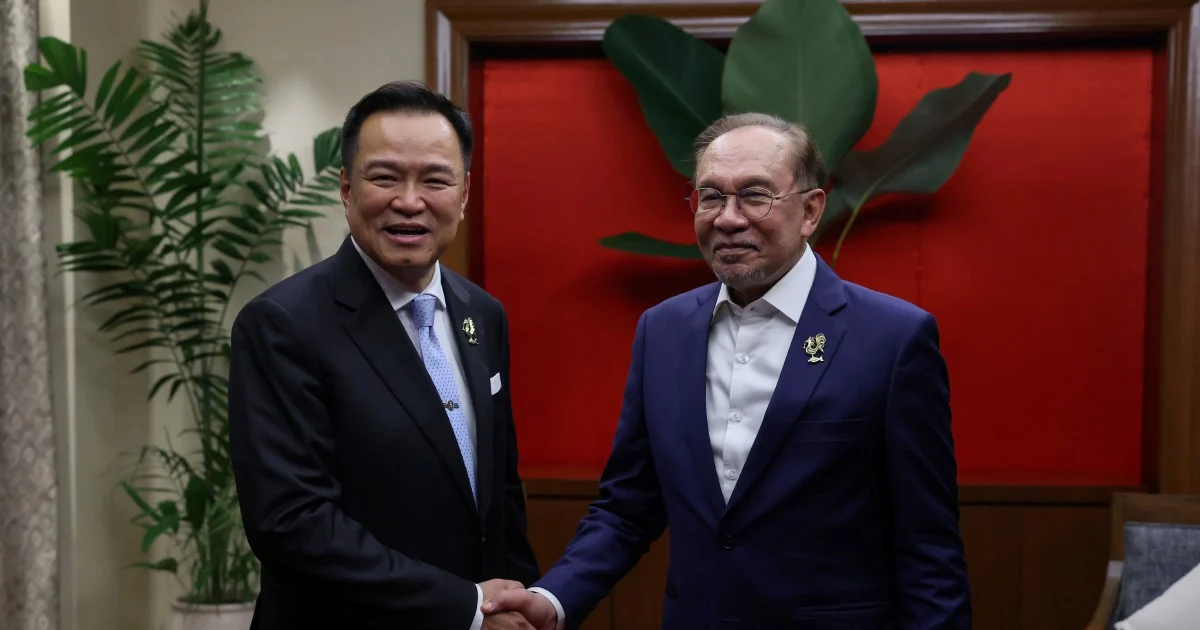
Thai Prime Minister Anutin Charnvirakul is set to arrive in Malaysia on July 9 for a two-day official visit that will bring together the leadership of two of Southeast Asia's most significant regional economies. The visit will see him engage in substantive discussions with Prime Minister Datuk Seri Anwar Ibrahim, marking an important moment for bilateral relations between Bangkok and Kuala Lumpur at a time when both nations face overlapping regional challenges and opportunities.
The timing of this visit reflects the deepening engagement between Malaysia and Thailand across multiple sectors. Both countries share a land border that spans several hundred kilometres, and this geographic proximity creates both opportunities for cooperation and complex security dynamics that require sustained diplomatic attention. The two-day schedule signals that officials anticipate detailed, wide-ranging conversations rather than a ceremonial exchange, with substantive working sessions likely to characterise the visit.
Border security concerns are expected to feature prominently in the bilateral agenda. The Thailand-Malaysia frontier has historically presented multilayered challenges ranging from cross-border trafficking in contraband goods and narcotics to irregular migration patterns. Both nations maintain significant law enforcement and military deployments in border regions, and intelligence sharing mechanisms have proven valuable for addressing transnational threats. Enhanced coordination between Thai and Malaysian security forces could yield concrete improvements in interdicting smuggling networks and disrupting organised criminal activity that exploits porous frontier zones.
The southern Thai provinces of Yala, Pattani, and Narathiwat, which adjoin Malaysian territory, have experienced prolonged security instability linked to an ongoing separatist insurgency. This protracted conflict has periodically displaced populations and created humanitarian concerns affecting communities on both sides of the border. Malaysian authorities maintain interest in developments affecting regional stability, particularly as they impact cross-border communities and trade flows. Thai security operations and counterinsurgency strategies therefore represent a legitimate focus for bilateral consultations.
Economic cooperation between the two nations offers substantial untapped potential that both leaderships appear keen to unlock. Malaysia and Thailand are among the region's largest traders and investment destinations, yet bilateral commercial flows remain below what geographic proximity and complementary economic structures might suggest. Enhanced trade frameworks, investment facilitation agreements, and sector-specific partnerships could generate employment and growth on both sides of the border. Special economic zones and cross-border manufacturing initiatives have proven successful in neighbouring countries and warrant serious exploration.
Energy security represents another dimension of potential economic collaboration. Thailand's energy needs and Malaysia's hydrocarbon resources and renewable energy development projects create natural partnership opportunities. Joint infrastructure initiatives, whether in power transmission or liquefied natural gas, could improve energy security for both nations while generating substantial commercial returns. Such projects also carry strategic significance for regional energy stability at a time when global energy markets face transition pressures.
Digital economy and technology sectors offer emerging opportunities for bilateral cooperation. Both nations aspire to advance their digital infrastructure and foster innovation ecosystems. Malaysian expertise in semiconductor manufacturing and technology services complements Thai strengths in agricultural technology and food processing automation. Cross-border digital initiatives and technology transfer arrangements could position both countries more competitively within the broader Southeast Asian economic landscape.
Tourism represents an established pillar of bilateral commercial ties that warrants continued development. Malaysians constitute a significant visitor population to Thailand, particularly in provinces like Phuket and Bangkok, while Thai tourists represent an important segment of Malaysia's tourism revenue. Enhanced connectivity through simplified visa arrangements and improved transportation links could expand this mutually beneficial sector substantially. Cultural exchange programmes accompanying improved tourist flows strengthen people-to-people bonds that underpin lasting diplomatic relationships.
The visit also occurs within the broader context of ASEAN regional dynamics and great power competition. Both Malaysia and Thailand navigate complex relationships with major powers, including China, the United States, and India. Deepening bilateral ties serve the mutual strategic interest of both nations by strengthening intra-regional bonds and reducing openings for external actors to exploit differences. Enhanced Malaysia-Thailand cooperation reinforces ASEAN unity while providing both nations with stronger negotiating positions within multilateral forums.
Prime Minister Anwar Ibrahim's government has emphasised renewed regional engagement as a cornerstone of its foreign policy agenda. The Thai Prime Minister's visit fits squarely within this strategic orientation, demonstrating Malaysia's commitment to revitalising relationships with neighbouring states and positioning the country as an active participant in shaping regional outcomes. For Anutin's government, the visit similarly signals Thailand's interest in deepening cooperation with a fellow ASEAN heavyweight and important economic partner.
The discussions between the two premiers will likely produce joint statements or memoranda of understanding addressing specific areas of cooperation. Such formal instruments, while sometimes perceived as ceremonial, can establish concrete frameworks for follow-up action by relevant government agencies. Lower-level technical committees often prove more impactful than high-level political declarations, as they drive actual implementation of bilateral initiatives and ensure continuity across government transitions.
Looking forward, the success of this visit will be measured not merely by its occurrence but by the substantive outcomes it generates. Whether discussions translate into concrete cooperative mechanisms addressing border security vulnerabilities, expanded trade arrangements, or joint infrastructure projects will determine the visit's lasting significance. The visit represents an opportunity for both leaderships to chart a course toward closer integration that serves mutual interests while contributing to broader regional stability and prosperity.

