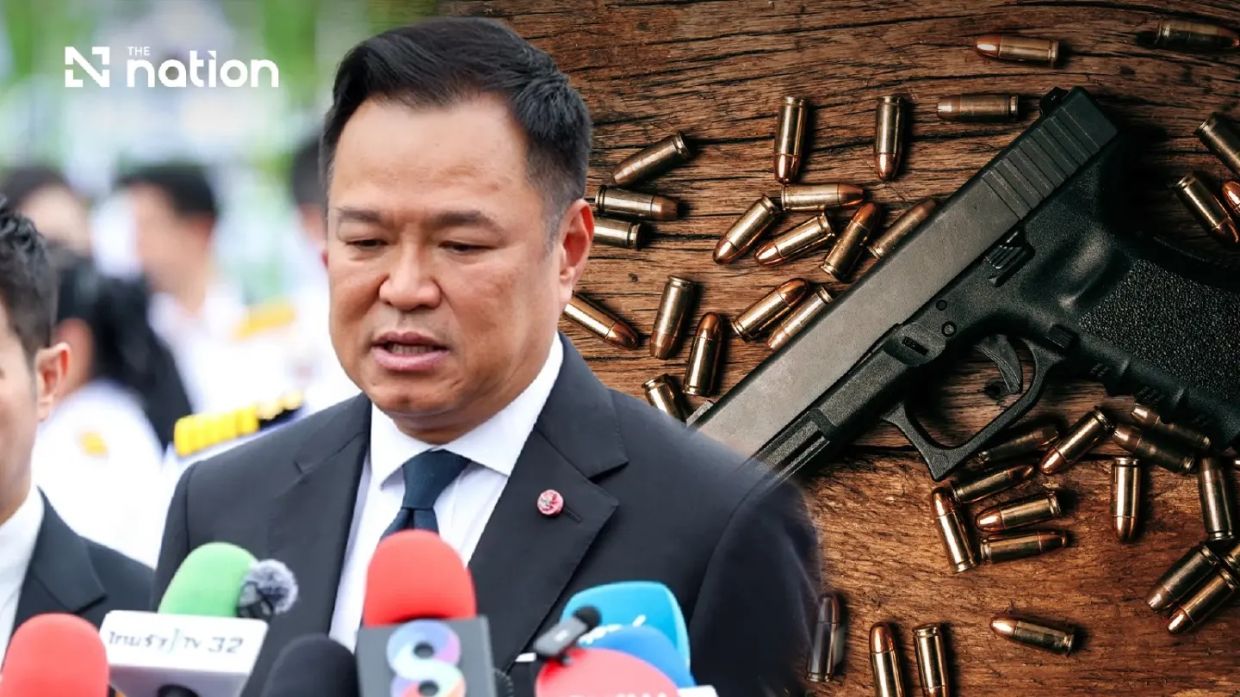
Prime Minister Anutin Charnvirakul has announced a comprehensive crackdown on illegal firearms ownership following the devastating mass shooting at Debsirin Nonthaburi School, signalling the government's determination to tighten weapons regulations across the country. After visiting the shooting scene and consulting with national police chief Pol Gen Kittharath Punpetch at Government House, Anutin outlined plans to work with Deputy Prime Minister Pakorn Nilprapunt on legislative amendments designed to establish stricter control mechanisms over gun ownership and usage in public spaces.
Central to the prime minister's proposed enforcement strategy is an intensified checkpoint system and inspection regime targeting individuals found carrying firearms outside their residences without legitimate official purposes. Anutin was unequivocal in declaring that unauthorised possession in any location—whether vehicles, public areas, or homes—constitutes a serious criminal offence warranting substantial penalties. This hardline stance reflects growing governmental concern that permissive attitudes towards informal gun carrying have created dangerous conditions in Thai society, particularly when weapons fall into the hands of individuals experiencing psychological distress or social grievances.
The government has explicitly rejected suggestions from some quarters that arming schoolteachers could provide an adequate defensive response to campus violence. Anutin firmly maintained that educators lack the legal status and training requisite for authorised weapon handling, and that introducing firearms into educational institutions would fundamentally contradict rather than advance student safety objectives. This position stands in contrast to security proposals sometimes advanced in other contexts, demonstrating Thailand's commitment to keeping weapons outside school environments entirely rather than proliferating them within institutional settings.
Among the more pragmatic measures being considered is the reinstatement of a voluntary surrender programme permitting individuals possessing unregistered or illegally obtained firearms to relinquish them to state authorities without facing criminal prosecution. This amnesty-style approach represents an attempt to balance enforcement rigour with incentives encouraging compliance, recognising that some illegal weapons holders may be motivated to regularise their status if provided a penalty-free exit mechanism. However, Anutin cautioned that this opportunity would be time-limited and that any firearms not surrendered during the programme window would subsequently be subject to confiscation and their possessors to heightened criminal liability.
Underscoring the permanent nature of the government's enforcement commitment, Anutin declared that individuals discovered with illegal firearms during his tenure in office would face prosecution and accumulated charges reflecting both the weapons offence and any related criminal activities. He emphasised that the risk-benefit calculation does not favour retention of illegal arms, as possession itself constitutes a primary criminal count entirely separate from any ancillary offences. This layered approach to penalties aims to create genuine deterrent effects by substantially escalating the legal consequences for unlawful gun ownership.
The administrative mechanisms for firearms surrender have been specified to ensure transparency and official documentation. Citizens wishing to regularise their status can deliver weapons to the Department of Provincial Administration, district offices, or police stations, where officers will formally record the transaction and the weapon's characteristics. This requirement for official registration upon surrender addresses governmental concerns that informal or undocumented weapons transfers could perpetuate the circulation of untraceable firearms within communities, thereby undermining enforcement capacity across the entire system.
Regarding the underlying factors that may have contributed to the Nonthaburi incident, Anutin counselled restraint in public commentary pending completion of official police investigations. Reports suggesting that the shooter had experienced bullying or social isolation prompted the prime minister to emphasise that speculation about motives could generate unfounded public anxiety or inspire copycat incidents. By insisting that investigation teams be allowed to establish facts through systematic inquiry rather than through media-driven narratives, Anutin sought to depoliticise the incident while maintaining official control over information flows during the sensitive aftermath period.
The broader governmental strategy encompasses comprehensive residential firearms regulation extending beyond merely preventing unauthorised public carrying. Even firearms legally registered to household owners must now meet heightened security storage standards, be kept inaccessible to children, and comply with documentation requirements. This expansion of responsibility to legitimate gun owners reflects recognition that inadequate home security practices can facilitate weapons theft or accidental access by minors, thereby converting legally held arms into potential instruments of unintended harm.
Liability provisions will be structured to encompass both the registered owner and any individual actually deploying a weapon in criminal activity, effectively creating shared responsibility frameworks. This dual-liability approach represents an effort to ensure that legal gun owners maintain rigorous oversight of their weapons and take active steps to prevent unauthorised use, rather than merely passively holding registration certificates. By making ownership itself a continuing obligation involving active security measures and monitoring, the government aims to shift cultural attitudes toward firearms from treating them as passive possessions to viewing them as instruments requiring constant vigilant stewardship.
The enforcement architecture outlined by Anutin involves coordinated operations across police services and provincial administration departments receiving explicit policy directives to conduct systematic inspections targeting unlawful weapons. This multi-agency approach acknowledges that firearms control cannot be achieved through police action alone but requires integrated governmental capacity across administrative, law enforcement, and community engagement functions. The specification that authorised officers have received formal orders and policy guidance establishes clear operational parameters and accountability mechanisms.
For Malaysia and other Southeast Asian nations monitoring Thailand's response, the Nonthaburi incident and the government's legislative reaction provide instructive examples of how rapidly escalating gun violence can catalyse comprehensive firearms policy responses. Thailand's emphasis on administrative enforcement mechanisms, voluntary surrender programmes, and layered criminal penalties offers potential models for regional governments seeking to address unauthorised weapons proliferation without fundamentally restructuring existing legal frameworks. The incident underscores that school safety cannot be achieved through armed teacher programmes but requires upstream prevention of illegal weapons circulation.
The government's determination to maintain stricter gun controls long-term signals that the Nonthaburi shooting has catalysed a genuine shift in official firearms policy rather than generating temporary reactive measures. By anchoring enforcement authority in legislation rather than administrative discretion, and by establishing permanent penalties for non-compliance, Thai authorities are attempting to create sustainable institutional capacity for weapons control that will persist beyond the immediate political moment when public attention inevitably disperses to other issues.

