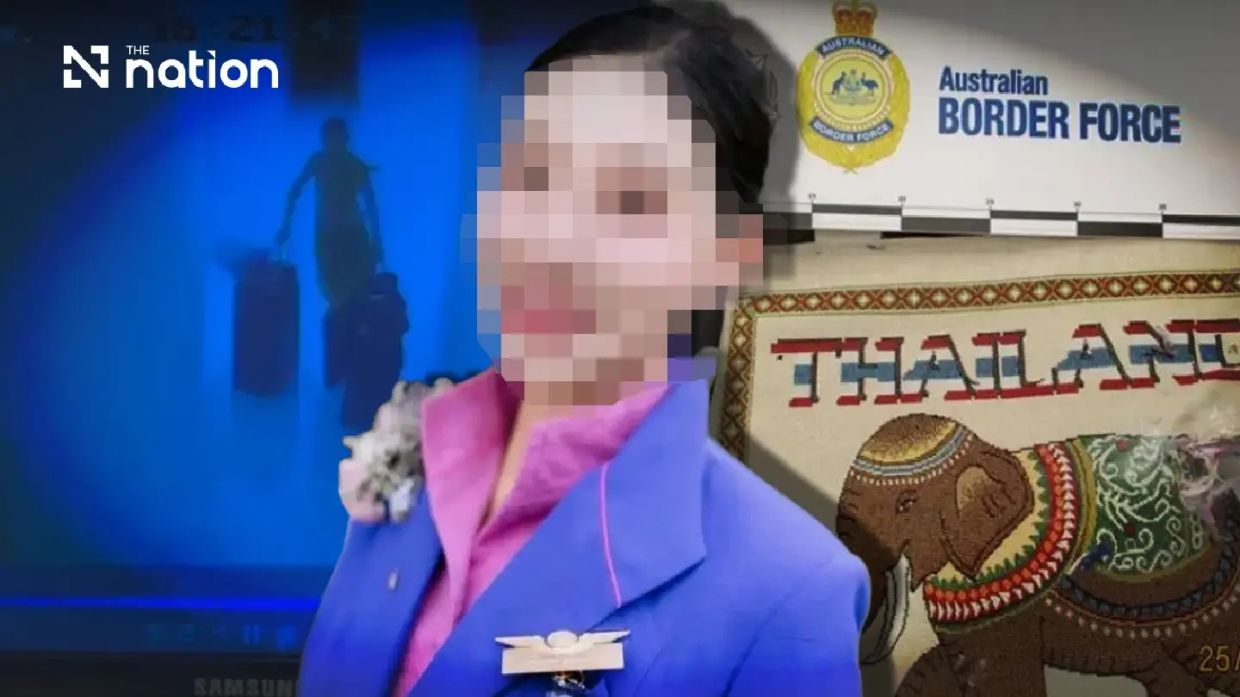
Thai authorities are intensifying their investigation into a sprawling international heroin smuggling operation following the detention of a Thai flight attendant at Melbourne Airport, where she was found carrying 900 grammes of the drug. Rather than treating her as a criminal suspect at this stage, the Office of the Narcotics Control Board and related security agencies are examining evidence that suggests she may have been manipulated by an elaborate transnational scam network connected to major narcotics syndicates in the Golden Triangle region. Thai officials have already coordinated with Australian police and consular representatives to compile materials for her legal defence, indicating a shift toward viewing her as a potential victim of organised crime rather than a willing participant.
The investigation has revealed a methodical and sophisticated criminal operation that specifically targets mobile workers such as flight attendants and other frequent international travellers. According to Thai law enforcement, the network operates through social media, creating fake profile pages and sending mass messages offering lucrative payments in exchange for transporting parcels across borders. The scheme typically presents itself as a legitimate business opportunity, with participants unaware that the goods they are carrying contain controlled substances. This targeting of airline personnel exploits both their frequent international movement and their often-modest salaries, making the promised payments appear attractive to vulnerable workers.
The scope of the operation became apparent when Thai authorities arrested three to four individuals in Bangkok and seized more than 26 kilogrammes of heroin, suggesting this represents merely one segment of a much larger criminal enterprise. The Department of Special Investigation has taken the lead in these cases because preliminary evidence indicates the network operates on a significant transnational scale, involving coordination across multiple countries and sophisticated logistics. The investigation has identified a delivery rider who received heroin from a foreign national and subsequently made deliveries to intended recipients, while a Lao couple has also been implicated in the trafficking chain. The network appears to employ two primary distribution methods: postal delivery systems and direct hand-to-hand transfers, each offering different advantages for evading detection.
In Australia, Thai investigators have identified the intended recipient of the heroin as an individual known as "Dear," a Thai national with a confirmed identity who has been residing in the country for approximately ten years. The precise immigration status or citizenship status of this person remains unclear to Thai authorities, though the Australian Federal Police have undertaken responsibility for determining whether Dear has become an Australian citizen and for expanding the investigation to identify the final recipients in the distribution chain. Thai officials believe the Australian network is substantial and likely involves non-Thai nationals as well, suggesting the operation has established deep roots in the receiving country and operates with considerable sophistication.
The flight attendant's involvement appears to follow a textbook pattern that investigators have linked to the scam methodology. According to statements provided by her boyfriend, she received a delivery of parcels containing elephant-pattern bags, which she inspected before placing them in her luggage. The boyfriend reported that when the bags were opened and examined during this inspection, they appeared empty or contained nothing suspicious. However, heroin was subsequently discovered when the suitcase was examined in Australia, raising critical questions about whether the drugs were inserted after the Thai inspection or whether the initial check was insufficiently thorough. Notably, the suitcase passed through Thai airport security without triggering alarms, a detail that may be significant in determining whether the flight attendant knowingly participated in the smuggling.
Financial records in the case remain incomplete and contradictory, further complicating efforts to establish her culpability. The Australian Federal Police reported finding evidence of an 8,800 baht payment on a mobile phone, yet Thai investigators have been unable to verify this transaction through the flight attendant's bank records. Alternative reports suggest two separate transfers of 1,700 baht each were made, one upon receipt of goods and another when an airline ticket became available, totalling 3,400 baht, but bank account analysis has not confirmed these transactions. Given that the flight attendant's account appears to contain modest funds, investigators cannot yet confirm the accuracy of these payment claims and have determined that further detailed questioning will be necessary to establish the financial dimensions of her involvement.
The delivery rider's account of his activities provides additional evidence that may support the narrative of the flight attendant's unwitting participation. The rider stated that he had conducted similar deliveries three or four times previously but emphasised that this particular delivery to the flight attendant represented his first contact with her. This statement, if corroborated, could suggest the flight attendant was a new target rather than an established member of the smuggling network, potentially supporting the theory that she was deliberately selected through the social media scam methodology. The ONCB has acknowledged that such evidence could reasonably be interpreted as indicating she may not have acted with full knowledge or criminal intent, though authorities stress that extensive additional investigation is required before reaching any definitive conclusions.
The broader context of the operation reveals how drug trafficking networks have adapted their routes and methods in response to increased law enforcement pressure. Historically, narcotics from the Golden Triangle were transported through northern Thailand, but as Thai authorities intensified interdiction efforts in these high-risk frontier areas, syndicates shifted their operational focus toward the north-eastern region bordering Laos. The Mekong River stretches across this frontier in provinces including Nakhon Phanom, Bueng Kan, Loei and Nong Khai, presenting formidable surveillance challenges for authorities. The river is relatively narrow in these areas, but the overall border length is extensive, making continuous monitoring with available personnel resources extraordinarily difficult. These geographical and logistical constraints have allowed some drug shipments to successfully transit into Thailand despite escalated enforcement operations.
The heroin destined for Melbourne appears to have followed the typical distribution pattern employed by these networks. Once the drugs are packaged at their origin point in the Golden Triangle, they are passed sequentially through various criminal intermediaries and storage locations within Thailand before being consolidated for international transport. Each hand-off in this chain reduces individual exposure and distributes risk across the network, making it extremely challenging for law enforcement to penetrate the entire operation by arresting a single participant. The flight attendant case may represent merely one operational line within a substantially larger organisation, with numerous parallel smuggling routes and distribution channels operating simultaneously across Southeast Asia and beyond.
Thai and Lao authorities maintain regular coordination and information-sharing mechanisms regarding transnational drug trafficking, though the intensifying pressure on traditional northern smuggling routes suggests that criminal organisations continue to identify and exploit gaps in regional enforcement coverage. The shift toward north-eastern routes indicates these networks possess considerable intelligence about law enforcement deployment patterns and can rapidly adjust their operations accordingly. This sophisticated adaptive capacity, combined with the targeting of vulnerable individuals through social media deception, reflects the evolution of transnational drug trafficking into a highly organised and technology-enabled criminal enterprise.
For the Thai flight attendant currently detained in Australia, her legal status remains that of a detainee rather than an accused person, a distinction that may prove significant for her ultimate fate. Thai authorities have committed to providing Australian legal authorities and the Thai embassy with all available evidence that could support her defence, including the statements suggesting she may have been a victim of the scam rather than a knowing conspirator. The investigation will ultimately determine whether her involvement resulted from deliberate participation in smuggling or from insufficient awareness of what she was transporting. However, the broader significance of this case extends beyond her individual circumstances to illuminate how sophisticated international criminal networks exploit the mobility and relative vulnerability of ordinary workers, and how these operations have adapted to exploit geographic vulnerabilities along Southeast Asian borders.

