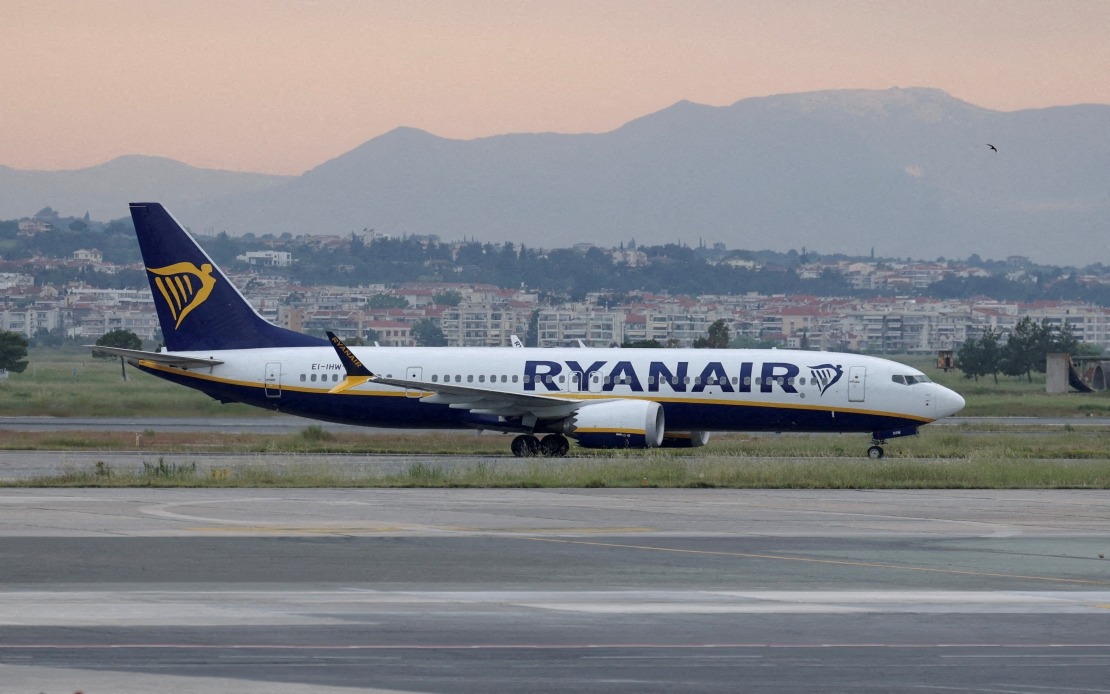
Chaos erupted aboard a Ryanair aircraft departing Thessaloniki on Friday when a window suddenly fractured at altitude, forcing an immediate emergency landing just minutes into the journey toward southern Germany. The incident, which unfolded without warning during what should have been a routine flight to Memmingen, left passengers in shock and triggered a full-scale investigation into the structural failure that endangered everyone aboard.
Accounts from those present describe a sudden, loud impact followed by the explosive decompression characteristic of rapid cabin pressure changes. Witnesses reported that a window pane gave way violently, with the closest passenger suffering immediate injuries from the fracturing glass and the force of air rushing through the gap. The situation escalated when that passenger's upper body became partially exposed to the external environment, with onlookers describing his head and shoulders protruding through the damaged opening as the aircraft continued forward at cruising speed.
The rapid response of fellow passengers prevented what could have become a tragedy. Those seated nearby managed to pull the injured man back into the cabin, likely saving his life in the process. Simultaneously, the aircraft's safety systems activated as the cabin pressure dropped, causing oxygen masks to deploy throughout the passenger compartment. Video footage captured on mobile phones and subsequently shared across social media platforms documented the terror of that moment, showing the masks hanging from overhead compartments as passengers screamed in alarm.
Cockpit procedures kicked in swiftly as the flight crew responded to the emergency. Rather than attempting to continue the journey or divert to an alternative airport, the pilot made the decision to abort the flight immediately and return to the point of departure. This judgment proved sound given the structural integrity of the aircraft had been compromised. The return flight from the cruising altitude back to Thessaloniki Airport consumed approximately twenty minutes, during which cabin crew worked to stabilise both the aircraft and the frightened passengers.
The injured passenger, identified as a Serbian national, received medical attention upon landing in Thessaloniki. Emergency services transported him directly to a hospital in the city for treatment of injuries sustained during the incident. His condition and the extent of injuries have not been disclosed in available reports, though the fact that he was conscious and capable of being transported suggests he avoided catastrophic harm.
For travellers across Southeast Asia and Europe, such incidents serve as stark reminders of the critical importance of rigorous aircraft maintenance and structural inspection protocols. Window failures, though rare in modern aviation, represent potentially catastrophic safety events. Aircraft windows operate under tremendous stress due to the pressure differential between cabin and external environment at altitude, with cabin pressures equivalent to roughly 8,000 feet elevation even when cruising at 35,000 feet or higher. Any compromise in window integrity can have immediate, severe consequences.
Ryanair, Europe's largest low-cost carrier operating hundreds of daily flights across the continent and beyond, had not issued a formal statement at the time of reporting. Similarly, aviation authorities in both Greece and Germany remained silent on initial findings. The investigation launched by relevant regulatory bodies will examine multiple factors, including maintenance records for this specific aircraft, the manufacturing quality of the window assembly, any prior incidents involving this plane, and operational practices that may have contributed to the failure.
Such structural emergencies raise questions about aircraft fleet management at budget carriers, who operate under intense pressure to maintain profitability through high utilisation rates and minimal downtime. While budget airlines maintain the same regulatory oversight as full-service carriers in European airspace, the commercial pressure to keep aircraft flying can sometimes create tension with maintenance scheduling. This incident will likely prompt a review of window inspection intervals across similar aircraft types throughout Ryanair's fleet and potentially the broader industry.
The incident also highlights the effectiveness of aircraft design redundancies and crew training in responding to emergencies. The cabin's ability to remain pressurised despite a window breach, the automatic deployment of oxygen systems, and the crew's rapid decision-making all contributed to preventing loss of life. Modern aircraft are engineered with multiple safety layers specifically to handle situations exactly like this, though such failures remain exceedingly uncommon in daily operations.
For passengers, the incident underscores why safety briefings matter and why following crew instructions during emergencies remains essential. The quick thinking of fellow passengers who prevented the injured man from being pulled further out likely made the difference between recovery and tragedy. As investigations continue, authorities will determine whether this was an isolated manufacturing defect, a maintenance oversight, or something else entirely—findings that will shape safety practices for years to come.

