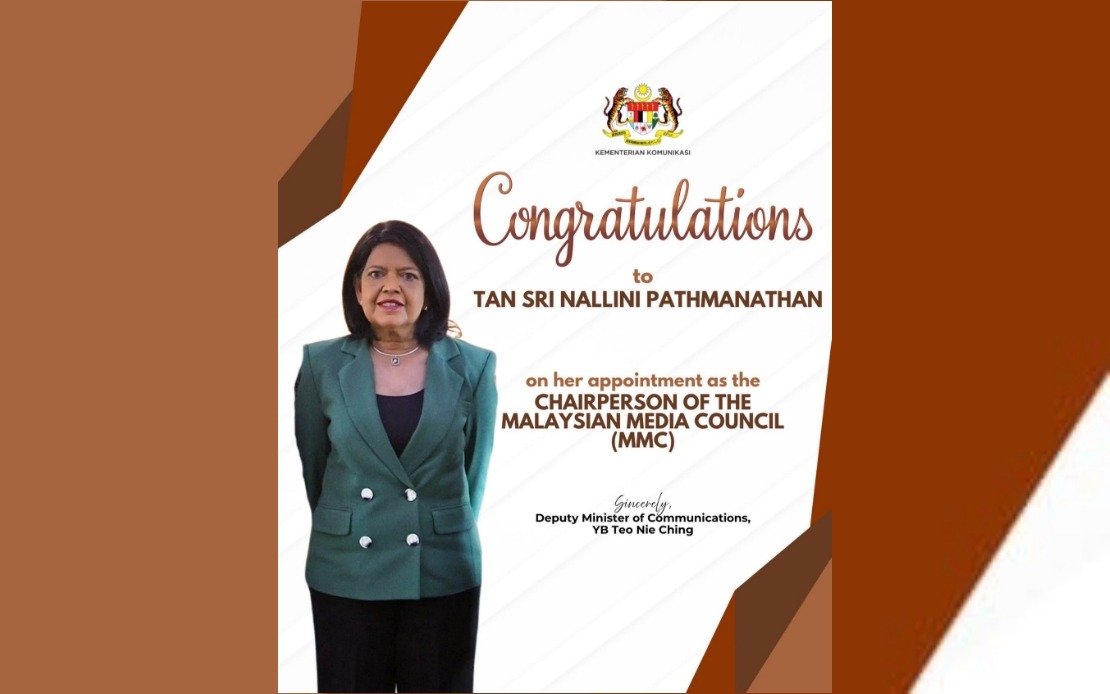
Tan Sri Nallini Pathmanathan, a retired Federal Court judge, has been unanimously appointed chairperson of the Malaysian Media Council (MMC), a milestone that comes nearly five decades after Malaysia's news industry and civil society organisations first began advocating for a self-regulatory body. Deputy Communications Minister Teo Nie Ching has thrown her weight behind the appointment, using a Facebook statement to emphasise Nallini's judicial credentials and her consistent defence of press liberty, positioning the selection as instrumental to the council's credibility and independence.
Teo's endorsement centred on Nallini's track record as a jurist, specifically her willingness to issue thoughtful dissenting opinions when she believed the law required a more nuanced reading. Most notably, Teo cited Nallini's dissent in a closely divided citizenship case—a 4-3 decision in which she urged the court to adopt a purposive and compassionate approach to constitutional citizenship provisions. In that instance, the case involved an illegitimate child born to a Malaysian father and a foreign mother, an outcome that illustrated Nallini's inclination to balance strict legal interpretation with human fairness. Such reasoning, according to Teo, demonstrates the judicial temperament necessary to oversee media regulation in an era when questions of editorial responsibility and online speech have grown increasingly complex.
Equally significant was Nallini's dissent in a landmark case concerning an online news portal's liability for reader comments. The judge ruled that news organisations should not bear legal responsibility for unmoderated subscriber commentary, a position that directly addresses one of the thorniest modern challenges to press freedom: the distinction between editorial content and user-generated material. This judgment speaks to her understanding of how digital platforms operate and the dangers of imposing impossible moderation standards on publishers, concerns that will likely shape the MMC's approach to industry self-governance in coming years.
The establishment of the Malaysian Media Council represents a watershed moment for Malaysia's media landscape. Although the concept has circulated in policy discussions since the 1970s, it took the passage of the Malaysian Media Council Act 2025 to finally create a formal institutional framework. The timing reflects growing international pressure on countries to ensure robust, transparent media regulation that does not rely on government intervention, a distinction that Teo emphasised in her remarks. The appointment of someone with Nallini's judicial pedigree and philosophical alignment with press freedom is designed to signal that the MMC will function as an impartial arbiter rather than a tool of state control.
Teo was explicit about the reasoning underpinning self-regulation over state oversight. In her statement, she noted that journalists occupy a constitutionally unique position as the fourth estate, a role that carries responsibility for holding power to account. When governments directly regulate media, she argued, such intervention is inherently perceived—whether fairly or not—as censorship or suppression. By contrast, industry-led regulation, conducted transparently and accountably, allows the press to maintain its independence while still establishing ethical standards and addressing legitimate public complaints. This philosophical distinction matters enormously in Malaysia, where historical concerns about press freedom have been persistent and where international press freedom organisations continue to monitor developments.
The MMC board unanimously endorsed Nallini's appointment at a meeting held on May 26, signalling broad consensus among the council's inaugural membership about the need for leadership that combines legal expertise with genuine commitment to constitutional principles. The unanimity itself carries weight, suggesting that Nallini's peers in the media and regulatory spheres view her as someone above factional dispute and capable of building institutional trust. This consensus will be crucial as the MMC establishes its operational guidelines, complaint procedures, and ethical framework during its formative years.
For Malaysia's media industry, Nallini's appointment addresses a long-standing gap in institutional architecture. Unlike some peer democracies, Malaysia has lacked a credible, independent body through which journalists and news organisations could collectively police their own conduct and respond to complaints without escalating matters to government agencies or courts. The MMC promises to fill that void, offering a forum where disputes between media outlets and the public can be mediated by industry figures acting in concert with ethical principles rather than political considerations. Nallini's judicial experience, particularly her ability to write persuasive reasoning that accommodates competing values, positions her to help the MMC earn legitimacy among all stakeholders.
The establishment of the council also reflects broader regional trends toward independent media regulation. Countries across Southeast Asia have experimented with various models of media self-governance, each attempting to balance press freedom with public accountability. Malaysia's approach, emphasising self-regulation backed by law but insulated from government day-to-day control, aligns with international best practices and the recommendations of press freedom organisations. By appointing someone of Nallini's stature and philosophy, Malaysia signals intention to make the experiment work.
Looking forward, Nallini will face considerable challenges in building an MMC that commands respect from journalists, publishers, the public, and the government alike. The council must establish clear, fair procedures for handling complaints; manage competing interests within the industry itself; and navigate the minefield of online speech regulation, where traditional editorial norms are increasingly difficult to apply. Nallini's judicial background, especially her dissents on press freedom and constitutional interpretation, suggests she understands these complexities and is inclined to prioritise principles over expediency. Whether the MMC ultimately becomes the robust, independent body Teo envisions will depend not only on Nallini's leadership but also on her ability to recruit experienced media professionals to the council and secure the cooperation of news organisations in adopting and enforcing ethical codes.