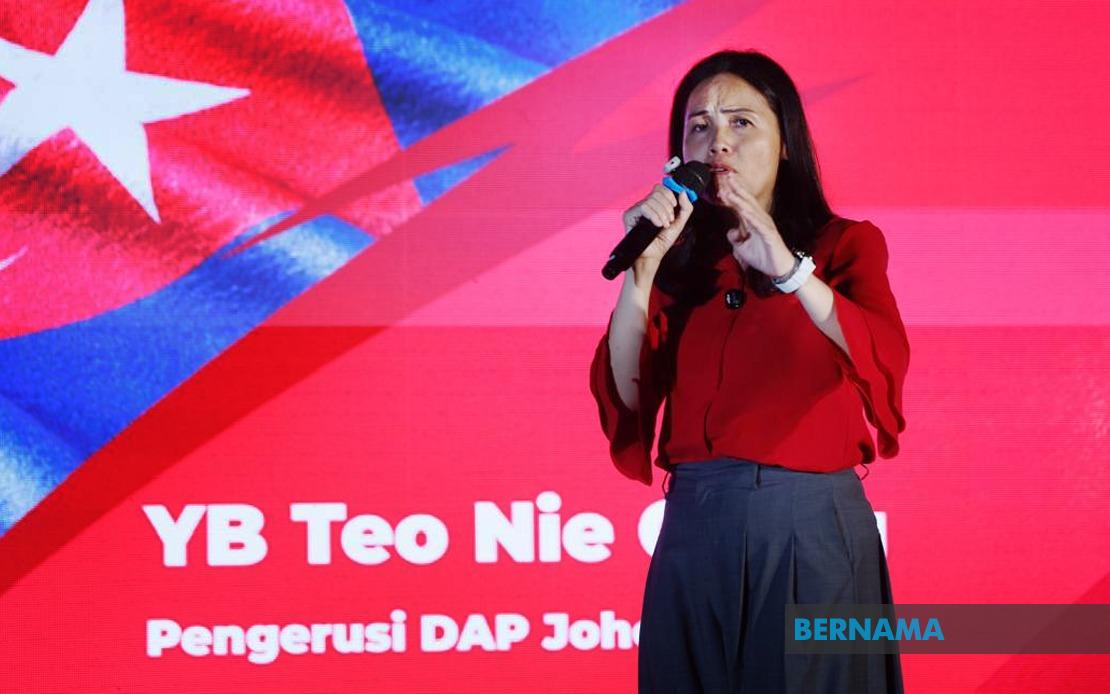
In a pointed challenge to the Johor state administration's governance approach, DAP chairman Teo Nie Ching has raised sharp questions about newly created appointed assemblyman positions, suggesting the mechanism lacks transparency and democratic legitimacy. Speaking at a Pakatan Harapan rally in Paloh on July 9, Teo expressed reservations about allowing state officials to appoint legislators who would bypass the electoral process entirely, a concern that strikes at the heart of ongoing debates about representation and accountability in Malaysia's state legislatures.
The controversy centres on legislation passed by the Johor State Legislative Assembly on May 7, which amended the state enactment to permit the appointment of up to five assemblymen. The government has characterised this as a strengthening measure for the assembly's institutional capacity and overall composition, framing it as a technical adjustment to improve governance. However, Teo's intervention signals that opposition parties view the move quite differently, interpreting it as a potential avenue for political manoeuvrring and patronage that circumvents the democratic mandate of the ballot box.
Teo's scepticism focuses on the absence of public clarity regarding whom these appointees might be and what criteria would govern their selection. She pointedly questioned whether these positions were designed as consolation posts for losing candidates from the ruling coalition, a suggestion that would render the appointments particularly controversial given they would effectively provide alternative pathways to legislative influence for those rejected by voters. Her specific reference to PAS's substantial contributions to the state government's electoral victory adds a layer of political tension, implying that appointment decisions could be shaped by coalition bargaining rather than merit or public interest.
The core democratic concern underpinning Teo's critique is straightforward yet fundamental: appointed assemblymen would lack the electoral scrutiny that ballot-box candidates endure. Voters cannot hold appointed representatives accountable through the same mechanisms available for elected ones, creating an asymmetry in democratic accountability that Teo argues threatens the integrity of legislative processes. She called on the state government to provide detailed public explanation of the appointments scheme to prevent eroding public confidence and to reaffirm that administrative accountability remains a governing principle rather than a flexible proposition negotiated behind closed doors.
Beyond the institutional friction over appointed seats, Teo's remarks at the Paloh constituency rally served to defend the track record of Malaysia's Unity Government coalition, which has governed nationally since November 2022. She acknowledged candour that the administration remains imperfect, declining to claim perfect performance or comprehensive achievement. Yet she mounted a substantive defence centring on incremental systemic reforms rolled out methodically across education and social welfare sectors, positioning these changes as foundational investments in Malaysia's longer-term institutional strength.
Educational access emerged as the centrepiece of Teo's reform narrative. She highlighted a new guarantee that all SPM students securing 10A grades would secure matriculation programme places irrespective of socioeconomic or other background factors, removing barriers that previously screened out qualified candidates from less privileged cohorts. Simultaneously, the government has expanded access for Unified Examination Certificate holders, broadening pathways for students from vernacular systems. These adjustments address longstanding concerns about equity in post-secondary transitions and represent meaningful shifts in how Malaysia allocates educational opportunity.
The government has also substantially increased allocations to Chinese independent schools, raising funding to RM20.16 million this year compared with RM12 million in 2019, representing a 68 percent increase. For communities invested in vernacular education, this represents tangible commitment reversing previous patterns of constrained support. Teo characterised these initiatives collectively as systemic reforms intended to bequeath future generations stronger institutional frameworks rather than merely solving immediate problems. She framed democratic progress as necessarily incremental, inviting voters to view electoral participation in 2026 as continuation of a longer transformation process rather than expecting instantaneous comprehensive change.
The timing of Teo's remarks, delivered just before Saturday's state election when approximately 2.7 million Johor voters were set to elect 56 state representatives, demonstrates how institutional governance questions intersect with immediate electoral competition. The appointed assemblymen controversy has become a mobilising issue for opposition parties, enabling them to contrast their commitment to representative democracy with what they characterise as majoritarian shortcuts by ruling coalitions. For Pakatan Harapan candidates like Dr Ruban Arumugam in Paloh, such arguments provide electoral messaging connecting local governance concerns to broader themes about democratic quality and political accountability.
For Malaysian political observers and Southeast Asian analysts watching Johor as a bellwether for opposition momentum, Teo's intervention signals that DAP is positioning itself as institutional democracy's defender rather than purely partisan opposition. By challenging appointed assemblymen on transparency grounds rather than merely partisan grounds, she frames the critique as applicable to any government regardless of coalition, lending the argument broader potential legitimacy among voters concerned about democratic standards regardless of factional affiliation. This approach may resonate particularly with urban and educated voters who prioritise institutional quality.
The Johor appointed assemblymen issue also reflects broader tensions within Malaysia's federal system about how states balance flexibility in governance with democratic constraints. Unlike purely appointed or nominated chambers familiar in other Westminster systems, Johor's hybrid model mixes elected and appointed representation within a single chamber, potentially creating confusion about accountability mechanisms. If the appointed assemblymen model gains traction in Johor without clear public opposition, other states might consider similar arrangements, potentially shifting Malaysian subnational governance incrementally toward less purely representative systems.
Teo's simultaneous defence of Unity Government reforms and attack on appointed assemblymen positions reflects the complex political landscape facing Malaysia's ruling coalition. Government partners must simultaneously claim credit for reform achievements while defending institutional decisions that opposition parties effectively characterise as undermining democracy. This balancing act becomes particularly fraught when institutional reforms favour partisan interests, as critics contend the appointed assemblymen scheme does by potentially providing alternative legislative access to coalition parties' unsuccessful candidates.
Saturday's Johor election therefore functions as a referendum not merely on specific policies but on these competing visions of how representative democracy should operate in contemporary Malaysia. Opposition parties have successfully elevated questions about appointed seats into campaign messaging, while the government must contend with criticism of a tool that may serve practical coalition management purposes but struggles in the court of democratic principle. For Malaysian voters contemplating their ballots, the appointed assemblymen controversy exemplifies how institutional structures distribute political power often with consequences that extend far beyond technical governance considerations into the fundamental character of electoral representation.

