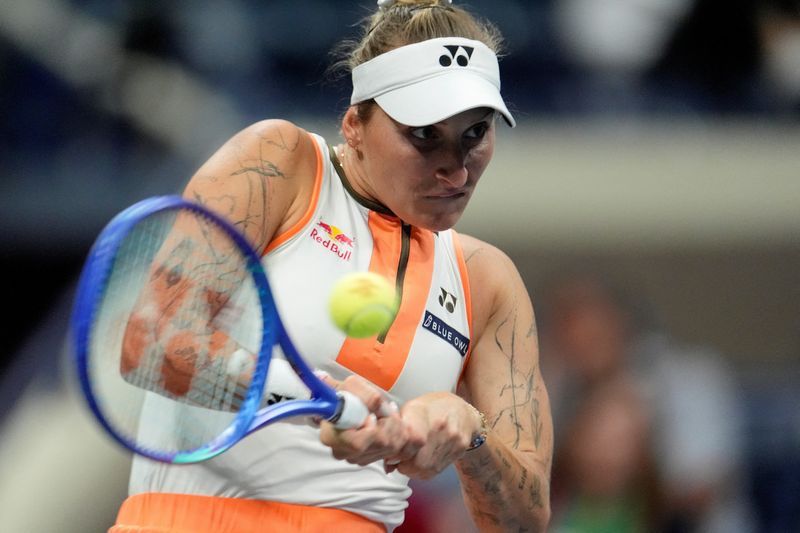
The suspension of former Wimbledon champion Marketa Vondrousova for four years has reopened longstanding tensions within professional tennis over how strictly anti-doping rules should be enforced and who bears responsibility for ensuring compliance. The International Tennis Integrity Agency handed down the penalty on Monday following Vondrousova's failure to provide a sample during an out-of-competition test at her home in December, a decision that has galvanized the Professional Tennis Players Association to demand meaningful player participation in the governance structures that oversee drug testing protocols.
Vondrousova's case presents a complex narrative that extends beyond simple rule violation. The Czech player, who claimed in April that she had endured considerable physical and mental strain leading up to the incident, described the testing officer's arrival at 8:15 p.m. as an invasive intrusion into her private life that left her feeling unsafe. Her reluctance to open her door to an unidentified individual connects to deeply personal security concerns—she cited the 2016 knife attack on fellow Czech player Petra Kvitova at her residence as shaping her response to late-night visitors. This context illustrates how blanket enforcement of anti-doping regulations can collide with legitimate athlete welfare considerations, particularly for female players navigating concerns about personal safety.
The timing of this ban proves especially contentious given recent precedent in professional tennis. High-ranking players including Jannik Sinner and Iga Swiatek received relatively lenient treatment following positive drug test results, with both avoiding substantial competitive bans. This disparity has intensified scrutiny of the International Tennis Integrity Agency's decision-making processes and raised questions about whether enforcement consistency truly depends solely on facts and evidence, as the organization claims, or whether other factors influence outcomes. The PTPA seized on this inconsistency, issuing a pointed statement questioning why a player who has never tested positive faces a four-year suspension while others who actually tested positive received minimal penalties.
The players' association's advocacy extends beyond Vondrousova's individual case to a broader structural critique of how tennis conducts anti-doping governance. The PTPA stated explicitly that athletes deserve genuine representation in formulating the rules they must follow, positioning player involvement not as a courtesy but as a fundamental requirement for fair and legitimate regulation. This argument reflects growing recognition across professional sports that governance structures lacking athlete input risk producing rules perceived as unjust or inappropriately calibrated to real-world circumstances. The association filed a lawsuit last year specifically targeting privacy violations stemming from random drug tests, demonstrating sustained organizational commitment to this reform agenda.
Tennis adopted World Anti-Doping Agency standards to align its testing regime with international norms applied across all sports disciplines. The ITIA emphasizes that this standardization ensures impartial application regardless of a player's ranking, nationality, or public profile. According to ITIA CEO Karen Moorhouse, unpredictable testing remains essential for protecting competitive integrity and distinguishing genuine clean athletes from those who might attempt to evade detection. From this institutional perspective, player comfort or convenience cannot override the imperatives of fair competition, and relaxing testing protocols risks undermining the credibility of the entire anti-doping framework that underpins professional tennis.
Moorhouse's public statements address the safety dimensions Vondrousova raised, asserting that testing procedures incorporate multiple safeguards. She noted that testers receive professional training, carry identification at all times, and arrange for testing witnesses to match player gender. Players retain the ability to verify tester credentials through alternative mechanisms if they harbour doubts about identity. The ITIA framed these provisions as evidence that the organization takes welfare seriously and has constructed protocols with athlete protection in mind. Nevertheless, the gap between institutional assurances and athletes' lived experience during testing encounters remains evident, particularly when unscheduled visits occur during evening hours at residential addresses.
The broader context reveals fundamental tensions within professional sports between anti-doping enforcement and athlete autonomy. Testing regimes predicated on unpredictability necessarily restrict players' ability to plan their schedules around testing windows, and out-of-competition testing at residences creates security considerations that extend beyond traditional competitive environments. Female athletes face particularly acute concerns about personal safety during home visits by unidentified officials, yet anti-doping protocols have historically been designed with less attention to gendered dimensions of security. Vondrousova's case crystallizes how athletes from different backgrounds may experience identical testing procedures very differently depending on their personal circumstances and previous trauma.
Vondrousova's opportunity to appeal the ban to the Court of Arbitration for Sport provides a potential avenue for reviewing both the merits of the original decision and the appropriateness of the penalty severity. Her shoulder injury, which has sidelined her from competition since January, adds another dimension to the case by removing from active play a player whose career trajectory might otherwise have been flourishing. The extended absence from tennis combined with a four-year ban could effectively terminate her professional career unless successful appeal reduces the suspension substantially. This potential outcome has motivated some observers to question whether proportionality in anti-doping penalties receives adequate consideration within current governance frameworks.
For Southeast Asian tennis audiences and players, the Vondrousova case carries particular relevance as it sets precedent for how international anti-doping bodies will treat violations in future cases. Southeast Asia has produced emerging tennis talent competing at professional levels, and understanding how anti-doping rules are applied and interpreted becomes essential for athletes navigating international competition. The controversy surrounding governance representation also speaks to broader questions about whether Southeast Asian players have sufficient voice in shaping rules that directly affect their careers. As professional tennis continues expanding globally, ensuring that anti-doping governance reflects diverse athlete perspectives and accounts for varying security contexts becomes increasingly important for maintaining sport legitimacy.
The dispute fundamentally hinges on how professional tennis balances competing values: protecting competitive integrity through rigorous, unpredictable testing against respecting athlete autonomy, privacy, and safety. Neither objective is inherently wrong, but their interaction creates genuine conflicts that current governance structures struggle to navigate equitably. The PTPA's call for expanded athlete participation in rule-making reflects recognition that sustainable anti-doping systems require legitimacy grounded in fair procedures and inclusive deliberation, not merely institutional authority backed by enforcement power. Whether tennis's governing bodies will substantively engage with these structural critiques or treat them as peripheral complaints will significantly influence the sport's evolution regarding athlete rights and welfare protection.

