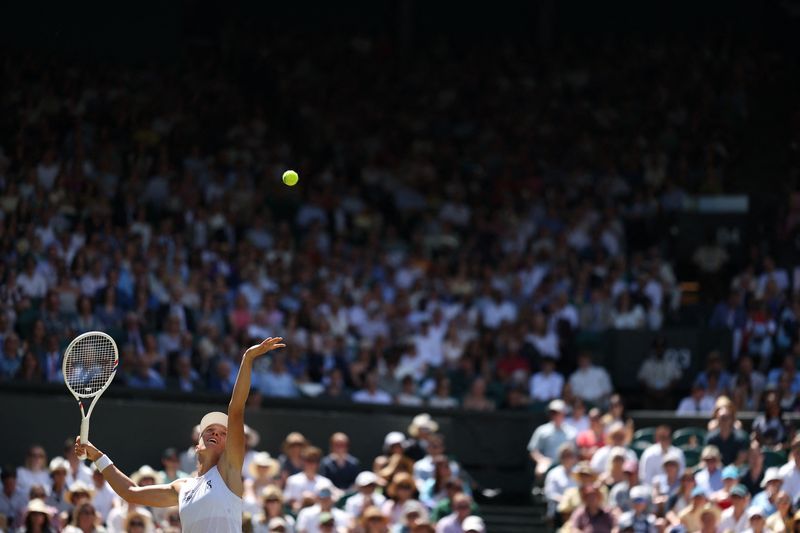
The grass courts of Wimbledon witnessed an upset of considerable magnitude on Saturday when rising Filipino star Alexandra Eala dismantled defending champion Iga Swiatek in a third-round thriller at the All England Club. The 20-year-old from the Philippines defeated Poland's Swiatek, seeded third, by a scoreline of 7-6(9) 6-2 in a match that showcased Eala's emerging prowess on the sport's most prestigious surface. The result represents a significant moment in Philippine tennis on the global stage, positioning Eala among the elite competitors in women's professional tennis.
Swiatek's journey to this match had already been marked by uncertainty and inconsistency. Last year's triumph at Wimbledon finally addressed a long-standing criticism regarding her performance on grass, a surface where aggressive baseline play proves essential. However, the 25-year-old Pole arrived in London carrying the burden of an early exit from the Bad Homburg tune-up event, suggesting her preparation had been compromised heading into the tournament. Despite navigating past American Taylor Townsend and dispatching Czech veteran Karolina Pliskova with apparent ease in her preceding rounds, Swiatek found herself underprepared for the intensity that Eala would bring to their Centre Court encounter.
The opening set evolved into an exhibition of competitive tennis that captivated spectators under blazing afternoon sunshine. Neither competitor offered the other respite as they exchanged powerful strokes from the baseline in a tightly contested tiebreaker that extended to 9-7. The psychological impact of losing this opening set manifested visibly in Swiatek's demeanor. She appeared composed enough initially, smiling as the set concluded, but quickly deteriorated into animated exchanges with her coaching team visible in the stands and frustrated gestures including a racket strike against a chair. Eala, meanwhile, absorbed the roaring appreciation from the Centre Court crowd, feeding off the energy of supporters who recognized they were witnessing something special.
The trajectory of their rivalry provides important context for understanding Saturday's outcome. When these two competitors previously met in Miami, Eala had captured an upset victory that momentarily suggested the Filipino could challenge the Polish champion. However, when they reconvened on the clay courts of Madrid, Swiatek reclaimed dominance and reasserted her status. The Wimbledon meeting thus represented a critical third encounter between players whose competitive relationship remained unsettled, with neither having definitively established supremacy across multiple surfaces.
Eala's technical strengths became the decisive factor as the second set progressed. The Filipino left-hander deployed a powerful baseline game that generated consistent difficulty for Swiatek throughout the opening stages. Her aggressive shot-making and confident court movement immediately forced her opponent into defensive positions. Eala capitalized by securing consecutive breaks of serve to establish a commanding 3-0 lead, momentum that appeared to signal a straightforward progression to victory.
Swiatek's resilience momentarily suggested a potential comeback, as she managed to retrieve one of the lost service games and created opportunities to narrow the gap. However, the Polish champion lacked the coherence and rhythm required to mount a genuine threat. Eala remained composed under pressure and efficiently closed out the match with a decisive forehand winner that confirmed her advancement to the fourth round.
This victory carries particular significance for Philippine tennis, which has historically struggled to produce competitors capable of succeeding consistently at Grand Slam tournaments. Eala's achievement demonstrates the technical development and mental toughness increasingly evident in her game. Her performance against a three-time Grand Slam winner and defending Wimbledon champion validates her status as a genuine rising force in professional women's tennis rather than a promising prospect still awaiting major breakthroughs.
Looking forward, Eala's fourth-round opponent will be Jasmine Paolini of Italy, who reached the 2024 Wimbledon final. This matchup promises to be significantly more challenging than the Swiatek encounter, as Paolini has demonstrated sustained excellence across multiple seasons and surfaces. Nevertheless, Eala's convincing demolition of the defending champion suggests she possesses the technical capability and mental fortitude to compete effectively against virtually any opponent in the current women's tennis landscape.
The broader implications of this result extend beyond individual player rankings and advancement through tournament stages. Eala's breakthrough performance indicates that the established hierarchy in women's professional tennis remains subject to disruption from emerging talents who combine technical excellence with match toughness. For Malaysian and Southeast Asian tennis enthusiasts, the result provides inspiration that players from the region can compete with and defeat the world's elite competitors at tennis's most prestigious venues. Eala's journey through Wimbledon thus commands continued attention from regional audiences who recognize her potential to reshape expectations regarding Asian representation at the Grand Slam level.

