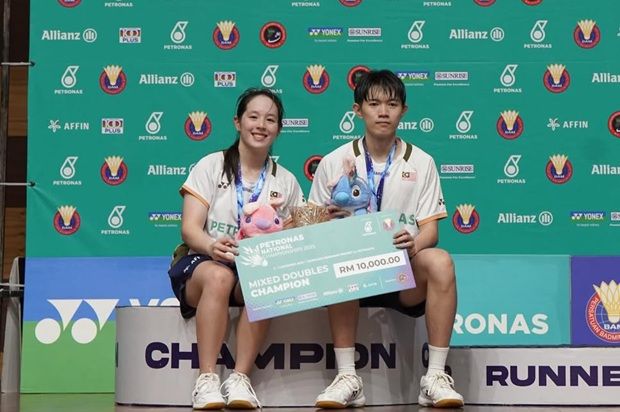
Twenty-year-old mixed doubles shuttler Clarissa San steps into the most significant tournament of her career next week with reassuring words from those closest to her in the sport. After being hastily paired with Chen Tang Jie to replace the injured Toh Ee Wei at the Japan Open, the Malaysian player has received consistent counsel from both her new partner and mixed doubles head coach Nova Widianto: remain composed and savour every moment on court. This guidance reflects the measured approach many high-performing athletes adopt when facing career-defining opportunities, particularly in major tournaments where pressure can derail even talented players.
The circumstances of Clarissa's selection underscore the unpredictability of professional badminton. Toh Ee Wei's anterior cruciate ligament injury has sidelined the original champion-in-waiting, forcing her to undergo rehabilitation in Melbourne whilst her partner seized an unexpected chance to compete at one of the Badminton World Federation's most prestigious events. For Clarissa, this represents both opportunity and uncertainty. Rather than years of gradual progression through qualifying rounds and lower-tier tournaments, she finds herself thrust into the deep end of international competition against world-class opponents. This accelerated pathway places considerable psychological demands on athletes still in their early twenties.
Clarissa has embraced the situation with maturity, articulating her goals with careful realism rather than unbridled optimism. She has explicitly acknowledged harbouring no grand expectations, framing her participation as a learning experience rather than a medal pursuit. Her primary objective remains straightforward: translate the technical work and tactical patterns she has developed through intensive training sessions into competitive performance. This mental framing—focusing on process rather than outcome—represents sound psychological preparation for athletes navigating high-pressure environments where external noise often drowns out fundamental principles.
The partnership with Tang Jie offers Clarissa a stabilising influence that extends beyond their on-court coordination. She has praised her senior partner's mentoring approach, describing how he provides constructive guidance whenever technical or tactical errors emerge during training or competition. This informal coaching relationship complements the formal instruction from Widianto, creating a supportive ecosystem designed to nurture her development whilst minimising self-doubt. Such layered support systems prove invaluable for emerging players making their breakthrough at elite levels, where mental resilience often determines success as much as physical prowess.
Tang Jie's role transcends typical mixed doubles partnership dynamics. By adopting what Clarissa describes as both mentoring and elder brother positioning, he actively mitigates the isolation young athletes often experience when competing against established international rivals. This personal investment in Clarissa's well-being creates psychological safety—essential when athletes face unfamiliar opponents and tournament environments. Malaysian badminton's strength partly derives from such mentorship cultures, where experienced players facilitate smoother transitions for emerging talent rather than treating them as mere partners.
The couple's opening assignment against Taiwan's Yang Po-hsuan and Hu Ling-fang presents a demanding but surmountable challenge. Taiwanese mixed doubles combinations have demonstrated competitive prowess on the international stage, requiring flawless execution and cohesive teamwork. Nevertheless, the pairing avoids immediate encounters with top-seeded combinations, granting Clarissa opportunity to accumulate match experience and build confidence through early-round progression. This calibrated difficulty curve allows players to settle into tournament rhythms without immediate exposure to the sport's elite tier.
Clarissa's candid acknowledgement of her developmental needs reflects maturity uncommon among athletes of her age competing at such elevated levels. Rather than projecting false confidence, she recognises substantial room for improvement across technical, tactical, and fitness dimensions. This self-awareness, coupled with her determination to maximise learning from competing alongside Tang Jie across multiple tournaments extending beyond the Japan Open, suggests a long-term perspective increasingly rare in modern sport. She has explicitly identified three or four additional tournaments lined up with her partner, indicating the Malaysian Badminton Association's commitment to stabilising and developing this nascent pairing.
Beyond Clarissa's storyline, other Malaysian combinations will compete across the Japan Open's mixed doubles draw. Jimmy Wong-Cheng Su Yin face Japan's Yuichi Shimogami-Sayaka Hobara in opening-round action, whilst the independent pairing of Goh Soon Huat-Shevon Lai Jemie take on American representatives Chen Zhi Yi-Francesca Corbett. Wong Tien Ci-Lim Chiew Sien encounter Chinese fifth seeds Guo Xinwa-Chen Fanghui, presenting Malaysia's most formidable opening hurdle. Collectively, these multiple matchups underscore the depth of Malaysian mixed doubles capability, with various combinations targeting success across different skill levels and seeding brackets.
For Malaysian badminton followers, Clarissa's Japan Open appearance carries broader significance. The tournament serves as a testing ground for whether emerging players can navigate the psychological and competitive demands of BWF World Tour elite events. Success stories like hers—driven by combination of talent, mentorship, and resilience—strengthen the talent pipeline essential for maintaining Malaysia's competitive edge in mixed doubles. As the regional badminton powerhouse faces increasing competition from China and other nations, cultivating young players capable of performing under pressure becomes strategically critical.
Clarissa's advice to remain calm and enjoy proceedings may sound simplistic, yet embodies sophisticated sporting philosophy. Enjoyment—often dismissed as frivolous in elite training environments—actually enhances performance by reducing anxiety and enabling athletes to access their full technical repertoire. By anchoring herself to this perspective alongside Tang Jie's steady mentorship and coach Widianto's direction, Clarissa positions herself to make meaningful progress at the Japan Open regardless of specific match outcomes. Whether she progresses deep into the draw or encounters early elimination, the experiences gained will likely prove invaluable for her developing career.

