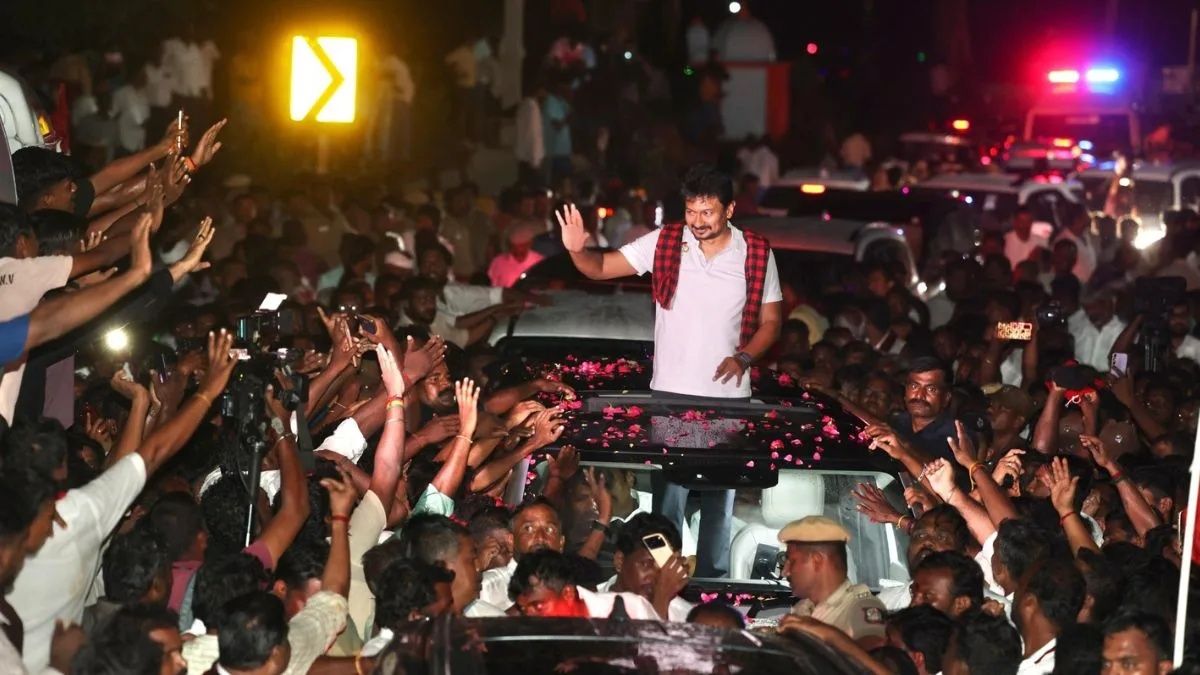
Tamil Nadu's Leader of Opposition Udhayanidhi Stalin walked free on station bail late Tuesday after spending several hours under police interrogation regarding allegations that his public remarks carried offensive undertones toward actress Trisha Krishnan. The former deputy chief minister's release sparked celebrations outside Sengipatti police station, where hundreds of DMK party supporters gathered to greet him, expressing their displeasure with what they characterised as politically motivated action by the state government led by Chief Minister Vijay and his TVK party.
The controversy originated during a DMK-organised protest gathering in Thanjavur district, where Stalin was addressing farmers' grievances and criticising the government's handling of the Cauvery water dispute and Karnataka's contentious Mekedatu dam project. As he spoke, supporters in the crowd began chanting the name of Trisha, a widely recognised Tamil cinema actress with reported proximity to Chief Minister Vijay. Stalin's response to hearing her name—a pause, a smile, followed by a comment about water flowing or not flowing to certain locations—was interpreted by ruling coalition members as containing double meanings and sexual innuendo.
The ruling TVK party seized upon the remarks, characterising them as constituting verbal harassment and inappropriate objectification of a woman. This interpretation prompted the party to escalate the matter by registering a formal police complaint and approaching the National Commission for Women with their grievances. Authorities subsequently arrested Stalin from his Chennai residence, an action that intensified political tensions in the state and drew widespread condemnation from DMK supporters who view the move as governmental vindictiveness.
Addressing journalists after his release, Stalin vehemently rejected all allegations against him, asserting that his words carried no disrespectful or malevolent undertones toward any woman. He characterised his arrest as a calculated diversionary tactic employed by the ruling administration to deflect attention from substantive governance issues and to intimidate opposition voices. Stalin maintained that his comments during the Thanjavur event were directed entirely at the Cauvery water matter and bore no connection whatsoever to the actress or any individual.
The DMK leader's statement highlighted what he views as a disturbing pattern of arbitrary arrests targeting his party's legislators and leaders whenever they challenge government policies. He articulated his perspective that the current administration in Tamil Nadu lacks the fundamental legitimacy of genuine governance, instead describing it as theatrical and performative in nature. Stalin emphasised that despite this arrest, neither he nor his party would be intimidated into silence on matters of public importance such as farmers' welfare and water resource management.
The incident reflects broader political friction between the DMK and TVK, two major competing forces in Tamil Nadu's complex electoral landscape. The TVK, led by CM Vijay, has positioned itself as a regional alternative to both traditional national parties and the DMK, which long dominated Tamil Nadu politics. Stalin, as the DMK's deputy chief minister in the previous government, represents the old guard that lost power in recent elections. This incident demonstrates how both parties weaponise legal and institutional mechanisms in their ongoing struggle for political supremacy.
For Malaysian and Southeast Asian observers, the Tamil Nadu situation illustrates how regional politics in India's southern states can escalate minor incidents into major confrontations with significant legal consequences. The involvement of women's commissions and the framing of remarks as gender-based harassment—regardless of disputed intent—shows how contemporary political contestation increasingly overlaps with advocacy around gender and dignity. This approach, while sometimes reflecting genuine concerns about objectification, can also become a political instrument when deployed selectively.
The case also underscores the precarious position of political opposition in Indian states where ruling coalitions command both governmental and law enforcement apparatus. While India's democratic institutions generally protect opposition voices from authoritarian suppression, individual states exhibit varying degrees of restraint in deploying police power against rival parties. Stalin's quick release on station bail—rather than sustained detention—suggests some institutional safeguards remain functional, though the arrest itself sends a political message.
Moving forward, the controversy may influence how Tamil Nadu politicians calibrate their language during public protests, particularly when addressing sensitive political figures. The integration of gender-based discourse into partisan political disputes creates new risks for public figures across the ideological spectrum. Stalin's assertion that his remarks were solely about water resources, however credible that interpretation may be, faced interpretation through a contemporary lens increasingly attentive to potential gender dimensions of political speech.
The incident also carries implications for how regional cinema personalities navigate politics in their home states. Actresses like Trisha occupy ambiguous positions, sometimes perceived as aligned with particular political figures or parties, creating vulnerability to weaponisation in political disputes. This dynamic reflects broader patterns across South Asian popular culture, where entertainment industry figures frequently intersect with political networks and interests.
The resolution through station bail rather than extended custody suggests both the weakness of the government's substantive case and the operation of political calculations about appearing too heavy-handed. Continued incarceration might have triggered more organised resistance and international attention regarding press freedom and political opposition. The quick release allows the government to register its disapproval while minimising reputational damage internationally or domestically among centrist voters.
As Tamil Nadu navigates the post-election political landscape following CM Vijay's TVK victory, incidents like this reveal how ruling coalitions and opposition parties will contest for legitimacy and public sympathy. The collision between traditional regional politics centred on caste, development, and linguistic identity with contemporary discourse around gender dignity and women's safety creates complex terrain where political actors must navigate carefully, or risk becoming entangled in precisely these sorts of controversies.

