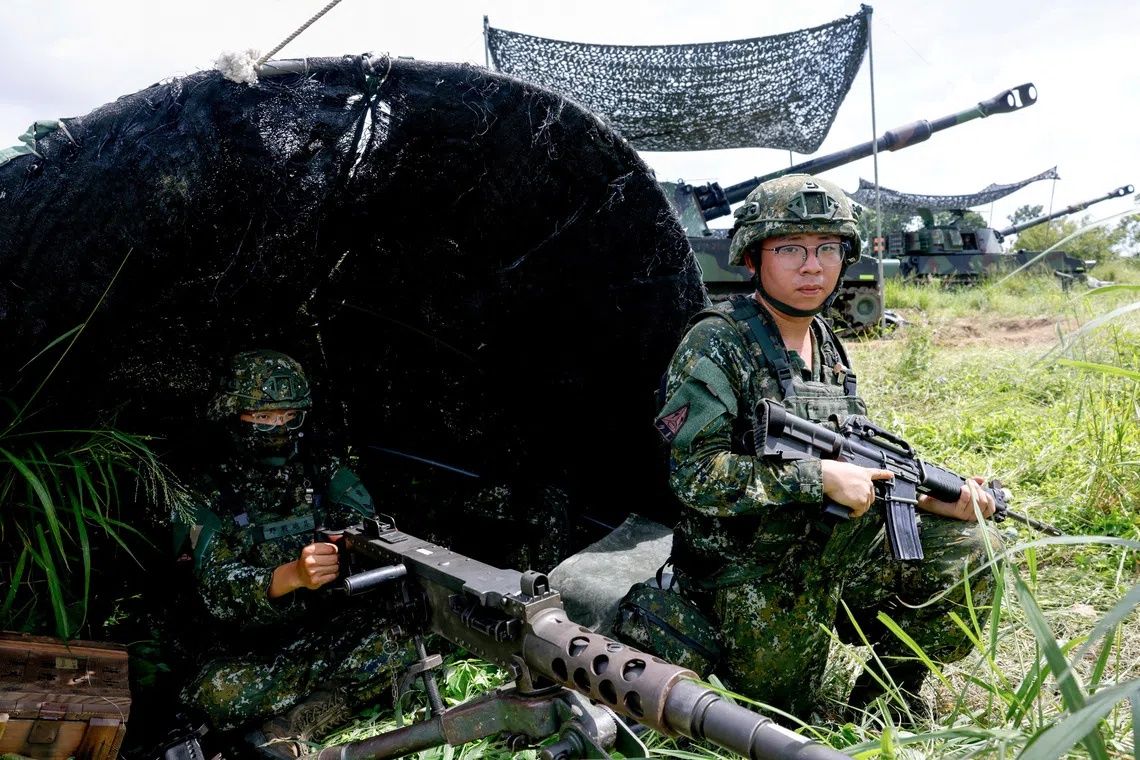
Taiwan initiated its most comprehensive annual military exercise on Wednesday with explicit emphasis on operational realism and adaptive command structures, marking a significant evolution in the island's defence posture as concerns about potential Chinese military action intensify. The Han Kuang drills, which commenced from an underground command centre in Taipei, will run for ten days and involve more than 20,000 personnel including approximately 5,000 reservists deployed across multiple operational theatres. Defence officials characterized the exercises as a decisive departure from previous iterations, moving beyond controlled, laboratory-style scenarios towards genuine field conditions that would mirror the chaos and uncertainty of actual armed conflict.
A notable innovation introduced this year involves the adoption of a "backbrief" methodology adapted from United States military doctrine, wherein junior officers receiving operational orders must restate mission parameters and objectives back to commanding officers before execution. This procedural shift aims to eliminate communication ambiguities and ensure hierarchical alignment on strategic intent throughout the chain of command. Taiwan's defence establishment views this mechanism as particularly critical given the unpredictable nature of modern warfare, where rapid enemy manoeuvres could render pre-planned responses obsolete within hours. The implementation reflects lessons drawn from international military experience and represents a tangible shift towards operational sophistication.
Perhaps most strikingly, authorities have incorporated internet bandwidth throttling into the exercise framework for the first time, deliberately slowing mobile network speeds to evaluate how civilian populations and government agencies would maintain communication functionality during wartime conditions. This dimension acknowledges the non-military dimensions of national resilience, recognizing that modern conflict extends beyond uniformed personnel to encompass entire societies dependent on digital infrastructure. The measure reflects Taiwan's growing awareness that Beijing might prioritize disrupting civilian connectivity alongside conventional military targets, forcing the island to prepare comprehensive population-level contingency measures. This civilian-focused testing represents recognition that modern warfare demands whole-of-society preparedness rather than military-only readiness.
The drills specifically target scenarios in which adversary forces attempt to neutralize Taiwan's command infrastructure, logistics networks, and defence manufacturing capacity during initial assault phases. Taiwan's strategic vulnerability lies partly in its geographical concentration of critical assets and its dependence on sea lanes for supply lines, dependencies that Chinese military planners have evidently studied extensively. The exercise will include simulated relocation of major military arsenals, mobilization of civilian manufacturing facilities for emergency production, and naval escort operations along Taiwan's Pacific coastline. These elements collectively address Beijing's presumed strategy of achieving rapid paralysis through coordinated strikes against nodal infrastructure rather than protracted conventional warfare.
Defence officials emphasized that field commanders will encounter deliberately unpredictable scenarios throughout the exercise, forcing them to rapidly reassess situations, recalibrate responses, and issue modified orders despite incomplete intelligence. This emphasis on adaptability and decision-making under uncertainty reflects fundamental military doctrine: combat rarely unfolds according to pre-arranged plans. One senior official noted that the exercise seeks to prepare commanders capable of asking critical questions—if circumstances diverge from anticipated enemy behaviour, what alternative courses of action become viable? How should one rapidly adjust previously established operational parameters? These questions address genuine command challenges that peacetime training often fails to adequately simulate.
The integration of "embedded reporter" mechanisms represents another dimension of the military's comprehensive approach. This framework will assess how Taiwan maintains effective public communication regarding frontline developments while simultaneously countering potential disinformation campaigns that adversaries might orchestrate. Modern conflict increasingly involves information warfare as a co-equal component alongside kinetic operations. Taiwan's defence establishment recognizes that controlling narratives around military engagements carries strategic weight, influencing both domestic morale and international perceptions of conflict developments. The embedded reporter system thus addresses both internal coherence and external communications during hypothetical wartime scenarios.
Taiwan's iterative refinement of its military exercises reflects hard-earned lessons from previous training cycles that critics characterized as overly choreographed and insufficiently challenging. Officials have systematically incorporated resilience drills examining how civilian government could sustain operations during compounding crises ranging from natural disasters to invasion scenarios. This comprehensive approach acknowledges that Taiwan's actual survival in armed conflict would depend not merely on military capability but on institutional capacity to function amid cascading disruptions across multiple domains simultaneously. The progression toward realistic exercises represents institutional learning that peacetime complacency carries catastrophic risks.
The strategic context undergirding these exercises reflects measurably increased Chinese military activity near Taiwan throughout recent years. Beijing has conducted repeated air incursions, naval exercises, and weapons demonstrations that military analysts interpret as rehearsals for potential military operations. China's defence ministry declined to comment on Taiwan's drills, maintaining its long-standing position that force remains an available option for achieving unification. This posture creates structural pressure on Taiwan to continuously enhance military readiness and adaptive capacity, a dynamic likely to intensify if cross-strait tensions remain elevated.
One senior defence official explicitly characterized the exercises as reflecting Taiwan's strategic evolution away from defensive assumptions based on historical adversary behaviour toward operational doctrines acknowledging genuine uncertainty. The phrasing—"entering a real field environment, facing real bottom-line conditions"—captures this transition from theoretical military science toward practical preparation acknowledging that actual conflict would impose extreme demands on personnel, systems, and institutions. This reorientation suggests Taiwan's defence establishment has internalized that deterrence through credible military capability requires not merely hardware acquisitions but demonstrated capacity to function effectively under wartime stress conditions.
The ten-day exercise concluding on August 14 will ultimately serve as diagnostic tool revealing institutional vulnerabilities and command inefficiencies that peacetime operations typically obscure. Incorporating fighter jet dispersals to alternative airfields, emergency naval deployments, and arsenal relocation procedures collectively creates operational stress sufficient to expose systemic weaknesses. Taiwan's defence community views such exercises not as mere compliance exercises but as essential investments in survival capability, particularly given China's demonstrated military modernization and strategic patience. The emphasis on realistic conditions throughout the Han Kuang drills thus reflects sober assessment of Taiwan's security environment and institutional commitment to preparedness that transcends political cycles.
For regional observers, Taiwan's exercise evolution carries implications extending beyond the island itself. Other Indo-Pacific democracies facing asymmetric military pressure—particularly the Philippines and potentially Vietnam—may examine Taiwan's methodologies for lessons applicable to their own defence planning. Taiwan's systematic emphasis on civilian resilience, command adaptability, and realistic operational stress testing offers a model for smaller nations attempting to develop credible deterrents against larger, more militarily advanced adversaries. As Chinese military capabilities continue expanding, Taiwan's institutional learning from these exercises may influence broader regional security approaches.

