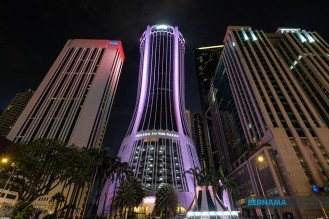
Tabung Haji's acquisition of a 30 per cent stake in Putrajaya Perdana Bhd proceeded through its entire approval chain in 2014 whilst the construction company was understood to be operating under the control of Low Taek Jho through Utama Banking Group Bhd, according to sworn testimony presented in parliament during deliberations on a Royal Commission of Inquiry report into the hajj fund's management.
Finance Minister II Datuk Seri Amir Hamzah Azizan disclosed the chronology during special sitting proceedings chaired by Minister in the Prime Minister's Department (Religious Affairs) Dr Zulkifli Hasan, responding to parliamentary concerns raised by several members including representatives from Muar, Putrajaya and Port Dickson. The investment committee endorsed the deal on July 24, 2014, followed by board approval on August 25 and ministerial sign-off on August 27, with the purchase agreement finalised on December 3 that same year. Throughout this timeline, according to testimony from Putrajaya Perdana director Datuk Rosman Abdullah recorded in the SRC International case, the company remained under Jho Low's operational control until the actual sale to Rosman's investment vehicle was completed on April 13, 2015.
The testimony further documented that SRC International, the former 1Malaysia Development Bhd subsidiary allegedly controlled by Jho Low, channelled RM170 million into Putrajaya Perdana's construction subsidiary across three instalments between July and August 2014, precisely overlapping the period when Tabung Haji was pursuing its investment approval. Whilst the court has made no formal finding regarding Jho Low's beneficial ownership status at the time, the sequential timing of these financial movements and regulatory decisions raises fundamental questions about due diligence practices during one of Malaysia's most scrutinised periods of corporate governance failures.
The valuation underpinning this transaction warrants particular examination. Tabung Haji's internal research division initially assessed the 30 per cent stake at between RM124 million and RM155 million, representing a substantially more conservative valuation than what ultimately received approval. Instead, the investment committee and board signed off on RM193.5 million without providing documented justification for the significant upward revision or for the concurrent expansion of the planned stake from 25 to 30 per cent. This departure from the original technical assessment proceeded without the required scrutiny mechanisms, as the investment panel had specifically requested identification of the ultimate shareholder but received no documented response from management prior to advancing with the transaction.
The pricing itself merits closer inspection when contextualised against the seller's own acquisition costs. Cendana Destini, the investment vehicle through which Rosman Abdullah acquired majority control, had purchased the entire equity stake for RM260 million in 2012, translating to approximately RM78 million for a 30 per cent position. Two years later, when Tabung Haji completed its purchase, the valuation had escalated to RM193.5 million, representing an increase of nearly 150 per cent in just 24 months with no corresponding operational improvements or fundamental business expansion justifying such appreciation. This extraordinary valuation jump was never disclosed to decision-makers at Tabung Haji, obscuring the economically questionable nature of the transaction at the point when approvals were being sought.
The due diligence process itself occurred outside proper governance frameworks. Rather than being conducted before approvals and presented to the investment panel or board, comprehensive due diligence was deferred until after all formal sign-offs had been secured, fundamentally inverting the appropriate sequence of corporate oversight. The 2023 fact-finding assessment commissioned to examine Tabung Haji's operations documented this pattern extending beyond this single transaction, identifying four investments that bypassed required due diligence procedures whilst recommendations from the risk management department were insufficiently addressed across the broader portfolio.
The two commercial promises anchoring the investment thesis both failed to materialise, further compounding the poor outcomes. Tabung Haji relied upon commitments that the company would secure relisting within twelve months and achieve RM86 million in profits during 2015. Neither objective was achieved, yet corrective action was not taken immediately. Instead, Tabung Haji only exercised its contractual put option in March 2018, demanding that the seller repurchase the shares at RM210.7 million. The seller declined to meet this obligation, leaving Tabung Haji with a depreciating asset. By the 2024 financial year, the entire RM193.5 million investment had been written off as a complete loss, erasing depositor capital that should have been reserved for hajj financing purposes.
The institutional complications were compounded by structural conflicts of interest. The then-chairman of Tabung Haji simultaneously held the chairman position at Putrajaya Perdana, creating an inherent tension between representing the hajj fund's interests and overseeing the company into which those interests were being invested. This dual role arrangement should have triggered enhanced scrutiny, yet appeared to have operated without commensurate governance safeguards.
Tabung Haji is now pursuing court action to recover losses, having filed a writ and obtained a Mareva injunction to freeze related assets. Court-directed mediation was scheduled for August 11, with trial proceedings now set for June 23, 2027, indicating protracted legal proceedings that may extend several years before final resolution. The extended timeline reflects the complexity of unravelling transactions executed during the period when governance standards were demonstrably compromised across multiple public institutions.
For Malaysian depositors and the broader public, this investment represents a cautionary episode in how governance failures at crucial decision-making junctures can result in permanent value destruction within institutions holding public trust. The approval architecture functioned not as an oversight mechanism preventing poor investments, but rather as a sequential rubber-stamping process where technical concerns from research divisions were overridden without documented justification. The connection to Jho Low's financial networks, whilst not formally adjudicated as conferring beneficial ownership, illuminates how interconnections between dubious corporate structures and public institution investment committees created conditions for wealth transfer away from hajj fund beneficiaries during a period when regulatory vigilance should have been at maximum intensity.

