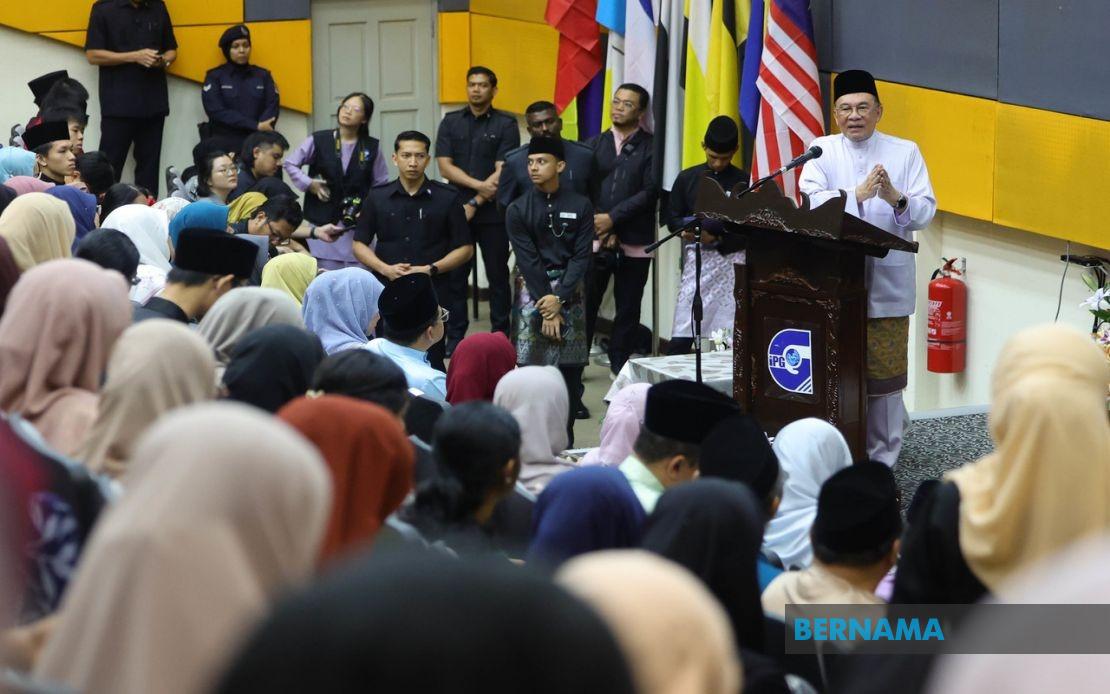
Prime Minister Datuk Seri Anwar Ibrahim has identified institutional resistance and entrenched interests as the principal barriers to Malaysia's reform agenda, rather than technical or human resource constraints. Speaking at the Technical Education Campus of the Institute of Teacher Education (IPG) in Bandar Enstek during a "Temu Anwar" engagement with students and staff, Anwar pointed to a troubling pattern whereby certain segments of society actively obstruct efforts to strengthen governance and eliminate longstanding corrupt practices.
The Prime Minister's observation reflects a sobering assessment after more than three years at the helm of government. His administration's attempts to modernise the administrative apparatus and root out systemic corruption have repeatedly encountered pushback from quarters that have benefited from the status quo. These obstructionist forces operate across both private and public sectors, creating friction against the very institutions meant to drive transformation. The resistance, Anwar suggested, transcends simple disagreement and extends to deliberate sabotage of initiatives designed to enhance transparency and accountability.
Anwar's framing of the challenge diverges markedly from conventional explanations that cite inadequate funding, insufficient expertise, or technological gaps. Instead, he argues the blockage lies deeper—in the unwillingness of established power brokers to surrender privileges derived from an opaque, unaccountable system. This resistance emerges not from ignorance but from rational self-interest: reform threatens positions and disrupts comfortable arrangements. The Prime Minister noted that even as Malaysia's administrative class may project modernity through appearance and lifestyle, this veneer masks a reluctance to genuinely transform institutional culture and practice.
The dynamics Anwar described carry particular resonance for Malaysian observers of governance. The nation has long struggled with a contradiction between aspirational reform rhetoric and institutional inertia. Numerous anti-corruption and transparency initiatives have foundered when they've threatened powerful interests within the bureaucracy, judiciary, and political establishment. By naming this phenomenon explicitly, the Prime Minister acknowledges a reality that previous administrations often skirted around. The challenge is not technical implementation but rather political and cultural will at all levels of the system.
Anwar emphasised that while reform efforts may encounter public resistance or unpopularity, government commitment to these measures must remain unwavering. He positioned strengthening governance and combating corruption as imperatives rooted in religious, cultural, and civilisational demands—framing reform as a moral obligation rather than merely an administrative convenience. This rhetorical move attempts to elevate the conversation beyond cost-benefit calculations to appeal to higher principles that transcend particular interests.
The Prime Minister's remarks also implicitly acknowledge a frustration evident across his administration: the difficulty of changing institutional behaviour when those institutions themselves resist examination. Over three years, his government has pursued various anti-corruption initiatives, financial transparency reforms, and governance modernisations. Yet each effort has generated friction from defenders of the old system. This pattern suggests that legislating reform, while necessary, proves insufficient without accompanying shifts in institutional culture and personnel selection.
For Malaysia's education sector specifically—the audience Anwar addressed at IPG—the comments carry weight. Teacher training institutions bear responsibility for developing pedagogical approaches that emphasise integrity, critical thinking, and ethical governance. If future educators themselves encounter institutional resistance when attempting to introduce innovation or challenge accepted practices, their effectiveness diminishes. Anwar's address thus served to encourage educators to recognise systemic obstacles as surmountable challenges rather than inevitable features of institutional life.
The underlying tension Anwar highlighted extends beyond Malaysia's borders. Across Southeast Asia, governments pursuing anti-corruption and governance reforms encounter similar resistance. Singapore's experience demonstrates that such transformation requires both top-down political commitment and sustained institutional pressure. Thailand's repeated reform attempts have foundered on precisely the resistance Anwar describes. This context positions Malaysia's reform agenda within a broader regional struggle between modernising forces and entrenched interests protecting traditional power structures.
Anwar's diagnosis also touches on a critical question for Malaysia's future: whether the country can achieve substantive institutional change within existing political and economic frameworks, or whether genuine transformation requires more fundamental restructuring. If reform resistance stems from individuals and networks rather than systemic design flaws, targeted personnel changes and institutional redesign might suffice. If, however, the resistance reflects structural incentives embedded in Malaysia's political economy, more fundamental shifts in how power and resources flow through institutions may be necessary.
The Prime Minister's comments suggest growing impatience with incremental approaches and symbolic gestures. After three years in office, Anwar appears increasingly willing to explicitly criticise those blocking reform, naming the phenomenon rather than euphemistically referring to "stakeholder concerns" or "implementation challenges." This rhetorical shift may signal a hardening of government positions and a reduced willingness to negotiate with reform obstructionists.
Looking forward, Anwar's framing poses challenges for his coalition government. If resistance to reform emanates from within the government apparatus itself—from ministers, senior bureaucrats, or politically connected figures—then confronting this resistance risks internal political costs. Managing the balance between pushing transformative change and maintaining sufficient political cohesion to govern represents an ongoing challenge. The Prime Minister's public statements suggest he intends to press forward regardless, betting that popular support for cleaner, more accountable governance outweighs the political friction generated by challenging entrenched interests.

