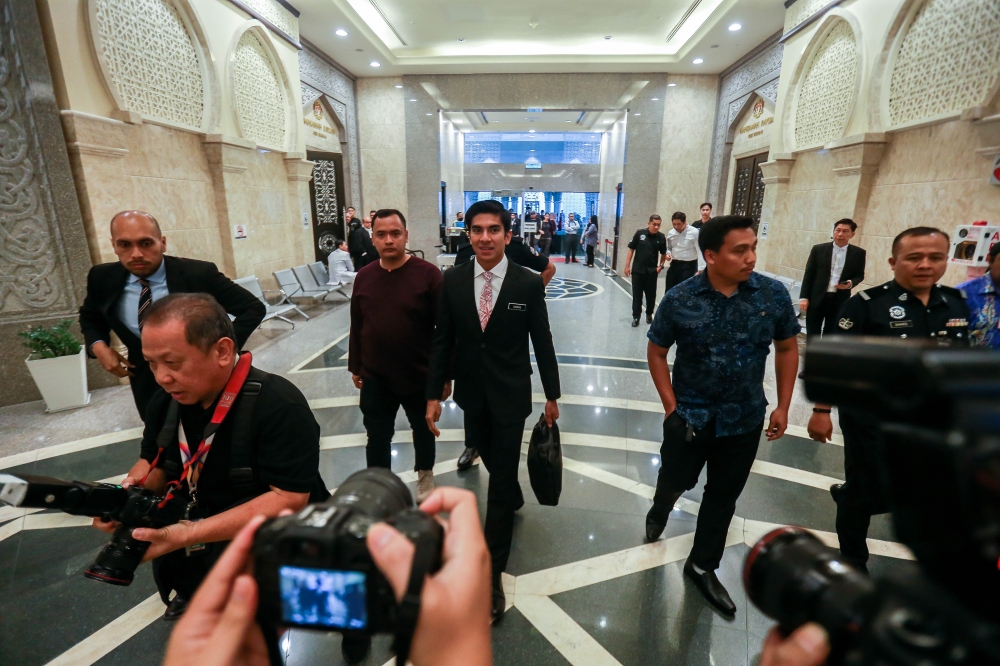
The Palace of Justice in Putrajaya became the focal point of intense political attention on July 13 as Muar Member of Parliament Syed Siddiq Syed Abdul Rahman arrived to face a pivotal Federal Court ruling that could determine the trajectory of his career and personal life. The high-profile case has drawn considerable public interest, with crowds assembling early at the courthouse to witness the proceedings unfold. Syed Saddiq, a prominent figure in Malaysian politics known for his advocacy on youth and entrepreneurship issues, appeared composed as he entered the building surrounded by family members and his fiancée, who provided visible support during what observers recognized as a watershed moment.
The case against Syed Saddiq encompasses serious corruption allegations that have gripped national attention for months. As a former Deputy Minister under the Perikatan Nasional administration, he has occupied positions of considerable influence, making the charges particularly significant for governance and accountability discourse in Malaysia. The specific allegations relate to financial irregularities involving political party funds, matters that strike at the heart of public trust in institutional integrity. Federal Court proceedings at this level typically address fundamental legal questions and constitutional principles, suggesting that the judgment could have ramifications extending beyond the individual defendant to broader jurisprudence on political finance oversight.
The gathering of supporters and family members at the courthouse reflected the polarized nature of Malaysian political discourse surrounding this matter. Syed Saddiq has maintained a vocal presence on social media and through public statements, asserting his innocence and criticizing what he characterizes as politically motivated prosecution. His supporters have organized demonstrations and launched campaigns questioning the impartiality of the legal process, arguments that resonate with segments of the population skeptical of the judiciary's independence. Conversely, his detractors argue that no individual should stand above the law, and that accountability for public officials represents a cornerstone of democratic governance that cannot be compromised regardless of political affiliation.
The composition of the Federal Court bench hearing this matter has attracted scrutiny from legal observers and political analysts alike. Malaysia's judicial system faces ongoing questions about the separation of powers and the extent to which executive pressure influences senior judicial appointments and decisions. The presence of multiple judges at the Federal Court level suggests that the legal questions under consideration warrant careful deliberation among senior jurists, though the specific grounds for judicial review remain subject to legal interpretation that will only become clear upon judgment delivery. This procedural complexity underscores how Malaysian constitutional and criminal law intersect with practical politics.
Syed Saddiq's political trajectory prior to these allegations demonstrated meteoric rise through government ranks. His appointment to ministerial positions at a relatively young age positioned him as a potential future leader within his political party and the broader political ecosystem. The charges, if substantiated, would mark a dramatic reversal of fortune and raise questions about internal party mechanisms for vetting candidates and monitoring ministerial conduct. His career arc exemplifies both the opportunities and perils within Malaysian politics, where rapid advancement can be followed by equally rapid downfall when legal troubles emerge.
The presence of his fiancée at the courthouse carries symbolic weight in this narrative. Personal relationships often become scrutinized when public figures face legal proceedings, with family support interpreted as loyalty during adversity. The decision to have his fiancée present signals an attempt to project normalcy and stability despite the gravity of circumstances, a calculated public relations move that reflects broader trends in how political figures manage their image during crises. Whether such displays influence judicial decision-making remains an open question, though empirical evidence suggests courts operate independently of courtroom atmospherics.
From a Southeast Asian perspective, this case illustrates challenges that multiple democracies in the region grapple with regarding political finance transparency and elite accountability. Thailand, Indonesia, and the Philippines have all confronted similar scandals involving public officials and misappropriated funds, suggesting that institutional weaknesses around campaign finance regulation and oversight cut across national boundaries. The verdict in Syed Saddiq's case could establish precedents that Malaysian authorities cite when addressing comparable situations, potentially strengthening or weakening mechanisms for political finance accountability depending on the judgment's nature.
The timing of the Federal Court ruling carried implications for Malaysian politics beyond the individual case. Political alignments within Parliament remain delicate, with coalition stability dependent on individual lawmakers maintaining their positions. Should the court impose custodial sentences or substantial sanctions against Syed Saddiq, his parliamentary seat could become vacant, triggering byelectoral processes that might reshape local political dynamics. Conversely, an acquittal or lenient judgment would vindicate his supporters' claims about prosecutorial overreach and raise troubling questions about whether Malaysia's legal system applies uniform standards to political opponents and allies.
Media coverage of the case reflected deeper partisan divisions within Malaysia's information ecosystem. Different news outlets and online commentators interpreted identical facts through divergent political lenses, contributing to polarization around the legitimacy of the legal proceedings. This fragmentation of shared factual understanding complicates efforts to build public consensus around accountability mechanisms, creating an environment where judicial decisions face rejection from substantial constituencies regardless of their substantive merits. The Federal Court ruling would need to address not only the technical legal questions but implicitly also the broader institutional legitimacy crisis affecting Malaysian courts.
As proceedings moved forward, observers recognized that this case would establish important precedents for how Malaysian courts handle allegations against sitting parliamentarians and former government officials. The intersection of parliamentary privilege, ministerial accountability, and criminal culpability raises complex constitutional questions that the court's judgment would necessarily address. Legal scholars have long debated whether Malaysia's constitutional framework adequately protects democratic institutions while maintaining mechanisms sufficient to pursue legitimate prosecutions against government officials. The Syed Saddiq judgment would contribute meaningfully to this ongoing jurisprudential conversation.

