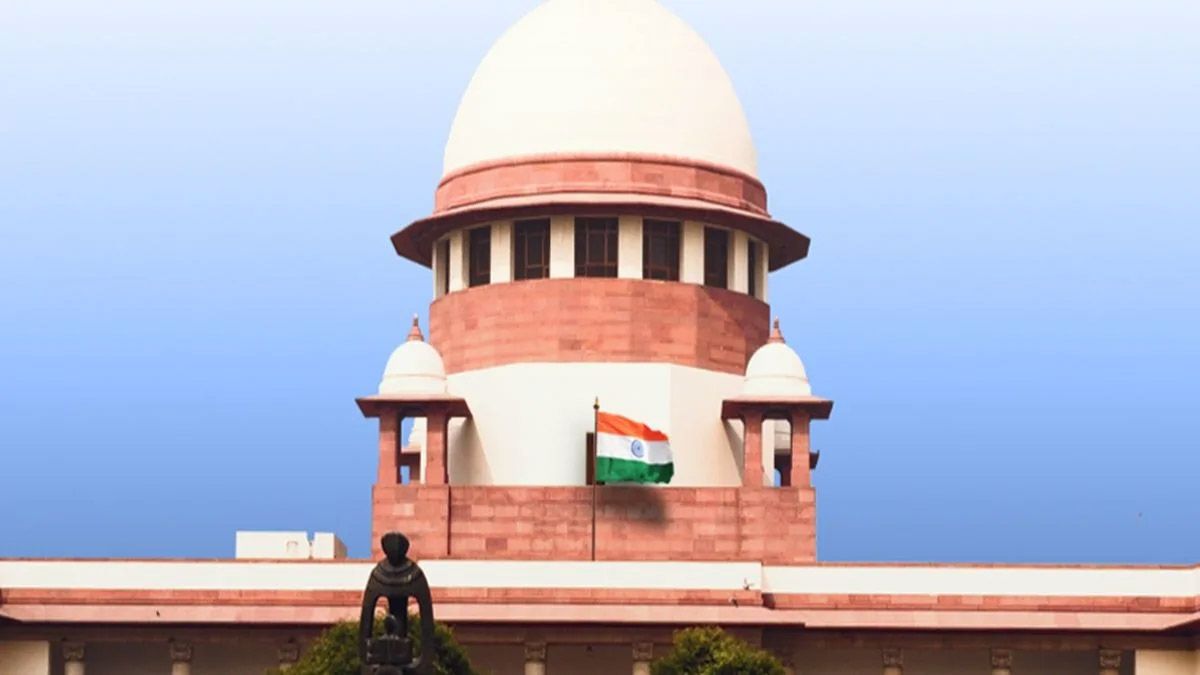
The Supreme Court of India on Monday intervened to suspend a sweeping judgment from the Madras High Court that would have eliminated cow and calf slaughter across Tamil Nadu entirely. A bench comprising Justices Vikram Nath and Sandeep Mehta issued a formal notice to the Tamil Nadu government's Special Leave Petition and granted an interim stay of the May 27 High Court order, signalling the top court's preliminary view that the lower court's directive had overstepped acceptable judicial bounds. Justice Nath's observation that the impugned order required "correction" before interim relief could be granted suggested the Supreme Court found fundamental flaws in both the reasoning and scope of the Madras High Court's decision.
The Tamil Nadu government's appeal to the Supreme Court centred on a critical distinction between regulation and outright prohibition. State authorities argued that the Madras High Court had fundamentally misinterpreted its role by transforming what began as a targeted petition about slaughter conditions into a sweeping ban that contradicted established statutory frameworks. The original public interest litigation, filed by K Surya Prasanth of the Hindu Makkal Katchi, had sought reasonable safeguards: preventing cow slaughter in public spaces and confining any killing to authorised facilities. Instead, the High Court expanded this to prohibit all cattle slaughter anywhere in the state, without exception—even during significant occasions like Bakrid or in regulated slaughterhouses designed specifically for this purpose.
The legal landscape governing animal slaughter in Tamil Nadu reflects a carefully constructed system balancing multiple interests and concerns. The Tamil Nadu Animal Preservation Act of 1958 provides the foundational regulatory framework, establishing conditions under which cattle slaughter may be permitted rather than imposing blanket prohibition. This legislation has coexisted with a 1976 Government Order that banned slaughter of cows and heifers in official slaughterhouses, creating a nuanced position that allows regulated slaughter of other categories of livestock while restricting cattle specifically. The state's position rests on interpreting these instruments as complementary regulatory measures, not as absolutes that should eliminate discretion or deny slaughter rights entirely.
The state government further invoked multiple national statutes to support its argument that existing law contemplates managed slaughter through designated facilities. The Prevention of Cruelty to Animals Act of 1960 and its associated Slaughter House Rules of 2001 establish procedural safeguards and infrastructure standards. Urban local bodies legislation, including the Tamil Nadu Urban Local Bodies Act and its 2023 rules, define responsibilities for regulating slaughterhouses. Food safety regulations add another layer of oversight. Together, this legal architecture creates oversight mechanisms and quality controls rather than categorical bans, allowing the state to balance animal welfare concerns with cultural and religious practices affecting significant populations.
The Madras High Court's May 27 judgment had grounded its expansive prohibition in Article 48 of the Indian Constitution, which encourages states to prohibit slaughter of cows and other dairy and draught animals. The court also relied heavily on the 1976 Government Order, interpreting it as having achieved legal permanence through sustained government practice and treating it as effectively constitutional in force. The High Court's interpretation suggested that constitutional aspirations and historical government directives should convert into absolute judicial mandates, directing state officials including the Chief Secretary and police leadership to ensure nationwide compliance without exception on any occasion.
For Tamil Nadu and the broader Southeast Asian region, this dispute raises fundamental questions about judicial authority and legislative primacy. The Supreme Court's intervention signals concern that courts cannot unilaterally rewrite regulatory schemes, even when motivated by worthy objectives like animal protection. Judges cannot transform limited remedies requested by petitioners into categorical prohibitions affecting entire communities and economic sectors. This principle protects the separation of powers essential to functioning democracies, ensuring that courts interpret law rather than create new legal regimes from the bench. Malaysia's own constitutional order, with its Federal Court as the apex, relies similarly on respecting legislative and executive boundaries even when courts find compelling policy arguments.
The religious dimensions of this dispute warrant careful consideration. Bakrid celebrations, marking the Islamic festival of Eid al-Adha, hold profound spiritual significance for Muslim communities across India and Southeast Asia. Traditional practices including animal sacrifice remain central to this observance. A blanket prohibition imposed through judicial order effectively privileges one religious perspective over established pluralistic frameworks that accommodation multiple faith traditions simultaneously. This raises concerns about judicial overreach into matters of religious liberty and cultural practice, areas where democratic legislatures better serve pluralistic societies by balancing competing interests through open debate and negotiated compromise rather than binary prohibitions.
The Supreme Court's decision to stay the Madras High Court order pending full hearing preserves the status quo while allowing genuine legal consideration of the deeper issues. The interim relief prevents the blanket prohibition from taking effect while the court examines whether the High Court had jurisdiction to expand the case so dramatically beyond its original scope. This measured approach respects both the serious concerns about animal welfare that motivated the original petition and the concerns of communities for whom regulated slaughter remains culturally and religiously significant. The pending full hearing will determine whether the High Court can justify its extraordinary expansion of judicial power.
For livestock producers and slaughterhouse operators in Tamil Nadu, the interim stay provides temporary relief from an order that would have devastated their livelihoods and violated contractual obligations. Thousands of workers and small-scale operators depend on regulated slaughter facilities for their economic survival. The Supreme Court's caution suggests recognition that eliminating entire economic sectors and cultural practices requires democratic process, not judicial decree, however well-intentioned.
The broader implications extend across South Asia's federal systems. As courts increasingly receive public interest petitions on environmental, animal welfare, and religious matters, the question of legitimate judicial scope becomes ever more critical. Judges must distinguish between interpreting existing law creatively and rewriting regulatory frameworks wholesale. This case may influence how Indian courts, and by extension regional judicial systems, balance social activism with constitutional restraint—a tension increasingly apparent as courts worldwide grapple with their proper constitutional role in diverse, polarised societies where reasonable people disagree fundamentally on fundamental values.

