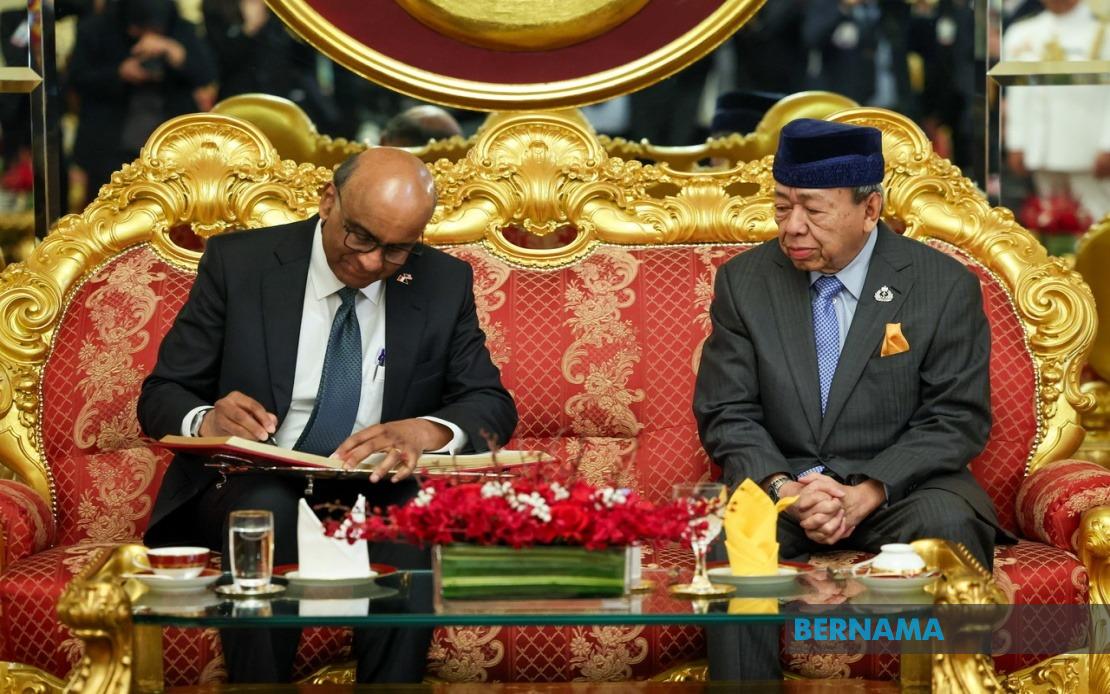
The Sultan of Selangor, Sultan Sharafuddin Idris Shah, held an official audience with Singapore President Tharman Shanmugaratnam at Istana Alam Shah in Klang on July 14, marking a significant moment in bilateral relations between Malaysia and Singapore at the state level. The meeting, which formed part of the Singaporean president's three-day official visit to Malaysia, highlighted the enduring diplomatic connections between the two neighbouring nations and the importance placed by both governments on maintaining high-level engagement.
President Tharman arrived at the palace at 11 am and was formally received by the Raja Muda of Selangor, Tengku Amir Shah, signalling the ceremonial importance accorded to the visit. The audience lasted approximately ninety minutes, concluding at 12.40 pm before the president departed. The presence of Entrepreneur Development and Cooperatives Minister Steven Sim, who served as the minister-in-attendance, underscored the governmental significance of the engagement and demonstrated Malaysia's commitment to facilitating productive dialogue with its closest regional partner.
President Tharman's visit to Malaysia, spanning from July 13 to 15, came by invitation of His Majesty Sultan Ibrahim, King of Malaysia. This three-day engagement represented a reciprocal gesture following the Malaysian sovereign's own state visit to Singapore on May 6 and 7, 2024. The alternating visits between the two nations' highest officials reflect established protocols in maintaining warm bilateral relations and provide opportunities for candid discussions on matters of mutual interest and concern.
The timing and venue of the Selangor audience carry particular significance within Malaysia's federal structure. As one of the country's most economically dynamic states and home to much of the Klang Valley's manufacturing and commercial base, Selangor holds considerable weight in national affairs. The decision to host the Singaporean president at Istana Alam Shah, the official residence of the Selangor Sultan, demonstrated respect for state-level institutions and provided the Sultan with a direct channel to engage with Singapore's leadership on matters affecting the region's largest metropolitan area.
Singapore's position as Malaysia's second-largest trading partner globally takes on added meaning when viewed through the lens of regional integration. Among ASEAN member states, Singapore ranks as Malaysia's most significant trading partner, a relationship built over decades of economic interdependence and shared commitment to regional stability. The bilateral trade flows reflect the complementarity of the two economies, with Singapore serving as a crucial financial and logistics hub for Malaysian businesses and Malaysia providing essential resources and manufacturing capacity to support Singapore's economic ecosystem.
The diplomatic engagement also occurs against the backdrop of broader Southeast Asian dynamics. As ASEAN navigates complex regional challenges ranging from trade negotiations to maritime security and digital transformation, the strong Malaysia-Singapore relationship serves as a stabilising anchor within the association. Both nations have demonstrated commitment to ASEAN centrality in regional affairs while maintaining robust bilateral channels that allow for nuanced discussions beyond the formal multilateral framework.
For Malaysia specifically, regular high-level visits from Singapore's leadership reinforce the country's position as a consequential player in regional geopolitics and economics. Such engagements provide platforms for addressing bilateral issues that require personalised diplomatic attention, from border management to trade facilitation and cultural exchanges. The Selangor audience represented an opportunity for the Sultan to articulate state-level perspectives on matters affecting the region, particularly given Selangor's direct proximity to Singapore and the extensive people-to-people connections that characterise the relationship.
The visit also signals continuity in leadership on both sides and a commitment to institutional stability. President Tharman's presidency, coupled with Malaysia's current political configuration, provides a stable foundation for sustained engagement. Both nations have demonstrated capacity to manage differences while amplifying areas of cooperation, a maturity that reflects their shared history and overlapping interests in maintaining a rules-based regional order.
Looking forward, such state visits serve broader strategic purposes beyond immediate diplomatic pleasantries. They create space for exploring new areas of cooperation, whether in technology, sustainability, or people-to-people exchanges. For Malaysian readers, particularly those in Selangor, the hosting of Singapore's president signals their state's continued relevance in national and regional affairs. The engagement underscores that prosperity and stability in the region depend fundamentally on the strength of the Malaysia-Singapore partnership, a relationship that transcends electoral cycles and political transitions to remain grounded in mutual interest and geographic necessity.

