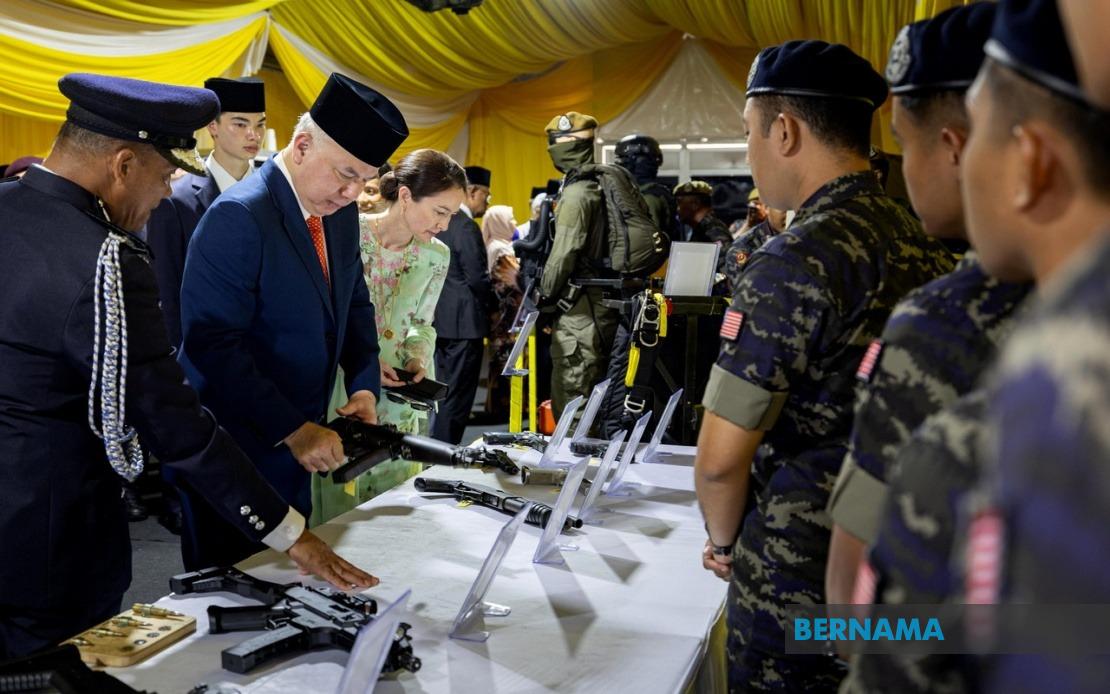
The Sultan of Perak, Sultan Nazrin Shah, formally inaugurated the Sultan Nazrin Shah 69 Commando Camp in Ulu Kinta on July 7, marking a significant milestone for one of Malaysia's most decorated security units. The ceremony brought together the state's royal household, senior government officials, and law enforcement leadership, underscoring the political and strategic importance of the new facility. Among those attending were Tuanku Zara Salim, the Raja Permaisuri of Perak, as well as state officials including Menteri Besar Datuk Seri Saarani Mohamad and Home Minister Datuk Seri Saifuddin Nasution Ismail.
The establishment of this modern facility represents more than routine infrastructure development. Home Minister Saifuddin Nasution framed the camp's opening as a tangible expression of the MADANI Government's resolve to fortify Malaysia's security apparatus in response to an increasingly volatile regional and global security landscape. He articulated the government's conviction that providing elite commando units with world-class facilities and training environments is essential to maintaining the nation's defensive posture. The rhetoric surrounding the launch reflects growing recognition within policymaking circles that counterterrorism and complex security challenges demand continuously upgraded operational infrastructure.
Malaysia's standing on the international peace index provided context for the government's investment narrative. The country's ranking of 12th among 163 nations in the Global Peace Index represents a point of institutional pride, and officials attributed this achievement partly to the professionalism and readiness of specialized units like the 69 Commando. This positioning serves multiple purposes domestically and internationally—it validates security spending while also projecting stability to foreign investors and regional partners concerned about Malaysia's security environment.
The 69 Commando unit's operational history demonstrates why the government considers this investment strategically sound. Established in 1969, the unit has accumulated more than five decades of active service across some of Malaysia's most demanding security operations. The unit's roster of significant engagements includes the prolonged campaign against communist insurgency, the 2000 Al-Maunah incident which tested hostage rescue capabilities, and the 2013 Operation Daulat response in Lahad Datu, Sabah, where the unit confronted an armed incursion. The unit also deployed personnel in connection with the MH17 tragedy investigation in 2014, expanding its operational scope beyond traditional counterinsurgency into international security matters.
The breadth of responsibilities the 69 Commando has undertaken reveals why Malaysian policymakers view this unit as a linchpin of national security architecture. Beyond conventional combat operations, the unit specializes in counter-terrorism work, high-risk hostage rescue missions, and responses to unprecedented security threats that stretch conventional policing responses. This diversification of tasks reflects the evolution of Malaysia's security challenges over recent decades, from Cold War-era communist threats to contemporary transnational terrorism and hybrid security scenarios.
The financial commitment underlying the new facility demonstrates significant capital allocation toward security infrastructure. Constructed at a cost exceeding RM206 million across a 338-hectare expanse, the Sultan Nazrin Shah Camp represents one of Southeast Asia's more substantial investments in specialized military infrastructure. The scale of this expenditure signals that the government views the 69 Commando not as a residual Cold War unit requiring minimal maintenance, but as a cornerstone institution deserving modern, comprehensive facilities spanning operations, training, and administrative functions.
The camp's development process incorporated extensive operational planning before the facility transitioned to Royal Malaysia Police administration in 2024. This deliberate approach, beginning with detailed requirement analysis and progressing through meticulous construction, reflects lessons learned from earlier military infrastructure projects in the region. The phased approach allowed the facility to incorporate contemporary operational doctrine and training methodologies rather than replicating outdated designs.
Saifuddin Nasution characterized the new camp as a generational investment with implications extending decades into the future. Beyond its immediate utility as a base of operations, he positioned the facility as an institution-building endeavor designed to cultivate successive cohorts of commando personnel. This institutional perspective acknowledges that security effectiveness depends not merely on equipment and facilities but on systematic professional development, knowledge transmission across generations, and maintenance of operational culture. The camp thus functions as a physical manifestation of organizational continuity.
The naming convention itself carries symbolic weight within Malaysia's political culture. Designating the facility after the reigning Sultan acknowledges both the unit's importance to national security and the constitutional role of the monarchy in Malaysia's political architecture. This naming practice, common throughout Malaysian government institutions, reinforces the symbolic connection between the security forces and the constitutional monarchy, grounding security operations within Malaysia's unique institutional framework.
For Malaysian and regional security observers, the camp's inauguration signals several broader policy trajectories. It indicates sustained government commitment to counterterrorism capabilities during a period when such threats persist across Southeast Asia. The facility's scale and sophistication also suggest Malaysia is positioning itself as a regional security player capable of managing complex threats independently rather than relying entirely on external partners. Additionally, the emphasis on training and institutional development suggests Malaysian military planners are thinking strategically about long-term force modernization beyond immediate procurement needs.
The regional implications warrant consideration as well. Southeast Asian governments increasingly recognize that transnational security threats—terrorism, maritime piracy, arms trafficking, human trafficking networks—demand specialized rapid-response capabilities. Malaysia's visible investment in upgrading its commando unit may influence defense planning conversations throughout the Association of Southeast Asian Nations, potentially encouraging peer nations to examine their own specialized forces infrastructure. Moreover, Malaysia's demonstration of institutional capacity to design, fund, and deliver large-scale security infrastructure may enhance its standing as a potential regional security partner and training provider.
Looking forward, the Sultan Nazrin Shah Camp represents a watershed moment in Malaysia's approach to specialized security operations. The facility embodies a maturation of thinking about how nations sustain elite military capabilities across generational transitions. By providing comprehensive modern facilities alongside systematic training and professional development frameworks, Malaysia is attempting to ensure that the 69 Commando's five-decade legacy of operational excellence continues uninterrupted into its next chapter. The camp's opening thus closes one chapter of the unit's history while opening another, with implications for Malaysia's security posture extending well beyond Perak.

