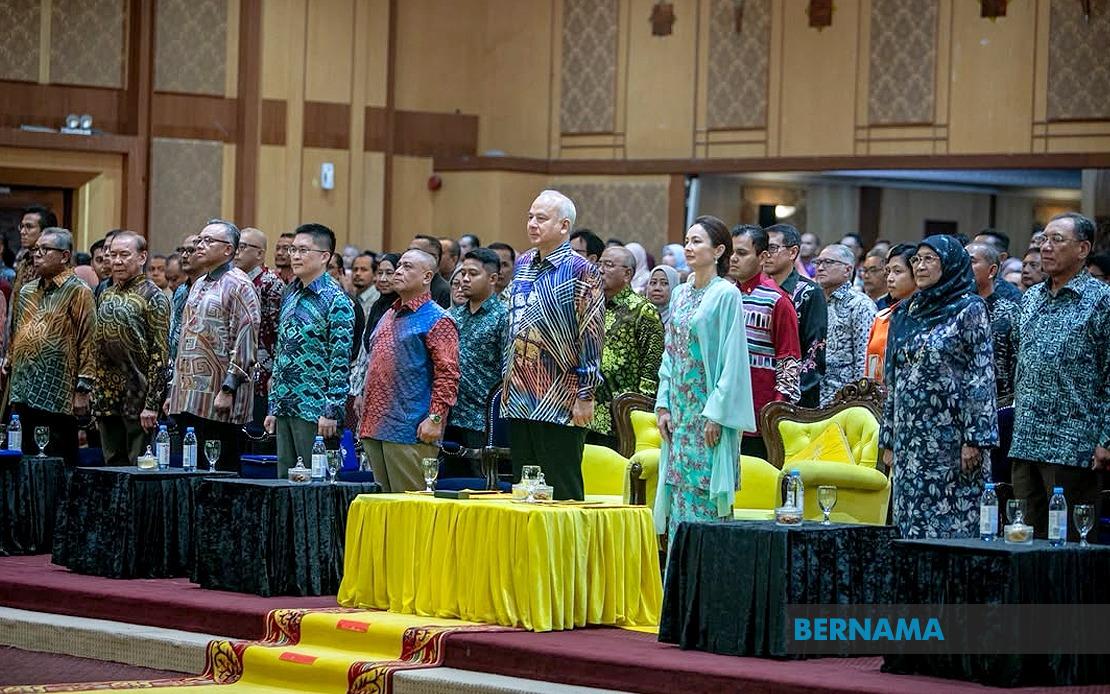
Sultan Nazrin Shah, the reigning Sultan of Perak, presided over the state's 2026 Merdeka Month celebration at Bangunan Perak Darul Ridzuan in Ipoh on Thursday evening, underscoring the royal house's continued commitment to fostering patriotic values among the younger generation. The presence of Raja Permaisuri Tuanku Zara Salim alongside Menteri Besar Datuk Seri Saarani Mohamad and Deputy Education Minister Wong Kah Woh highlighted the collaborative nature of the initiative, bringing together state and federal government stakeholders in a unified effort to nurture national pride through educational engagement.
The scale of the 2026 programme reflects a remarkable surge in public interest and student participation across Perak's education system. With 214,095 entries submitted across the competition categories, the event drew involvement from 83.6 per cent of the state's primary and secondary school students, demonstrating substantial reach within the education landscape. This broad-based engagement represents far more than mere numerical success; it signals genuine resonance with the programme's core objectives among young Malaysians and their families in the state.
Perak Education Department director Zulkafli Mohamed Mokhtar articulated the significance of these participation metrics during his address, emphasising that the fifteen per cent year-on-year increase in entries reflects the programme's expanding relevance within the education community. Beyond raw numbers, he characterised the initiative as having evolved into a vital platform for identifying and nurturing student talent across diverse fields, while simultaneously building the self-assurance that young people require to pursue their potential confidently. The director framed these competitions as vehicles for comprehensive personal development rather than mere academic exercises.
The pedagogical philosophy underpinning the Merdeka Month programme aligns closely with Malaysia's broader educational transformation agenda. Zulkafli referenced the Malaysia Education Plan 2026-2035, the government's overarching blueprint for systemic educational improvement, suggesting that the state-level initiatives serve as practical implementations of national strategic objectives. The programme targets the simultaneous cultivation of academic excellence, moral integrity, critical thinking capacity, and patriotic consciousness—qualities deemed essential for developing the country's future leadership cohort.
Cultural and linguistic competitions formed the backbone of the event's diverse offerings. The public speaking tournaments, conducted in both Malay and English, challenged students to articulate thoughts and ideas across Malaysia's two primary institutional languages, reflecting the bilingual foundation of Malaysian education. Ifwat Arrafi Mohd Amin of SMK Tun Abd Razak in Bagan Datuk claimed the upper secondary Malay language championship, whilst E Johnnes Abysia from SMK Sungai Pari in Kinta Utara emerged victorious in the English-language category, representing excellence across both linguistic domains.
The competition programme extended well beyond rhetoric and oratory into visual and performing arts domains. Choral speaking, choral recitation, and choir competitions provided platforms for collaborative artistic expression, whilst caricature drawing and other visual arts categories offered outlets for creative talent. Essay writing, poetry composition, and poster design competitions rounded out an impressively comprehensive suite of activities, each designed to engage different student temperaments and aptitudes. This diversity ensures that the Merdeka Month celebration reaches beyond the academically conventional to encompass creative and artistic dimensions of student development.
Recognition of institutional excellence formed another crucial element of the evening's proceedings. The Kinta Utara District Education Office received the special award for Best Achievement by District Education Office, accompanied by a cash prize of RM20,000. Such recognition mechanisms serve dual purposes: they acknowledge the administrative and pedagogical efforts of district-level education officials whilst establishing a competitive incentive structure that encourages continuous improvement across all district offices in the state. The monetary component provides tangible resources that district offices can reinvest in future educational initiatives and student development programmes.
The royal couple's participation in prize presentation ceremonies throughout the evening carried symbolic weight beyond the ceremonial formalities. By personally handing awards to student competitors across multiple categories, Sultan Nazrin and Tuanku Zara Salim demonstrated that the monarchy views these educational achievements as matters worthy of royal recognition and attention. For student recipients, receiving accolades directly from their state's ruler creates memorable moments that reinforce the connection between individual accomplishment and national service. Such ceremonial recognition can profoundly influence young people's sense of civic importance and belonging within the broader Malaysian national narrative.
The programme reflects broader Southeast Asian trends in education, where regional governments increasingly emphasise patriotic education and national consciousness-building alongside academic achievement. Malaysia's approach, centred on celebrating student talent whilst embedding nationalist values, positions educational competitions as instruments of nation-building. For a diverse, multi-ethnic society, such platforms offer opportunities for students from different backgrounds to participate collaboratively in shared national celebrations, potentially strengthening social cohesion during their formative years.
The fifteen per cent participation increase year-on-year suggests that the Merdeka Month programme has successfully embedded itself within Perak's educational calendar and student consciousness. As schools now routinely encourage students to participate in these competitions, the initiative has transitioned from peripheral activity to integral component of the academic year. This institutionalisation increases the likelihood of sustained engagement and expanding reach in future iterations of the programme.
For Malaysian policymakers and educators observing this success, the Perak programme offers instructive lessons about creating educational initiatives that simultaneously serve multiple objectives. By combining talent identification with patriotic education, artistic expression with competitive achievement, and individual recognition with institutional accountability, the programme demonstrates how well-designed competitions can become vehicles for comprehensive youth development. The royal patronage, government coordination, and broad-based school participation visible at this event exemplify the conditions under which educational initiatives can achieve meaningful scale and impact across an entire state's student population.

