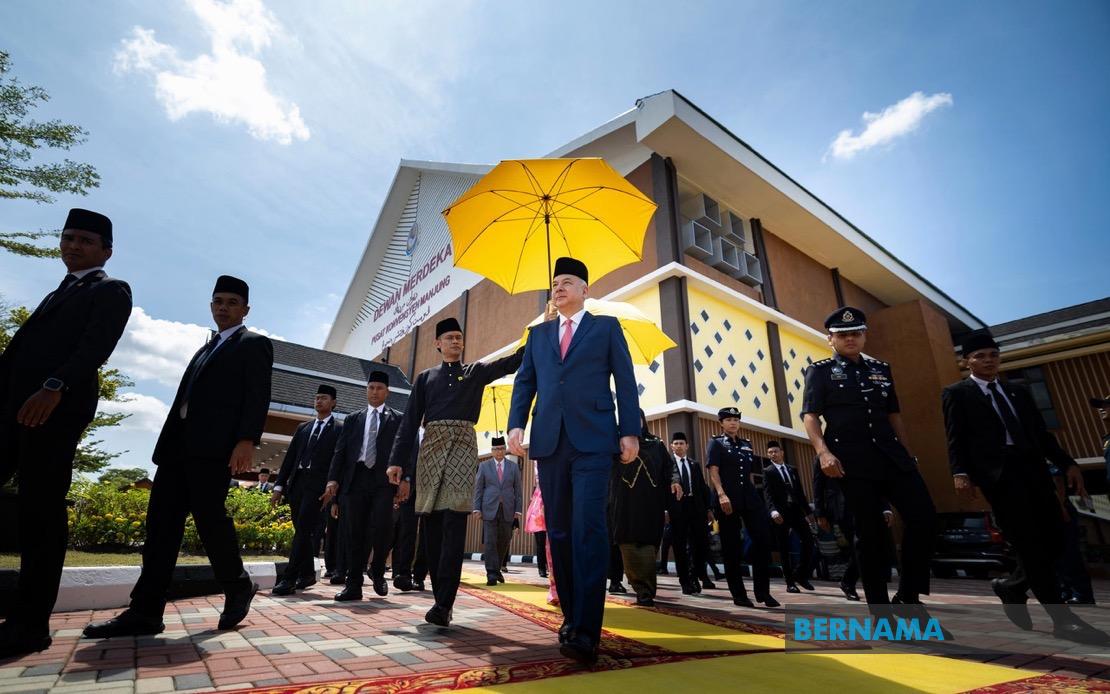
Sultan Nazrin Shah, the reigning monarch of Perak, has officially opened the Merdeka Hall at Manjung Municipal Council in Lumut, marking a significant infrastructure milestone for the industrial and maritime-focused district. The inauguration brought together senior state and federal dignitaries, including Raja Permaisuri Tuanku Zara Salim, Raja Di Hilir Raja Iskandar Dzurkarnain Sultan Idris Shah, Perak Menteri Besar Datuk Seri Saarani Mohamad, and Higher Education Minister Datuk Seri Dr Zambry Abd Kadir, underscoring the project's importance to both state and national development agendas.
The completion of the Merdeka Hall represents the culmination of a planning process that commenced in 2016 under the previous Perak administration. What began as a vision to modernize the municipal council's facilities has evolved into a centrepiece for the district's broader aspirations. The hall itself, constructed at a cost of RM12.7 million, boasts a capacity of 2,500 attendees, positioning it as a substantial venue capable of hosting major conferences, official ceremonies, and large-scale community gatherings across the Manjung region.
Saarani emphasized during the opening ceremony that the project's completion symbolizes three interconnected achievements for the district. Beyond the physical opening of the building, the occasion aligned with the celebration of Manjung Municipal Council's silver jubilee, marking 25 years since the council was formally established as a municipal entity. This convergence of events provided an opportunity to reflect on institutional progress while simultaneously launching forward into a new development phase intended to establish Manjung as a recognized Tourism and Maritime City by 2030.
The trajectory of the Manjung Municipal Council itself reflects the broader evolution of local governance in Perak. The council was originally constituted as a district council on January 1, 1980, operating for two decades before its elevation to municipal status on August 1, 2001. This institutional progression mirrors wider patterns of administrative development across Malaysia, where selective councils have been upgraded to handle expanded populations and economic responsibilities. The 25-year milestone since gaining municipal status provides a natural inflection point for assessing infrastructure needs and planning for future municipal services.
The Merdeka Hall's significance extends beyond its function as a meeting space. Saarani articulated the symbolic importance of the naming choice, suggesting that the hall serves as a tangible reminder of the independence that Malaysia attained and the values that must continuously undergird national life. In this framing, the facility becomes more than bricks and mortar; it represents institutional commitment to safeguarding constitutional foundations and maintaining democratic processes at the local level. The language employed—emphasizing trust, dignity, and values—positioned the opening within Malaysia's broader national narrative.
For Manjung specifically, the hall represents an attempt to position the district as a destination capable of hosting regional conferences, trade missions, and tourism-related events. The district, located in the northern portion of Perak and centered on Lumut, has historically derived its economic character from port activities, industrial development, and oil and gas operations. Upgrading municipal infrastructure for events and conventions aligns with regional diversification strategies that seek to leverage existing transportation connections and maritime assets while developing tourism components that might appeal to a broader demographic beyond industrial workers.
The funding trajectory of the Merdeka Hall project demonstrates how state-federal cooperation functions within Malaysia's federal structure. Although planning commenced at the state level, realization of the project required Federal Government allocation approval. Saarani explicitly credited this multi-level collaboration as essential to the project's success, using the hall's completion as a demonstration of governance continuity despite transitions in political leadership. Such statements carry particular resonance in Perak, a state that has experienced substantial political flux in recent years, with several transitions of chief ministerial office.
The RM12.7 million investment in Manjung's municipal infrastructure reflects broader trends in Malaysian local governance, where selective municipalities receive capital injections to modernize administrative and public facilities. The decision to allocate resources at this scale to Manjung suggests that state and federal planners regard the district as having strategic importance within Perak's economic and development architecture. Proximity to Port Klang's northern alternatives, existing industrial clusters, and the district's maritime economy likely factored into prioritization decisions.
Looking forward, the hall's operational success will depend on effective management and its adoption by both government agencies and private sector organizations seeking suitable venues. The 2,500-person capacity positions it as a mid-to-large scale facility capable of accommodating substantial conferences and exhibitions without requiring participants to travel to major metropolitan centers like Kuala Lumpur or Ipoh. For businesses and organizations operating across Perak's northern corridor, having such infrastructure locally available could reduce travel costs and enhance regional competitiveness.
The Tourism and Maritime City vision articulated by Saarani represents a deliberate strategic positioning for Manjung within Perak's diversified economy. Rather than competing with larger centers for conventional business activity, the district appears to be emphasizing its unique geographic and historical characteristics. The maritime dimension particularly resonates given Lumut's role as a major port and naval base, while tourism development could leverage both cultural heritage and natural attractions within the broader Manjung region.
The opening ceremony's ceremonial dimension, with multiple layers of royal and ministerial participation, signaled institutional commitment to Manjung's development trajectory. Such visible support from senior leadership tends to facilitate subsequent phases of infrastructure development and public-private partnerships. The symbolic value of royal patronage in Malaysian governance cannot be underestimated; Sultan Nazrin's presence effectively endorsed the project and signaled its alignment with state-level strategic priorities.
For Southeast Asian observers tracking Malaysia's local governance evolution and infrastructure development, the Merdeka Hall opening exemplifies how subnational units navigate modernization imperatives. The project timeline—running from 2016 conception through 2024 completion—reflects typical Malaysian infrastructure development cycles, where planning horizons extend across multiple electoral cycles and administrative transitions. Success in delivering the facility despite such transitions suggests institutional capacity for sustained project management, a factor increasingly important as Malaysian municipalities tackle more complex infrastructure challenges.
Moving forward, the critical factor will be whether the Merdeka Hall effectively catalyzes additional development activity in Manjung or remains underutilized as have some municipal facilities elsewhere in Malaysia. Sustainable outcomes depend on deliberate marketing to potential user organizations, competitive pricing structures, and integration with broader tourism and economic development strategies. The ambition to achieve Tourism and Maritime City status by 2030 provides a specific temporal target against which future progress can be evaluated, and the Merdeka Hall's contribution to realizing that vision will become apparent over the coming six years.

