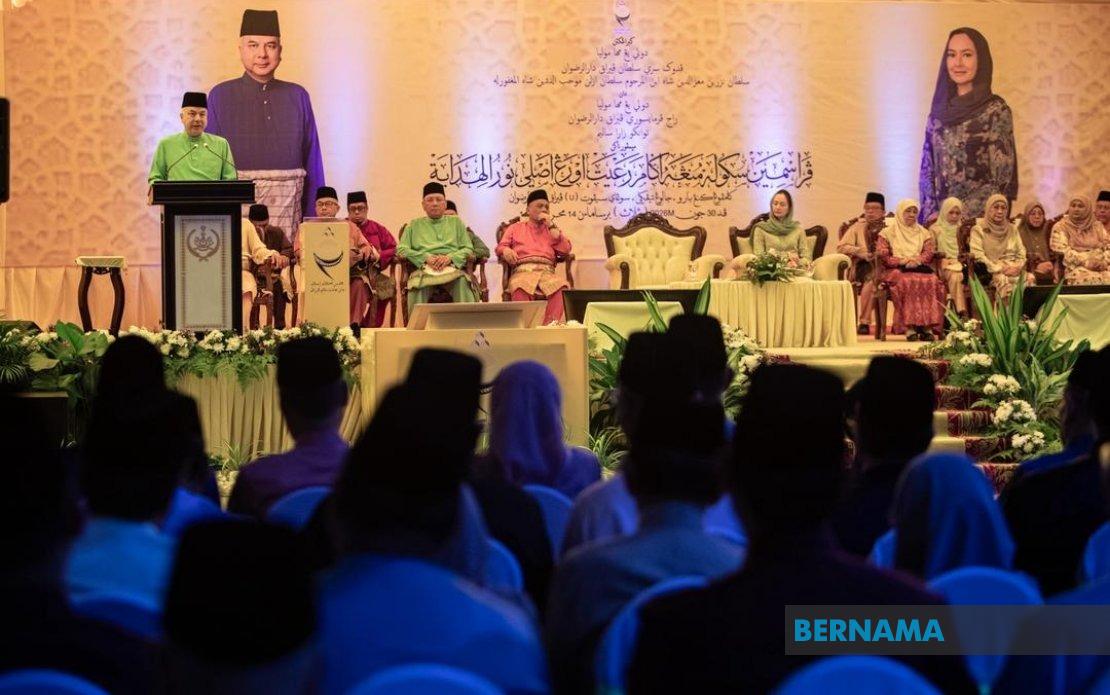
Sultan Nazrin Shah, the Sultan of Perak, today inaugurated Sekolah Menengah Agama Rakyat (SMAR) Orang Asli Nurul Hidayah at Kampung Kenang in Sungai Siput Utara, marking a watershed moment in the state's commitment to advancing educational opportunities for the Orang Asli population. The ceremony underscores a growing recognition among Malaysia's leadership that targeted interventions in indigenous communities require sustained institutional investment, with the school representing over three decades of grassroots effort to bridge educational disparities. Accompanying the Sultan were Raja Muda Raja Jaafar Raja Muda Musa and Raja Di Hilir Raja Iskandar Dzurkarnain Sultan Idris Shah, alongside state leadership including Menteri Besar Saarani Mohamad and officials from Perak's Islamic religious administration.
The establishment of this institution carries particular significance as Malaysia's first integrated educational facility specifically designed to serve the Orang Asli demographic while maintaining Islamic and academic excellence. In his address, Sultan Nazrin articulated a vision of the school extending beyond conventional classroom pedagogy, positioning it instead as a transformative agent within the Kampung Kenang community. The institution's trajectory illustrates how educational initiatives can evolve organically from grassroots needs, having originated as a religious study centre before developing into a comprehensive secondary establishment that merges secular and theological curricula within a single institutional framework.
The school's longevity and institutional persistence merit particular attention given the challenges indigenous communities across Southeast Asia face in accessing quality education. Over more than three decades of operation, SMAR Orang Asli Nurul Hidayah has accumulated substantial evidence of impact, producing graduates who have channelled their education back into community development. The returnee phenomenon—whereby former students come back to teach and advocate within their own villages—suggests a virtuous cycle where educational advancement translates into localised capacity building rather than talent migration, a pattern frequently observed when targeted schooling reaches historically marginalised groups.
Sultan Nazrin's emphasis on education as an investment in human capital reflects a broader policy shift within Malaysian governance toward recognising indigenous development not as charitable provision but as strategic national interest. By framing the school's construction as securing brighter futures for Orang Asli children, the Sultan positioned educational access as fundamental to equitable citizenship and meaningful societal participation. This rhetorical repositioning matters because it moves discussions of Orang Asli welfare beyond paternalism toward recognition of indigenous populations as essential contributors to national progress and economic vitality.
The school's curriculum design merits examination for what it reveals about contemporary educational philosophy in Malaysia. By integrating academic subjects with Islamic religious education and moral character development, SMAR Orang Asli Nurul Hidayah embodies a pedagogical approach that rejects the false dichotomy between secular knowledge and spiritual formation. Such integration responds to community values within the Orang Asli population while equipping students with credentials and competencies demanded by modern labour markets. This balanced approach proves particularly valuable for communities where educational advancement historically required cultural or religious compromise, thereby removing psychological barriers to participation.
The Perak Islamic Religious and Malay Customs Council (MAIPk) and Islamic Religious Department (JAIPk) function as institutional anchors for the school, connecting it to formal governance structures while preserving community agency. This institutional embeddedness ensures regulatory consistency and resource allocation reliability, factors critical for sustaining educational quality in rural and traditionally underserved localities. The involvement of state religious authorities also signals that Islamic education for indigenous populations represents not assimilationist imposition but culturally-responsive pedagogy that honours both faith traditions and indigenous identity.
Sultan Nazrin's articulation of education's comprehensive dimensions—intellectual, spiritual, emotional and physical—provides a counter-narrative to narrowly instrumental educational frameworks that prioritise only employment outcomes. By emphasising character development, ethical reasoning and identity strengthening alongside academic achievement, the Sultan articulated an educational philosophy suited to vulnerable populations historically undermined by systemic discrimination. For Orang Asli communities, such holistic development proves essential for building resilience, self-determination and psychological integration after generations of marginalisation.
The school's achievement in producing students who excel academically while maintaining strong religious and moral grounding addresses longstanding concerns about potential conflicts between indigenous identity preservation and educational modernisation. Evidence that SMAR graduates demonstrate both knowledge attainment and values consistency suggests that educational advancement need not require cultural erosion. This finding carries implications throughout Southeast Asia where indigenous populations grapple with balancing modernity and heritage, demonstrating viable institutional models that transcend false dichotomies.
For Malaysian policymakers and administrators across states hosting significant Orang Asli populations, SMAR Orang Asli Nurul Hidayah offers a replicable template for community-responsive educational development. The school's success hinged not upon massive centralised funding but rather sustained commitment, local ownership and institutional integration within existing religious and governmental frameworks. This scalability proves important given that Malaysia's diverse indigenous communities maintain distinct educational needs and cultural contexts requiring locally-adapted rather than nationally-uniform interventions.
The inauguration also reflects evolving understandings of how religious education can advance rather than hinder Orang Asli socioeconomic mobility. By demonstrating that Islamic schooling produces graduates who contribute meaningfully to community welfare, economic activity and social cohesion, the school challenges stereotypes that religious education diverts indigenous youth from productive engagement. Former students returning as educators exemplify how targeted educational investment generates multiplier effects across generations and kinship networks, gradually raising baseline capabilities throughout formerly isolated communities.
Sultan Nazrin's emphasis on equal access to education regardless of background or geographical location expresses an aspirational national standard that remains incompletely realised across Malaysia. The school's existence in rural Sungai Siput represents progress but also highlights persistent disparities whereby comparable institutions remain unavailable throughout other Orang Asli settlements. The challenge confronting policymakers involves scaling proven models while avoiding assumptions that a single institutional design suits all communities, instead supporting locally-determined educational innovations that reflect specific cultural values and development priorities.
As Malaysia navigates increasing socioeconomic complexity, indigenous populations who remain educationally marginalised face compounding disadvantages in labour markets prioritising technical skills and higher education credentials. SMAR Orang Asli Nurul Hidayah demonstrates institutional commitment to reversing this trajectory through deliberate educational investment, though the school's very singularity as Malaysia's first establishment of its type underscores how much work remains. Continued governmental support and resource allocation toward expanding similar opportunities across additional Orang Asli communities represents both moral imperative and practical investment in human capital that current economic models underutilise.

