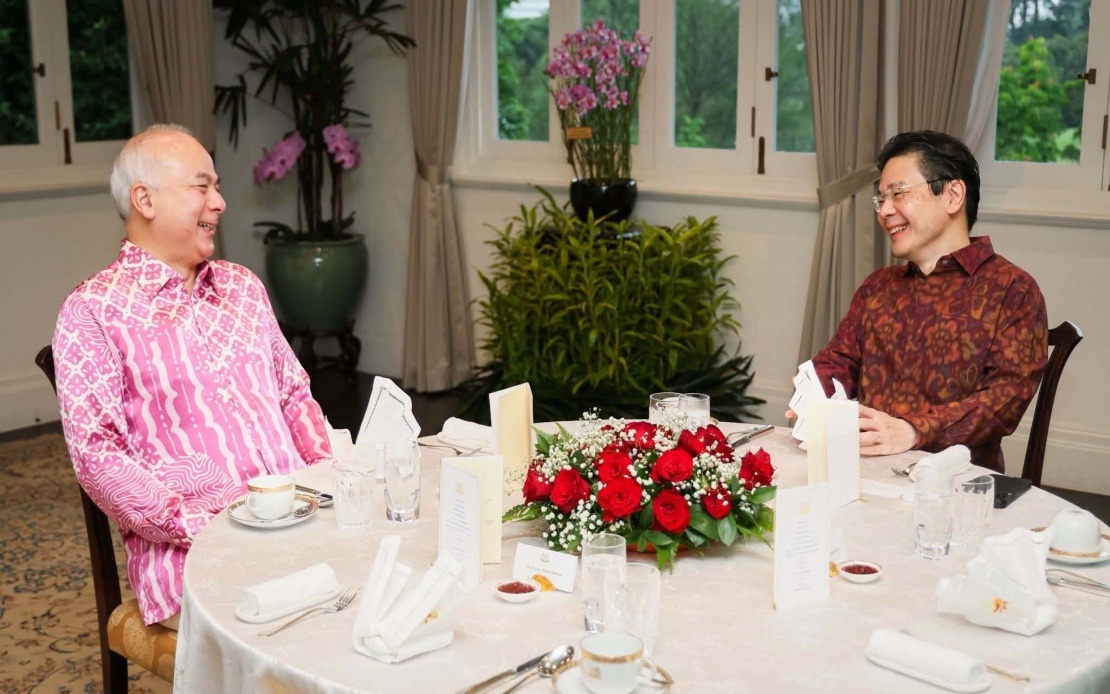
Singapore Prime Minister Lawrence Wong received Sultan Nazrin Shah, the Deputy Yang di-Pertuan Agong, for breakfast at The Istana on Thursday, reaffirming the depth of institutional and diplomatic relations that bind Malaysia and Singapore together. The engagement underscores how bilateral ties between the two neighbouring nations extend well beyond formal state protocols, encompassing a web of governmental, academic, and cultural connections that shape regional affairs across Southeast Asia.
During their private meeting, Wong and Sultan Nazrin explored substantive matters affecting both countries, with particular emphasis on strengthening the collective voice and coordinated action of the Association of Southeast Asian Nations. In remarks shared publicly, Wong highlighted that the two leaders had reviewed a comprehensive set of initiatives currently being pursued jointly, signalling that the Malaysia-Singapore partnership operates across multiple dimensions rather than remaining confined to traditional diplomatic channels.
The Singapore Prime Minister noted that geography, whilst significant, provides only a partial foundation for understanding the relationship between the two countries. He stressed instead the historical narratives that have intertwined Malaysian and Singaporean communities over generations, acknowledging that millions of ordinary citizens maintain family connections, professional networks, and cultural bonds that cross the border regularly. This emphasis on people-to-people linkages reflects a broader regional understanding that sustained bilateral cooperation depends ultimately on the goodwill and interdependence of ordinary residents, not merely government officials.
Wong articulated confidence that both nations would continue collaborating to realize a shared vision for their collective future. The framing of bilateral engagement as a forward-looking project rather than a preservation of historical arrangements suggests that Singapore and Malaysia view their relationship as dynamic and subject to ongoing development. This orientation proves particularly significant given occasional tensions in Malaysia-Singapore relations, with political leaders in both capitals periodically highlighting grievances—whether relating to water agreements, maritime boundaries, or labour movements—that complicate the narrative of seamless cooperation.
Sultan Nazrin's official capacity as Chancellor of Universiti Malaya adds an educational dimension to his presence in Singapore during this particular visit. Academic institutions serve as crucial platforms for bilateral engagement in the modern era, with universities facilitating intellectual exchange, research collaboration, and the training of future leaders familiar with neighbouring nations' perspectives and contexts. The chancellorship reflects his institutional standing within Malaysian academia and his commitment to fostering ties between Malaysian and international institutions.
The timing of Sultan Nazrin's Singapore visit was oriented toward participation in the 55th UM-National University of Singapore Inter-University Tunku Chancellor Golf Tournament, an annual sporting event that marries recreation with relationship-building between two leading regional universities. Such tournaments, whilst ostensibly casual, function as important informal venues where academic leaders, government officials, and business figures interact outside formal settings. The golf championship between Universiti Malaya and the National University of Singapore has accumulated significance over five-and-a-half decades, becoming embedded within the institutional cultures of both universities as a marker of their bilateral partnership.
The July 29 to 30, 2026 dates for the golf tournament place Sultan Nazrin's visit during a period when cross-border academic and professional movement between Singapore and Malaysia remains substantial. Educational exchanges continue to represent a major dimension of bilateral relations, with Malaysian students frequently pursuing tertiary education in Singapore and Singaporean scholars regularly conducting research at Malaysian universities. These educational pipelines create cohorts of professionals and policymakers across both nations who possess intimate familiarity with each other's systems, institutions, and intellectual traditions.
Singapore's hosting of Sultan Nazrin at the Prime Minister's official residence carries symbolic weight that extends beyond the immediate discussion agenda. The Istana functions as Singapore's seat of executive authority and the official residence of the President, making it a venue typically reserved for hosting dignitaries of considerable standing. The selection of this location for meeting the Deputy Yang di-Pertuan Agong signals Singapore's recognition of Sultan Nazrin's institutional importance within the Malaysian constitutional framework and reflects broader diplomatic protocols governing how nations accord protocol status to visiting officials.
The focus on ASEAN cooperation during their discussions reflects the reality that Malaysia and Singapore maintain distinct but overlapping interests within the regional grouping. Both nations hold significant weight within ASEAN's institutional structures and serve on various regional committees and working groups. Coordinating their approaches to regional challenges—whether economic integration, security matters, or environmental sustainability—strengthens the organization's overall capacity to address issues affecting all ten member states. The bilateral meeting thus functions partially as a coordination mechanism for broader regional diplomacy.
The articulation of bilateral initiatives being advanced jointly suggests active collaboration extending across sectors including trade, investment, infrastructure, technology, and potentially security cooperation. Specific joint projects typically involve technical working groups, cross-governmental committees, and private sector partnerships that operate with less visibility than high-level diplomatic engagement but generate substantive outcomes benefiting both economies. Malaysia and Singapore's geographic proximity and economic interdependence necessitate ongoing collaboration on matters ranging from supply chain management to maritime resource management and transportation logistics.
For Malaysian observers, Sultan Nazrin's engagement with Singapore's leadership carries implications for how constitutional monarchs navigate Malaysia's place within regional affairs. The Deputy Yang di-Pertuan Agong represents constitutional authority whilst maintaining sufficient political distance from electoral politics, positioning him as an appropriate vehicle for conducting high-level diplomatic engagement. His participation in bilateral discussions underscores the Malaysian constitutional monarchy's continuing relevance to statecraft and institutional diplomacy beyond ceremonial functions.
The broader context of this meeting reflects Southeast Asian regional dynamics, wherein bilateral partnerships between major players influence the trajectory of ASEAN cooperation and shape how smaller nations navigate regional relationships. Malaysia and Singapore's ability to coordinate effectively on regional matters contributes to ASEAN's coherence and capacity to project collective positions in international forums. Their demonstrated commitment to deepening cooperation through both formal and informal channels suggests that notwithstanding occasional bilateral tensions, the structural incentives for partnership remain powerful.

