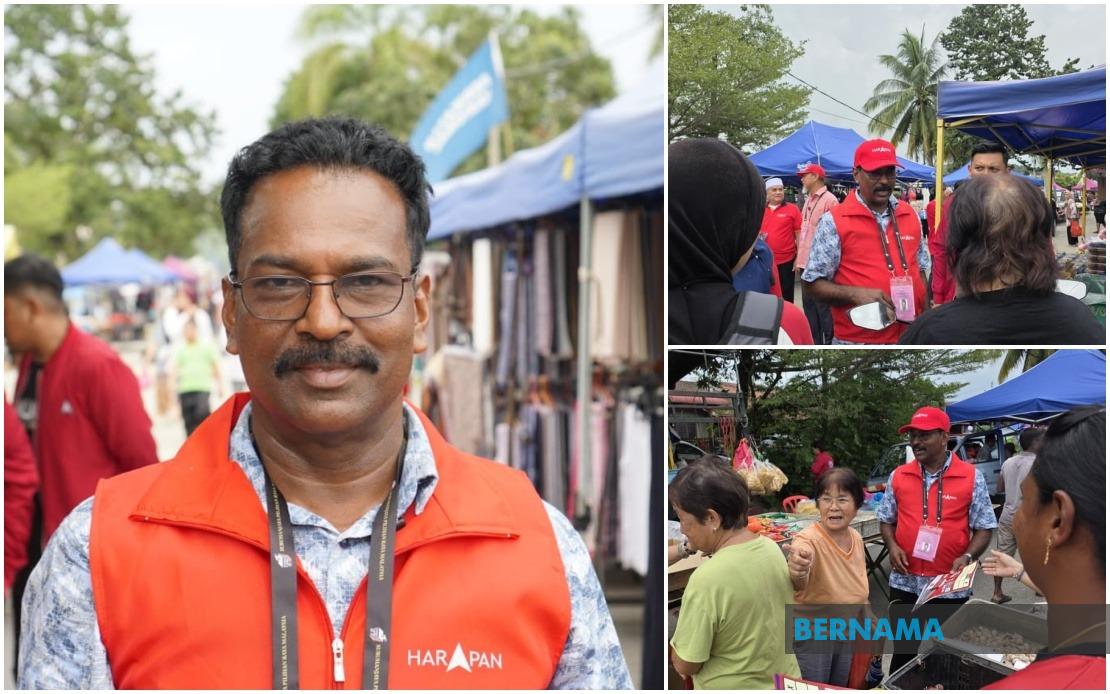
C. Subramani, the Pakatan Harapan candidate contesting the Bukit Kepong seat in the 16th Johor state election, is banking on grassroots momentum and a demonstrated commitment to local issues to secure an unexpected victory in a hotly contested three-way race. The Pagoh native has been actively engaging constituents throughout the campaign period and expressed confidence in his ability to overturn what many observers consider an uphill battle against established political rivals.
Subramani's campaign strategy centers on a core message that resonates deeply with Malaysian voters across the peninsula: the desire for substantive change and improved governance. During his extensive ground work, he has visited Orang Asli settlements scattered across the constituency to understand the specific infrastructure deficits and socioeconomic pressures that marginalised communities face. This direct engagement has allowed him to move beyond generic campaign rhetoric and ground his policy proposals in the lived experiences of residents who have historically received limited attention from mainstream political discourse.
The alignment of state and federal government agendas emerges as a critical plank of Subramani's platform. He argues convincingly that when administrations at different levels work in synchronisation, they can resolve local grievances more expeditiously by channelling concerns through ministerial offices or directly to the Prime Minister. This approach addresses a fundamental frustration among many Malaysians, who often find themselves caught between overlapping jurisdictions where neither level of government assumes clear responsibility for addressing particular problems affecting their daily lives.
Education, irrigation, and drainage issues exemplify the categories of challenges that Subramani believes require coordinated action across administrative boundaries. In rural and semi-urban constituencies like Bukit Kepong, inadequate water management infrastructure can devastate agricultural productivity and create public health hazards, while educational disparities perpetuate cycles of limited opportunity. By positioning himself as a bridge between state and federal institutions, Subramani offers voters a tangible mechanism for addressing longstanding complaints about bureaucratic inefficiency.
Beyond administrative alignment, Subramani has articulated several concrete development priorities for the constituency. Transforming the Bukit Kepong Gallery into a historical tourism destination could generate economic activity in a locality that has historically struggled to diversify its revenue streams beyond traditional sectors. Tourism development, when properly managed, can create employment opportunities while preserving cultural heritage—a combination that appeals to voters concerned about both livelihoods and community identity.
Street lighting deficiencies, narrow bridges that impede traffic flow and emergency response times, and a shortage of affordable housing stock for low-income households constitute the mundane yet essential infrastructure challenges that occupy Bukit Kepong residents' attention. These issues rarely generate national headlines, yet they accumulate into a pervasive sense that the government remains indifferent to ordinary citizens' welfare. Subramani's explicit commitment to addressing such neglected problems directly challenges the incumbent's record and suggests a candidate attuned to community priorities.
Subramani's previous experience as a candidate in the 2022 Johor state election, when he contested the Buloh Kasap seat, provides him with valuable institutional knowledge about campaign dynamics, voter behaviour, and local political networks. Unlike first-time candidates who must navigate unfamiliar terrain, he enters this contest with established relationships and an understanding of how electoral competition unfolds across different constituencies. His years of political engagement, particularly his role as Pagoh PKR chief, demonstrate sustained commitment to the party machinery and local community mobilisation.
The three-cornered contest between Pakatan Harapan, Barisan Nasional, and Perikatan Nasional candidates introduces considerable unpredictability into the Bukit Kepong race. In such scenarios, victory margins often prove razor-thin, and the outcome can hinge on voter turnout patterns and the strategic behaviour of supporters who must decide whether to consolidate behind their preferred coalition or splinter their votes across multiple candidates. Subramani's optimism appears grounded in positive voter sentiment that he attributes to genuine appetite for political alternatives rather than mere dissatisfaction with incumbents.
The broader context of Johor's 16th state election involves 172 candidates vying for 56 state assembly seats with approximately 2.7 million registered voters participating. This statewide contest carries significant implications for Malaysia's political trajectory, as Johor has historically served as a bellwether for national sentiment and coalition dynamics. Performance in economically important constituencies like Bukit Kepong can influence perceptions about whether opposition coalitions have successfully articulated compelling alternatives to ruling coalitions.
For Pakatan Harapan, securing victories in constituencies where they previously underperformed would signal that voter confidence in the coalition remains resilient despite challenges at the federal level. Subramani's campaign, with its emphasis on pragmatic governance and alignment between administrative levels, reflects a maturation in how opposition parties frame their appeal to voters who have grown weary of partisan grandstanding divorced from tangible improvements in service delivery.
Subramani's emphasis on cooperation between state and federal authorities, if successful, could offer a template for future campaigns where candidates position themselves as competent administrators capable of navigating Malaysia's complex federal structure rather than ideological warriors. This approach acknowledges that many voters care less about which coalition wins than about whether their potholes get filled, their children receive quality education, and their communities attract investment.

