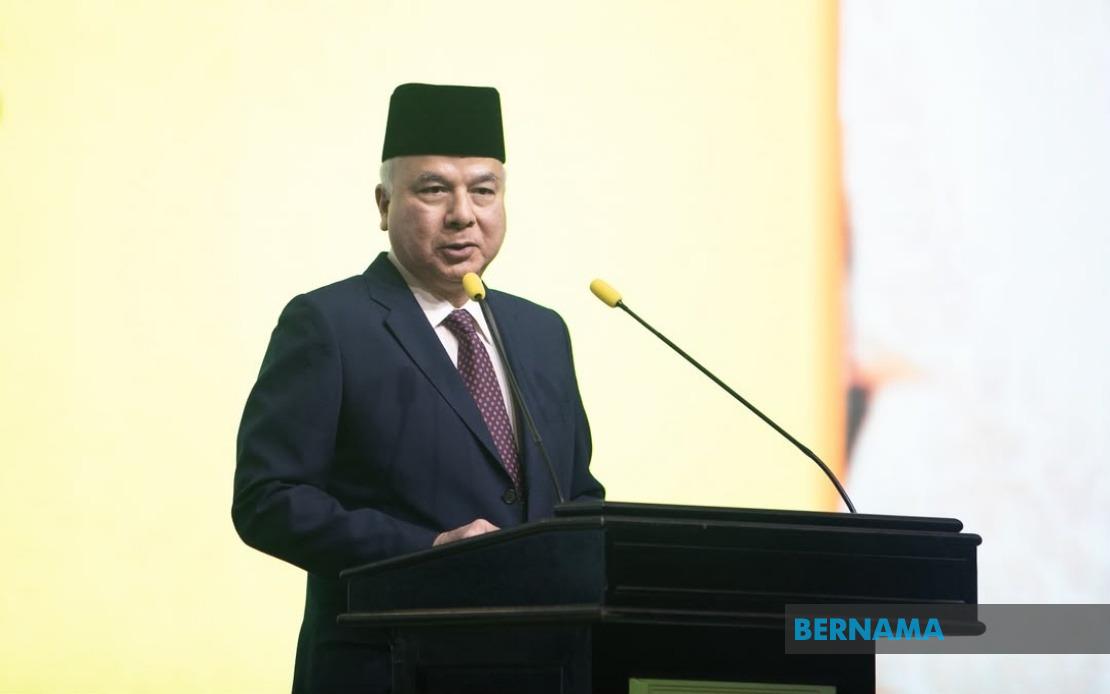
Addressing delegates at the 8th World Conference on Islamic Thought and Civilisation in Ipoh on July 21, Sultan Nazrin Shah, the Sultan of Perak, delivered a forceful message about the foundational requirements for national success. He argued that even nations blessed with substantial wealth, capable citizens, and vibrant cultural traditions will ultimately disappoint their populations if institutional frameworks remain weak, leadership lacks accountability, or political life becomes dominated by narrow factional interests rather than service to the broader population. The observation carries particular resonance for Southeast Asia, where many countries struggle to balance rapid economic development with institutional strengthening and governance reform.
The Sultan articulated a comprehensive vision of good governance that moves beyond abstract principles into practical implementation. He emphasised that effective governance requires the successful orchestration of multiple interdependent elements, with institutions robust enough to function reliably regardless of which specific leaders or administrations hold power at any given moment. This institutional permanence versus individual leadership is especially important in emerging democracies where transitions between administrations can introduce uncertainty. The framework he outlined addresses concerns familiar across the region, where institutional capacity often lags behind political ambition, and the concentration of power around individual strongmen can undermine longer-term stability.
Transparency in public finance stands as a cornerstone of Sultan Nazrin's governance model. He stressed that citizens require genuine confidence that their tax contributions and public resources ultimately serve collective interests rather than enriching connected elites or funding patronage networks. This emphasis on transparent resource management speaks directly to challenges facing many Malaysian and Southeast Asian governments, where public perception of corruption and misallocation of development funds continues to erode trust in state institutions. The Sultan's framing of budget allocations as moral documents rather than mere technical instruments reorients the conversation toward values and priorities, suggesting that how governments spend money reveals which populations they genuinely serve.
Equally fundamental is the impartial application of law across all social strata. Sultan Nazrin insisted that robust rule of law requires no individual, regardless of wealth, status, or political connections, to escape accountability, while simultaneously ensuring that vulnerable citizens receive equal legal protection and access to justice. This principle directly addresses a pervasive regional concern: the perception that legal systems often function differently for the powerful and the marginalised. In several Southeast Asian contexts, including Malaysia, questions about judicial independence and equitable application of law remain contentious political issues that affect public confidence in state legitimacy.
The Sultan outlined a vision of political culture fundamentally different from winner-take-all competition. He advocated for disagreement conducted through respectful channels, opposition treated as legitimate institutional check rather than existential threat, and peaceful power transitions reflecting popular will. Interestingly, he noted that political stability need not entail the absence of vigorous debate; indeed, many of the world's most stable democracies feature robust argumentative traditions precisely because institutional frameworks channel disagreements productively rather than permitting them to degenerate into street violence or extra-constitutional challenges. This observation provides useful counterpoint to arguments sometimes advanced in Southeast Asia that political harmony requires suppressing dissent.
Institutional erosion, according to Sultan Nazrin's analysis, occurs not when citizens disagree but when they lose faith in the systems supposedly managing disagreement. When elections appear manipulated, courts seem compromised, and public office functions as personal enrichment opportunity, the foundational trust binding state and society begins deteriorating. Most significantly, he noted that this institutional collapse harms vulnerable populations disproportionately—the poor, marginalised, and voiceless suffer first and most severely when governance systems fail. This distributional concern carries obvious relevance for Malaysia and the region, where inequality remains pronounced and access to state resources often follows pre-existing advantage.
Moving beyond governance structure to substantive policy orientation, Sultan Nazrin stressed that applying the principle of universal inclusion must originate within government itself. Budget priorities reveal authentic government commitments to different populations and needs. A civil service genuinely serving all citizens regardless of ethnicity, religion, or political affiliation embodies national unity in its most concrete manifestation. Leaders demonstrating humility, listening before legislating, and remembering that their authority derives from temporary public trust rather than personal ownership generate loyalty and national pride more effectively than rhetorical appeals. This emphasis on leadership comportment and bureaucratic professionalism addresses real concerns in several regional states about extractive governance models and politicisation of civil services.
On economic development, Sultan Nazrin rejected isolationist approaches, emphasising that even resource-abundant nations cannot prosper through autarky. International trade, investment flows, technological exchange, and knowledge transfer constitute the currents upon which modern prosperity depends. Economies embracing open commerce while simultaneously building resilient, diversified domestic industries consistently outperform those retreating into protectionism or dependent on single-sector extraction. For Malaysia and other ASEAN members navigating post-pandemic economic recovery and geopolitical tensions between major trading partners, this advocacy for balanced engagement with global markets provides strategic guidance.
Critically, Sultan Nazrin warned that international cooperation must not devolve into dependency or erode national autonomy. Nations should welcome foreign investment and expertise while deliberately cultivating domestic capacity, technical capability, and decision-making authority. This balanced approach directly addresses tensions visible across Southeast Asia, where rapid globalisation and foreign direct investment have sometimes occurred alongside concerns about sovereignty, resource control, and whether development benefits accrue primarily to foreign investors or local populations. The Sultan argued that wisdom lies in threading this needle—remaining open to international engagement while maintaining genuine strategic independence.
Turning specifically to Islamic finance, Sultan Nazrin identified a substantial untapped potential within the Muslim world. Malaysia's decades-long development as a global Islamic finance centre, encompassing sukuk issuance, takaful insurance, and Syariah-compliant fund management, represents considerable achievement. However, he argued that Islamic finance's true promise extends beyond regulatory compliance with prohibitions on interest and speculation. The distinctive philosophy underlying Islamic finance emphasises risk-sharing among participants, asset-backing of financial instruments, and equitable participation in economic returns. If taken seriously, this philosophy could transform Islamic finance into a powerful vehicle for cross-border infrastructure investment, SME financing throughout the Organisation of Islamic Cooperation membership, and long-term patient capital addressing critical development challenges from water security to renewable energy transition.
The Sultan's vision positioned Islamic finance as offering more than alternative technical compliance mechanisms; rather, it represents a fundamentally different approach to organizing economic activity with greater emphasis on shared risk, tangible asset support, and broader participation in prosperity. For Malaysia, which has cultivated Islamic finance expertise and infrastructure, his remarks suggest considerable opportunity for expanding the sector's development impact, particularly if Malaysian financial institutions and policymakers embrace the sector's philosophical foundations rather than merely its compliance architecture. This framing carries implications for how Southeast Asian nations might leverage Islamic finance for regional development cooperation and addressing shared challenges like infrastructure gaps and clean energy transition.
Collectively, Sultan Nazrin's address synthesised governance, political culture, institutional strength, economic policy, and Islamic finance into an integrated framework for national and regional progress. He grounded this framework in the conviction that institutional resilience, transparent resource allocation, impartial law, inclusive political culture, international engagement balanced against sovereign autonomy, and innovative deployment of Islamic finance principles constitute mutually reinforcing elements of sustainable development. For Malaysian policymakers and Southeast Asian observers, his emphasis on the primacy of institutions over individuals, the critical importance of popular trust in governance systems, and the necessity of balancing openness with autonomy offers substantive guidance as the region navigates ongoing political, economic, and social transitions.

