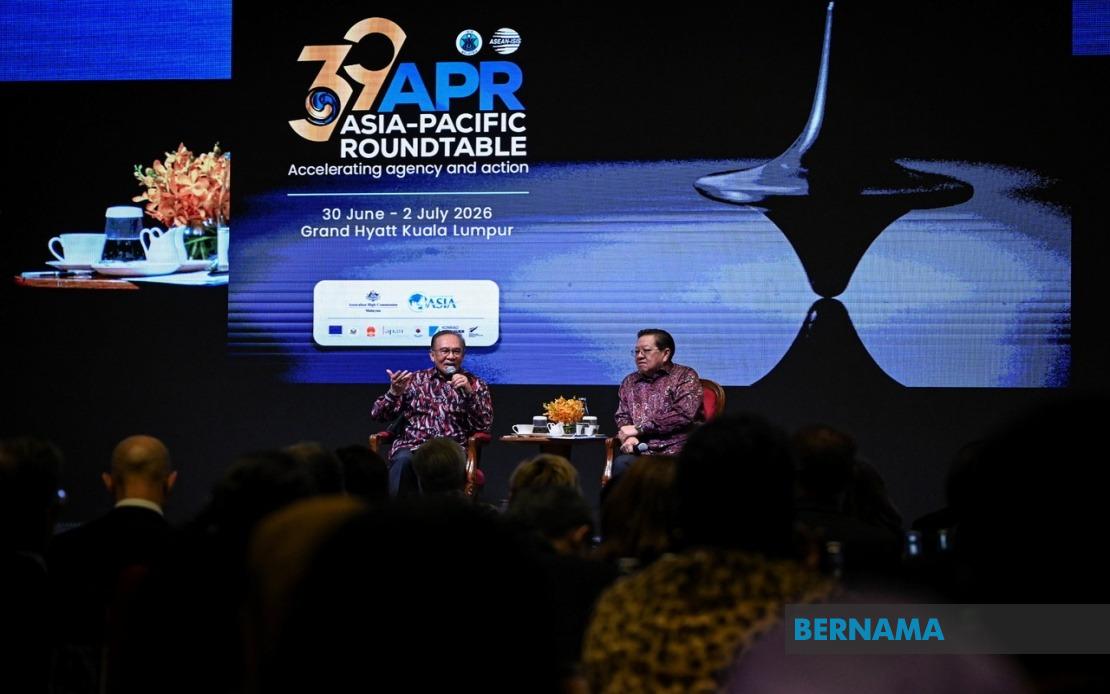
Prime Minister Datuk Seri Anwar Ibrahim has placed governance reform at the centre of his administration's agenda, asserting that Malaysia must first put its own house in order before attempting to exercise meaningful influence on the world stage. Speaking at the 39th Asia-Pacific Roundtable in Kuala Lumpur, Anwar outlined a vision of national development rooted in institutional improvement, anti-corruption efforts, and equitable access to essential services. His remarks underscore a strategic pivot away from grand international positioning towards demonstrable domestic achievement—a pragmatic recognition that Malaysia's credibility abroad depends fundamentally on the quality of governance citizens experience at home.
The Prime Minister's articulation of priorities reflects a deliberate reordering of focus within the government's mandate. Beyond general statements about fighting corruption, Anwar specified three interconnected pillars: narrowing the gap between rich and poor, universalising quality education, and extending healthcare to all citizens. These goals carry particular weight for Malaysia, a nation whose economic gains have not been uniformly distributed and where regional disparities in infrastructure and services remain pronounced. By anchoring his administration's legitimacy to concrete improvements in citizens' daily lives, Anwar is signalling that international standing will follow, not precede, domestic success.
A striking dimension of Anwar's intervention concerns his framing of the global order. Rather than accepting contemporary geopolitical divisions as inherent or inevitable, the Prime Minister challenged listeners to reconsider their assumptions about international conflict. By invoking the late scholar Edward Said's concept of "clash of ignorance" alongside the conventional phrase "clash of civilisations," Anwar proposed that many confrontations between nations and blocs stem not from fundamental incompatibility but from mutual misunderstanding and prejudice. This intellectual move has implications for how Malaysia positions itself in an increasingly polarised world, suggesting the country need not choose absolute loyalty to any single bloc but instead pursue engagement based on clear understanding and mutual respect.
The government's MADANI framework, which Anwar referenced, attempts to reconcile rapid technological progress with preservation of human dignity and social cohesion. For a nation wrestling with the digital transition, automation in manufacturing, and artificial intelligence's employment implications, this balance is not merely philosophical but practically urgent. The framework signals that Malaysia will not uncritically embrace technological change at the expense of social stability or cultural values—a reassuring message for citizens anxious about disruption while simultaneously positioning the country as modern and forward-looking.
Crucially, Anwar linked Malaysia's governance agenda to its identity as a Muslim-majority democracy. He emphasised that strengthening institutions, upholding democratic norms, and protecting minority rights are not Western impositions but values intrinsic to Islamic teaching and Malaysian constitutional tradition. This framing carries significant weight in regional and global discourse, where the compatibility of Islam and liberal democracy remains contested. By demonstrating through institutional performance that a Muslim-majority nation can simultaneously maintain democratic accountability, religious freedom, and inclusive governance, Malaysia could serve as a counterweight to narratives depicting Islam and democracy as fundamentally opposed.
The concept of 'li ta'arafu'—a Quranic injunction often translated as mutual understanding—became central to Anwar's address. He distinguished between mere tolerance, which suggests resigned acceptance of difference, and genuine appreciation, which involves active effort to comprehend and value others' perspectives. For Malaysia specifically, a country whose social cohesion depends on managing religious, ethnic, and cultural diversity, this distinction carries practical consequences. It suggests that government policy should move beyond preventing communal conflict toward actively fostering intergroup understanding through education, cultural exchange, and inclusive institution-building.
The Prime Minister's remarks arrive at a moment when Malaysia faces several governance challenges that will test these commitments. Corruption allegations continue to shadow political figures across the spectrum, inequality metrics show mixed trends despite economic growth, and education quality remains uneven between urban and rural areas. Healthcare accessibility, particularly in remote regions, continues to strain resources. By positioning these as his administration's principal responsibilities, Anwar has created benchmarks against which his government's performance will be measured. Success or failure in tackling these issues will determine whether his vision of domestic-first governance translates into tangible outcomes or remains aspirational rhetoric.
The timing of these remarks at a regional forum underscores Malaysia's desire to project stability and competent governance to investors, regional partners, and international observers. Southeast Asia's economic dynamism depends partly on confidence in institutional reliability and rule of law. By explicitly committing to governance strengthening, Anwar sends a signal that Malaysia remains committed to the regulatory predictability and judicial independence that attract foreign investment and secure capital inflows. This calculation reflects understanding that governance reform serves both moral imperatives and economic interests.
For Malaysian citizens, Anwar's emphasis on education and healthcare access represents a direct claim on government resources and attention. These are areas where service delivery failures—overcrowded schools, long waiting times in clinics, insufficient rural coverage—directly affect quality of life. The Prime Minister's explicit elevation of these issues suggests allocation decisions may shift toward expanding capacity and improving quality in these sectors, though implementation challenges remain formidable given budget constraints and competing demands.
Regionally, Anwar's governance-first approach offers a model potentially attractive to other Southeast Asian nations wrestling with similar development challenges. His argument that institutional strength precedes international influence could influence how neighbouring governments prioritise their own reform agendas. Whether Malaysia can demonstrate meaningful progress on corruption, inequality, and service delivery over coming years will either validate or undermine this strategic vision across the region.
The Prime Minister's integration of Islamic concepts with democratic governance language represents a deliberate rhetorical strategy designed to unite different constituencies behind reform. Conservatives can embrace the Islamic references while progressives appreciate the democratic commitment; both can support anti-corruption efforts. However, maintaining this coalition requires actual progress on multiple fronts simultaneously—a demanding objective that will test the government's political capital and administrative capacity throughout its tenure.

