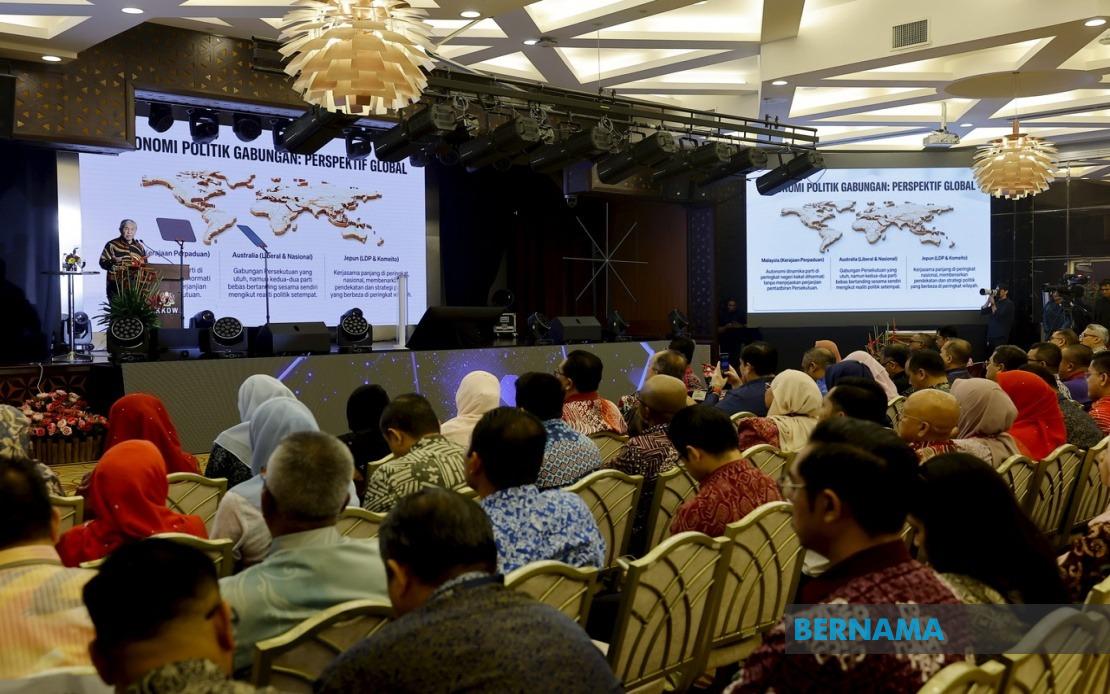
Deputy Prime Minister Datuk Seri Dr Ahmad Zahid Hamidi sought to reassure Malaysians on Tuesday that the federal administration remains insulated from the electoral turbulence unfolding across state constituencies, most notably in Johor and Negeri Sembilan. Speaking at a monthly gathering of the Rural and Regional Development Ministry (KKDW) in Putrajaya, he stressed that the governing coalition's institutional arrangements—built on explicit mutual understandings—create sufficient structural safeguards to absorb the pressures of competing state-level political interests without fracturing the national government.
The remarks came as Ahmad Zahid, who simultaneously chairs Barisan Nasional (BN), confronted a narrative increasingly circulating in Malaysian political commentary: that territorial contests between coalition parties risk unravelling the delicate equilibrium holding the Unity Government together. His intervention sought to establish a clear demarcation between what unfolds in state assemblies and the operations of the federal executive, suggesting that the two planes of political competition operate according to distinct logics and legal frameworks.
Central to Ahmad Zahid's argument is the concept of political autonomy within a coalition structure. He articulated a vision wherein member parties of the Unity Government retain the liberty to pursue independent strategic interests, devise their own political campaigns, and prosecute territorial ambitions without surrendering their foundational political identities or core principles. This formulation addresses a persistent anxiety among coalition observers: whether the requirement for federal unity necessarily demands the subordination of party interests to an overarching collective discipline.
The Deputy Prime Minister's framing appears calibrated to acknowledge the reality that Malaysia's coalition system requires flexibility rather than monolithic uniformity. By legitimising the notion that each constituent party may chart its own course within constrained bounds, he implicitly recognises that excessive suppression of party autonomy risks generating resentment, defection, or internal fracture more destabilising than measured competition would be. The framework thus attempts to convert a potential weakness—the coalition's inherent heterogeneity—into a source of resilience.
However, Ahmad Zahid's confidence rests fundamentally upon the binding force of the original agreement from which the Unity Government derives its constitutional authority. He contended that so long as Parliament remains intact and the dissolution mechanism is not triggered, the government's mandate and operational capacity remain undiminished. This positions the inter-party compact as the ultimate guarantor of stability, superior in force to any individual electoral outcome or state-level power shift.
The timing of these remarks carries particular significance given Malaysia's recent electoral volatility. The state contests referenced—particularly those in Johor and Negeri Sembilan—represent tests of the coalition's electoral appeal and internal cohesion. Any substantial shift in state control could theoretically embolden parties to recalibrate their calculations regarding federal participation or extract enhanced concessions from coalition partners. Ahmad Zahid's intervention functioned partly as a pre-emptive messaging strategy, establishing interpretive boundaries around what state results should and should not signify for federal governance.
More broadly, his comments reflect an important structural reality about Malaysia's political system: the federal government possesses significant statutory independence from state administrations, operating under distinct revenue streams, administrative hierarchies, and electoral mandates. This constitutional autonomy means that shifts in state power need not automatically cascade upward to disrupt federal arrangements. The government can maintain uninterrupted policy implementation, programme execution, and project delivery regardless of which coalition combinations control individual states.
Yet Ahmad Zahid's reassurances also implicitly acknowledge the political economy of coalition governance. If state-level defeats were to accumulate, or if particular parties were to suffer sustained electoral erosion, such trajectories could gradually alter the relative bargaining weights within the federal coalition. A party suffering consistent state-level losses might legitimately question the value of continued federal participation, or might use federal leverage to compensate for territorial setbacks. The sustainability of the current federal arrangement thus depends not merely on formal agreements but on continued perception among coalition members that participation yields tangible benefits.
The concept of political autonomy within coalition constraints that Ahmad Zahid articulated reflects lessons learned from previous Malaysian coalition experiments. Earlier arrangements that attempted to impose excessive discipline or suppress party competition often generated friction and eventual breakdown. The present formulation—allowing parties to compete at state level while maintaining federal cooperation—represents an evolved approach, more realistic about the nature of political organisations and more durable as a result.
For Malaysian stakeholders observing federal stability, Ahmad Zahid's message contained both reassurance and qualification. The reassurance concerns institutional robustness: the federal government will discharge its constitutional obligations, implement programmes, and maintain administrative continuity. The qualification concerns temporality: this stability holds precisely until Parliament is dissolved, at which point the entire federal arrangement enters contestation. This framing positions the current arrangement as structurally sound but ultimately provisional—stable for now, but inherently vulnerable to the next electoral cycle.
Looking ahead, the credibility of Ahmad Zahid's assertion will be tested through the Unity Government's ability to absorb additional state-level setbacks without triggering federal instability. The framework he articulated provides intellectual scaffolding for such absorption, but sustained practice will ultimately determine whether the theory of autonomous parties within a unified federal coalition can withstand significant electoral pressures. For now, the Deputy Prime Minister has attempted to establish that the two political arenas operate with sufficient independence that state contests need not destabilise national governance—a proposition that Malaysia's political system will continue testing.

