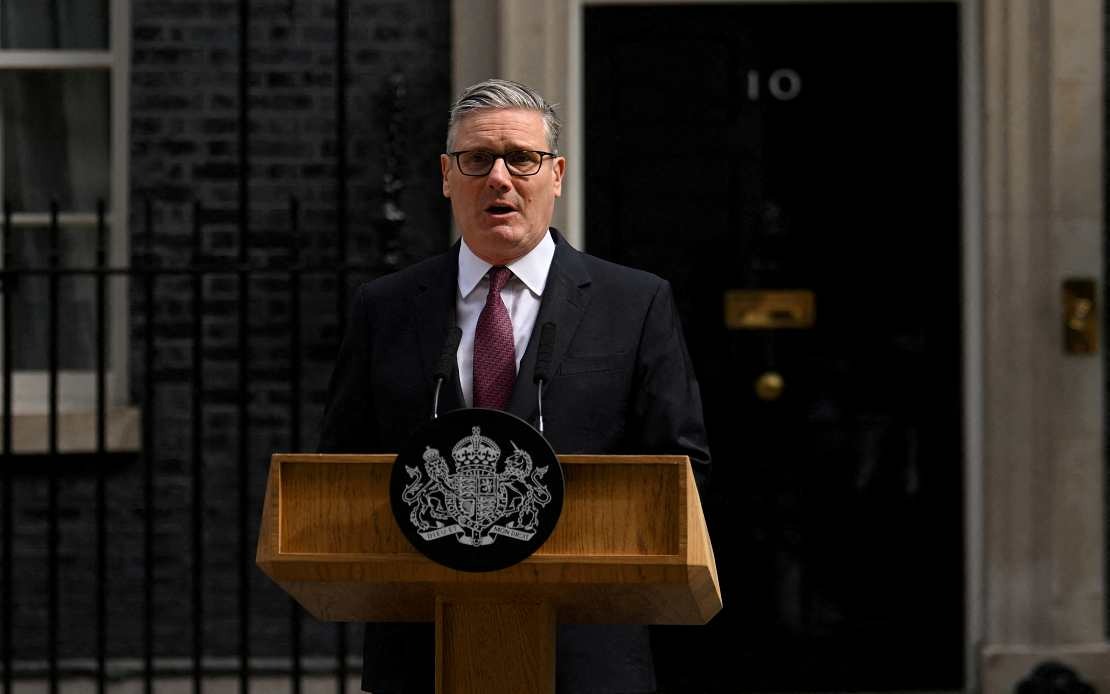
Keir Starmer announced his resignation as British Prime Minister on Monday, delivering what he described as his final address from Downing Street before formally submitting his resignation to King Charles III. In remarks made to gathered colleagues, friends and his wife Victoria Starmer, the departing leader expressed satisfaction with his tenure, stating that he would "pass the baton" to Andy Burnham and depart office "with a smile." The announcement comes after two years as the head of Britain's government and signals the conclusion of a significant chapter in recent British political history.
Starmer's departure marks the culmination of a remarkable political rehabilitation. The Labour leader took control of a party in ruins following its historic 2019 election defeat under Jeremy Corbyn, a moment that represented one of the most comprehensive rejections of a governing party in modern British electoral history. Over the subsequent years, he undertook substantial work to reshape Labour's direction and appeal. This transformation proved successful when voters delivered the party a landslide victory in the 2024 general election, endorsing the sweeping changes Starmer had implemented and providing Labour with a fresh mandate to govern.
In his resignation address, Starmer reflected on the improvements he claimed to have delivered during his tenure. He asserted that Britain had become "stronger and fairer" during his two years as prime minister, suggesting that his administration had left the country in a materially better condition than it had found it. This characterisation of his legacy represents his final public argument to the British electorate and his party for the significance of his time in office, even as he prepares to relinquish power.
The transition to Andy Burnham represents a continuation rather than a stark departure in Labour's leadership. Burnham, who has been prominent within Labour circles and held senior positions within the party and government, is positioned to carry forward Labour's agenda while bringing his own approach to the premiership. His ascension follows the established procedures by which a departing prime minister nominates their successor before formally stepping down, allowing for continuity in governance and clarity regarding the line of succession before the actual transfer of power occurs.
Starmer's decision to step down after two years rather than lead Labour through a full five-year term reflects the demanding nature of the premiership and the toll that high office can exact on political leaders. Two years represents a relatively brief tenure, though Starmer's accomplishments during this period—including the party's reversal of fortune and victory at the ballot box—suggest that he achieved significant objectives. His willingness to depart at this juncture may indicate a desire to leave office while maintaining personal wellbeing and allowing a successor to establish their own direction for the government.
The implications of this leadership transition extend beyond Westminster to affect British governance, domestic policy direction, and the nation's international standing. Burnham will inherit control of an administration with a substantial parliamentary majority and the opportunity to implement Labour's policy agenda across a broad range of issues affecting British citizens. From economic policy to social services, defence to climate action, the new prime minister will shape the trajectory of British governance for the foreseeable future.
For Malaysian and Southeast Asian observers, the British leadership transition carries several points of interest. The stability of Britain's political institutions and the orderly nature of power transfer demonstrate the functioning of Westminster-style democracy, which remains influential in the Commonwealth and across the region. Additionally, changes in British leadership can affect trade relationships, diplomatic priorities, and strategic alignments across Southeast Asia, given Britain's ongoing economic and security interests in the region and its recent pivot toward greater engagement with Indo-Pacific nations.
Starmer's tenure also represented an attempt to restore public faith in political institutions and leadership following years of controversy and division. His approach emphasised restoration of conventional governance standards and professional competence after a period characterised by significant political turbulence. The success or otherwise of this effort under his leadership, and how Burnham carries these themes forward, will shape perceptions of British governance both domestically and internationally.
The formal mechanics of the transition involve Starmer's visit to Buckingham Palace where he will formally tender his resignation to the King, who will then invite Burnham to form a government. This ceremonial process, rooted in British constitutional tradition, underscores the symbolic importance of orderly succession and the monarchy's continuing constitutional role in the governmental framework. Such procedural stability, while sometimes appearing ceremonial to observers from other political systems, reflects and reinforces institutional continuity across constitutional change.
Looking forward, the Burnham premiership will face its own array of challenges and opportunities as he attempts to consolidate Labour's hold on power and advance the party's vision for Britain. His early decisions regarding cabinet composition, policy prioritisation, and strategic direction will establish the tone for his government. The transition from Starmer's leadership to Burnham's presents a natural moment for potential reorientation of government priorities, changes in ministerial personnel, and recalibration of political messaging as Labour seeks to maintain momentum and public support beyond its initial election victory.

